


The H5 gaming industry has continued to evolve in 2026. While mobile app stores remain crowded with millions of games competing for downloads, browser-based H5 games continue attracting millions of players worldwide. The reason is simple: players want instant entertainment without installation, updates, or storage limitations.
For publishers, this creates a unique opportunity. Unlike app developers who rely heavily on app store rankings and in-app purchases, H5 game websites can attract players from multiple channels and monetize traffic through advertising.
However, successful H5 game monetization is no longer just about generating more visits. Publishers need to understand where players come from, how different traffic sources behave, and which channels generate the highest advertising revenue.
This guide explores the H5 player journey, compares the value of different traffic sources, and explains how publishers can turn player acquisition into sustainable revenue growth.
Table of Contents
Why Website H5 Game Monetization Still Matter in 2026
Despite growing competition from mobile apps, cloud gaming, and PC platforms, H5 game websites continue to be an attractive business model for publishers.
Instant Play Eliminates Friction
One of the biggest advantages of H5 games is accessibility.
Players can simply click a link and start playing within seconds. There is no installation process, no account creation, and no waiting for downloads. This frictionless experience makes H5 games especially appealing during short breaks, commutes, or casual browsing sessions.
The easier it is to start playing, the easier it becomes to acquire new users.
Casual Gaming Continues to Grow
Not every player is looking for an immersive RPG or competitive multiplayer title.
Millions of users prefer puzzle games, card games, arcade games, racing games, idle games, and hyper-casual experiences that require little commitment but provide instant entertainment.
H5 games are perfectly positioned for this audience because they prioritize convenience over complexity.
As casual gaming continues to expand globally, browser-based games remain an important part of the gaming ecosystem.
Publishers Own Their Audience
Unlike mobile apps that depend heavily on Google Play or the App Store, H5 publishers have greater control over how users discover their content.
Publishers can build their own websites, optimize for search engines, promote games across their network, collect first-party data, and develop long-term relationships with returning visitors.
This independence gives publishers more flexibility when developing acquisition and monetization strategies.
Advertising Creates Scalable Revenue
Most H5 game websites generate revenue through advertising rather than in-app purchases.
Every session creates opportunities to display ads, recommend new games, and increase pageviews without interrupting the player experience.
As traffic grows, advertising inventory grows alongside it, making H5 game monetization highly scalable for publishers who optimize both user experience and ad performance.
Understanding how players discover H5 games is therefore one of the most important factors influencing long-term advertising revenue.
H5 Game Monetization: Where Do H5 Game Players Come From?
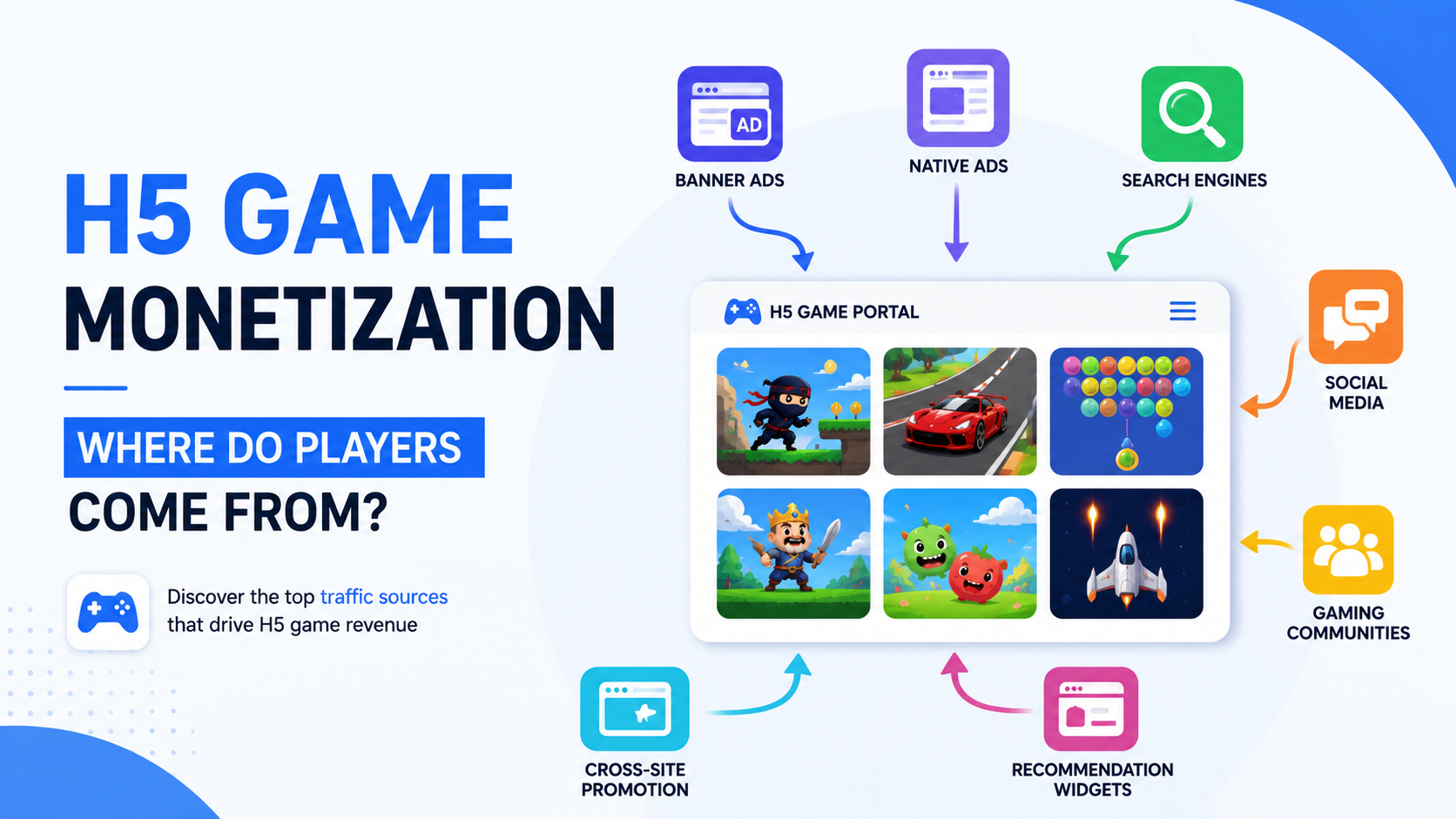
Unlike traditional games that depend heavily on app stores, H5 games are discovered across a wide range of channels. Each traffic source attracts different types of users and creates different monetization opportunities.
Banner Advertising
Display banners remain one of the most common ways players discover H5 games.
Gaming websites, entertainment portals, news websites, and content publishers frequently promote browser games through visual advertisements.
Banner traffic is excellent for increasing awareness and acquiring new players, particularly when campaigns are optimized for relevant audiences.
While user intent may vary, banner advertising continues to play an important role in scaling traffic.
Native Advertising
Native advertising blends naturally into surrounding content, making recommendations feel less disruptive than traditional display ads.
Players often click on suggested games while reading articles, browsing entertainment websites, or exploring gaming content.
Because native ads match user intent more closely, they often generate stronger engagement and better session quality than standard display banners.
Search Engines
Search traffic still matters, although it is rarely the primary discovery channel for H5 games.
Users typically search for:
- specific game names
- puzzle or arcade game categories
- walkthroughs
- browser versions of popular games
Search visitors often arrive with clear intent, making them valuable for engagement even if search contributes a smaller share of total traffic.
Cross-Site Promotion
Many successful H5 publishers build their own recommendation ecosystem.
A player finishes one game and immediately sees several related titles.
Sections such as “More Games,” “You May Also Like,” or “Trending Games” encourage users to continue exploring without leaving the website.
Cross-site promotion is one of the highest-performing acquisition channels because it targets users who are already interested in browser games.
Recommendation Widgets
Recommendation widgets help players discover relevant content based on popularity, category, or previous behavior.
These widgets increase pageviews, improve session depth, and encourage users to try multiple games during a single visit.
For publishers, they represent an effective way to increase both engagement and advertising opportunities.
Social Media
Social platforms continue to generate significant traffic for H5 publishers.
Players frequently discover games through:
- X
- Discord
- Telegram
- messaging apps
Social traffic can scale rapidly, especially when games become popular within gaming communities or viral trends.
Gaming Communities
Online communities remain powerful discovery channels.
Players actively recommend browser games through forums, Discord servers, Reddit discussions, Facebook groups, and niche gaming communities.
These audiences often produce highly engaged traffic because recommendations come from trusted sources rather than paid advertisements.
Organic Sharing
One of the greatest strengths of H5 games is how easy they are to share.
A simple URL can be sent through messaging apps, social platforms, or group chats.
Unlike mobile apps, recipients do not need to install anything before playing.
This low barrier significantly increases the likelihood of organic player acquisition.
Why Some Traffic Sources Generate More Revenue Than Others
Generating traffic is only part of successful H5 game monetization.
Different traffic sources produce different user behaviors, which directly affect advertising performance.
High-Intent vs. Low-Intent Traffic
Not every visitor has the same value.
Players arriving from recommendation widgets or cross-site promotion often spend more time playing because they are already interested in browser games.
By comparison, users arriving through broad display campaigns may leave after viewing only one page.
Understanding traffic intent helps publishers prioritize acquisition channels that generate long-term revenue instead of simply increasing visitor numbers.
Key Metrics That Matter
Publishers should evaluate traffic using metrics beyond pageviews.
Important performance indicators include:
- Session duration
- Pages per session
- Return visitor rate
- Ad viewability
- eCPM
- RPM
- Fill rate
These metrics provide a more accurate picture of monetization potential than traffic volume alone.
Comparing H5 Traffic Sources
| Traffic Source | User Intent | Engagement | Monetization Potential |
|---|---|---|---|
| Cross-site Promotion | Very High | Very High | Excellent |
| Recommendation Widgets | High | High | Excellent |
| Search Engines | High | Medium | High |
| Gaming Communities | High | High | High |
| Native Advertising | Medium-High | High | High |
| Social Media | Medium | Medium | Moderate |
| Banner Advertising | Medium-Low | Medium | Moderate |
The highest traffic source is not always the most profitable. Publishers who focus on traffic quality often achieve stronger advertising performance over time.
H5 Game Monetization: How H5 Publishers Turn Traffic Into Revenue
Attracting players is only the beginning. Sustainable H5 game monetization depends on maximizing the value of every visit.
Optimize the Player Journey
Small improvements in user experience can significantly increase revenue.
Publishers should encourage players to:
- discover additional games
- stay longer on the website
- move naturally between related content
- return for future sessions
Longer engagement creates more opportunities for advertising without overwhelming users.
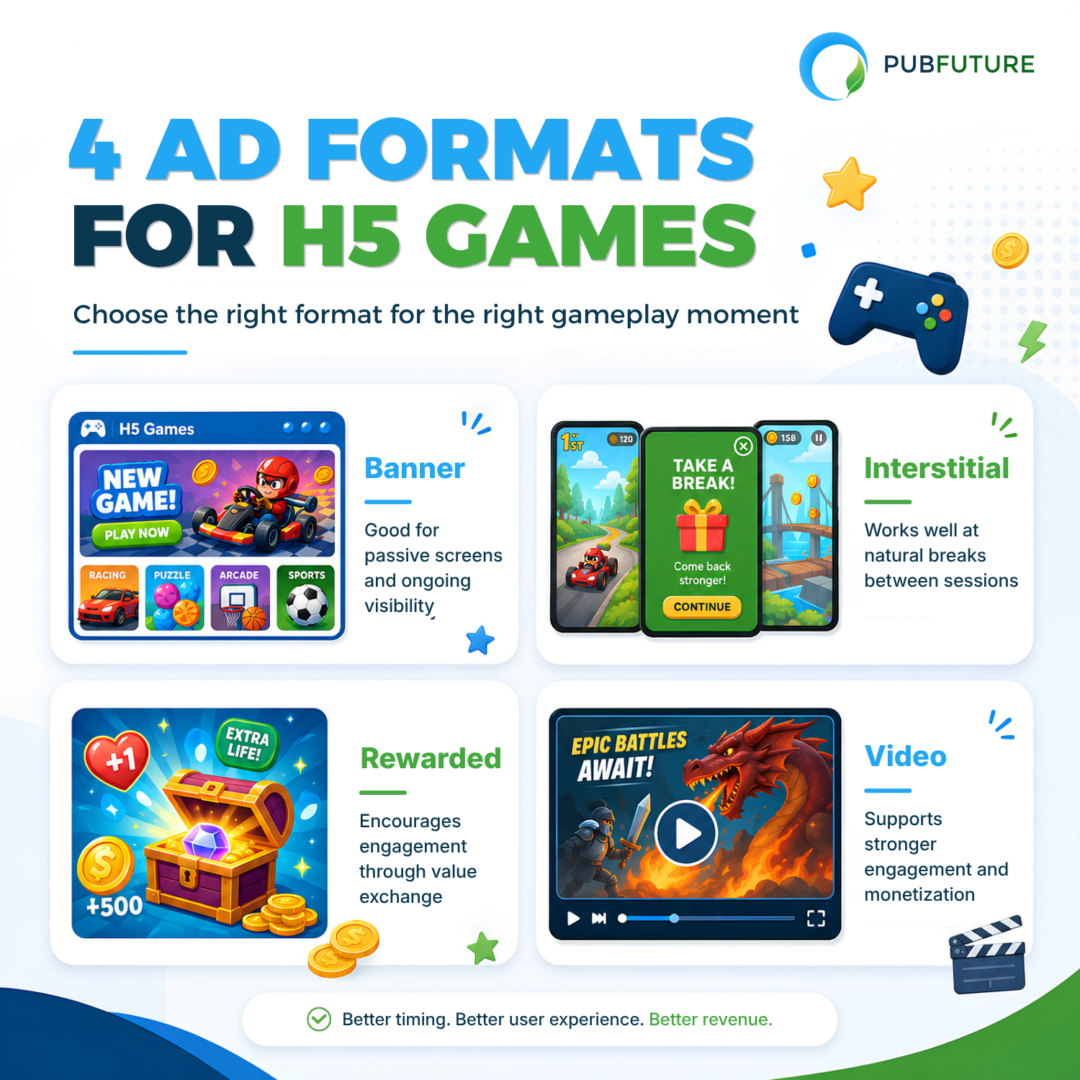
Choose the Right Ad Formats
Different moments in the player journey call for different advertising experiences.
Common high-performing formats include:
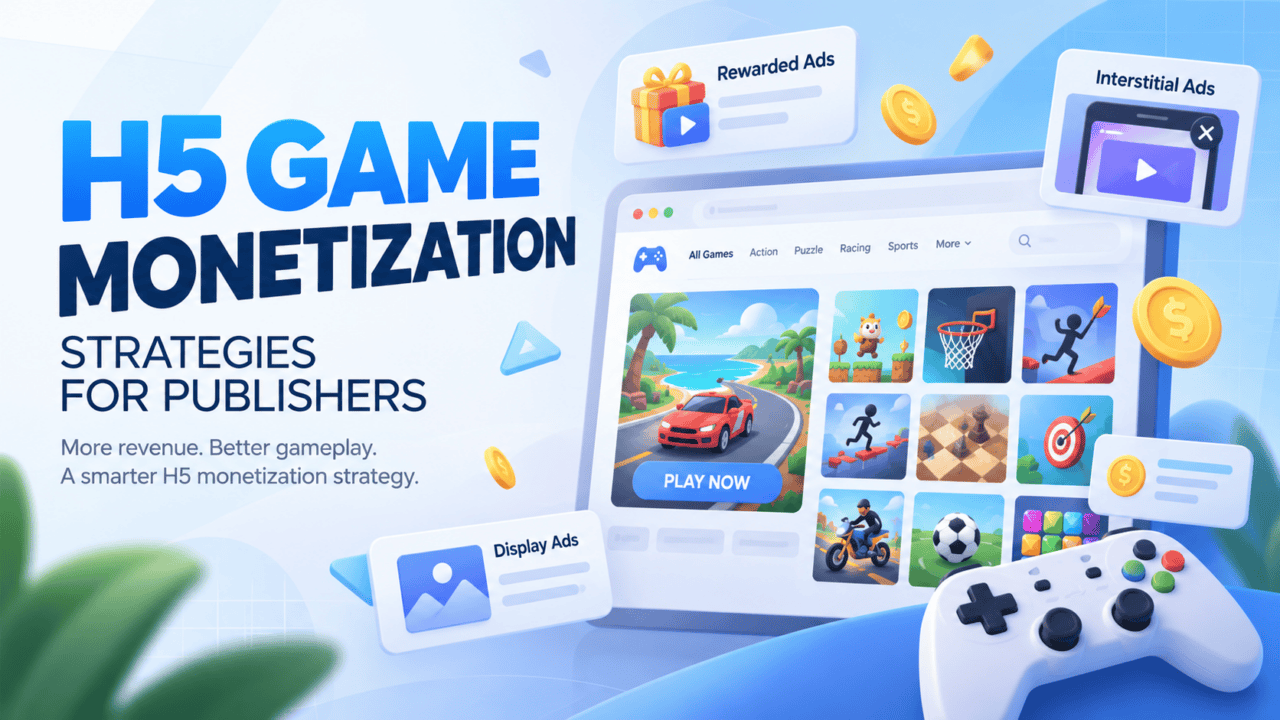
Display banners: A reliable option for category pages and game listings, helping publishers generate consistent impressions without interrupting the browsing experience.
Sticky ads: Remain visible as users scroll, making them one of the most effective formats for improving viewability and increasing revenue on mobile devices.
Interstitial ads: Best placed between natural transitions, such as moving from one game to another, where they can deliver higher CPMs without disrupting gameplay.
Rewarded ads: Encourage players to voluntarily watch an ad in exchange for hints, extra lives, or in-game rewards, often resulting in higher engagement and stronger advertiser demand.
Native ads: Blend naturally into recommendation sections, making it easier to promote additional games while maintaining a seamless user experience.
Video ads: Offer premium inventory that can command higher CPMs, particularly when combined with high-quality traffic and strong viewability.
The goal is to increase viewability while preserving a smooth gaming experience.
Increase Competition for Every Impression
Monetization is not only about serving ads. It is also about ensuring every impression receives competitive bids.
Technologies such as header bidding and access to multiple demand sources help publishers improve fill rates, increase eCPM, and maximize yield without adding more ad placements.
Greater competition generally leads to stronger revenue performance over time.
Build a Smarter Monetization Strategy
Successful publishers combine quality traffic acquisition with continuous monetization optimization.
Rather than relying on a single advertising partner or demand source, many publishers adopt more flexible monetization strategies that balance user experience, advertising performance, and revenue growth.
Platforms such as PubFuture help H5 game publishers simplify this process by connecting inventory to multiple demand partners, optimizing ad delivery, improving yield, and maximizing the value of every player session without compromising site performance.
Conclusion
Websites H5 Game Monetization continue to thrive because they offer something many platforms cannot: instant accessibility, flexible distribution, and scalable advertising opportunities.
The most successful publishers understand that H5 game monetization begins long before an ad is served. It starts with knowing where players come from, how they behave after arriving, and which traffic sources generate the greatest long-term value.
By focusing on high-quality acquisition channels, optimizing player engagement, and implementing a smarter monetization strategy, H5 publishers can transform everyday traffic into sustainable advertising revenue.
If you’re looking to unlock more value from your H5 game website, PubFuture provides the technology and demand needed to help maximize every impression, every session, and every opportunity to grow.