


Many publishers see the same pattern in their analytics: international traffic continues to grow, but ad revenue doesn’t keep pace. Visitors from countries like Brazil, India, Vietnam, or Mexico often account for a large share of pageviews, yet their average eCPMs remain well below those of Tier 1 markets.
This leads some publishers to view non-US traffic as less valuable. However, lower eCPMs don’t necessarily mean lower revenue. In many cases, international traffic underperforms because it’s monetized using the same strategy designed for the United States or Western Europe, despite differences in advertiser demand, user behavior, and market dynamics.
The good news is that publishers don’t need to replace their existing audience to increase revenue. By learning how monetizing Tier 2 Tier 3 traffic with geo-specific pricing, optimized demand partnerships, and mobile-first ad strategies, it’s possible to unlock significantly more value from the traffic you already have.
Table of Contents
Why non-US traffic is an untapped revenue opportunity non-US traffic is an untapped revenue opportunity
While Tier 1 markets continue to attract the highest advertising budgets, they aren’t the only source of strong publisher revenue. Many websites already receive a large share of their traffic from emerging markets where internet usage is growing rapidly and digital advertising continues to expand.
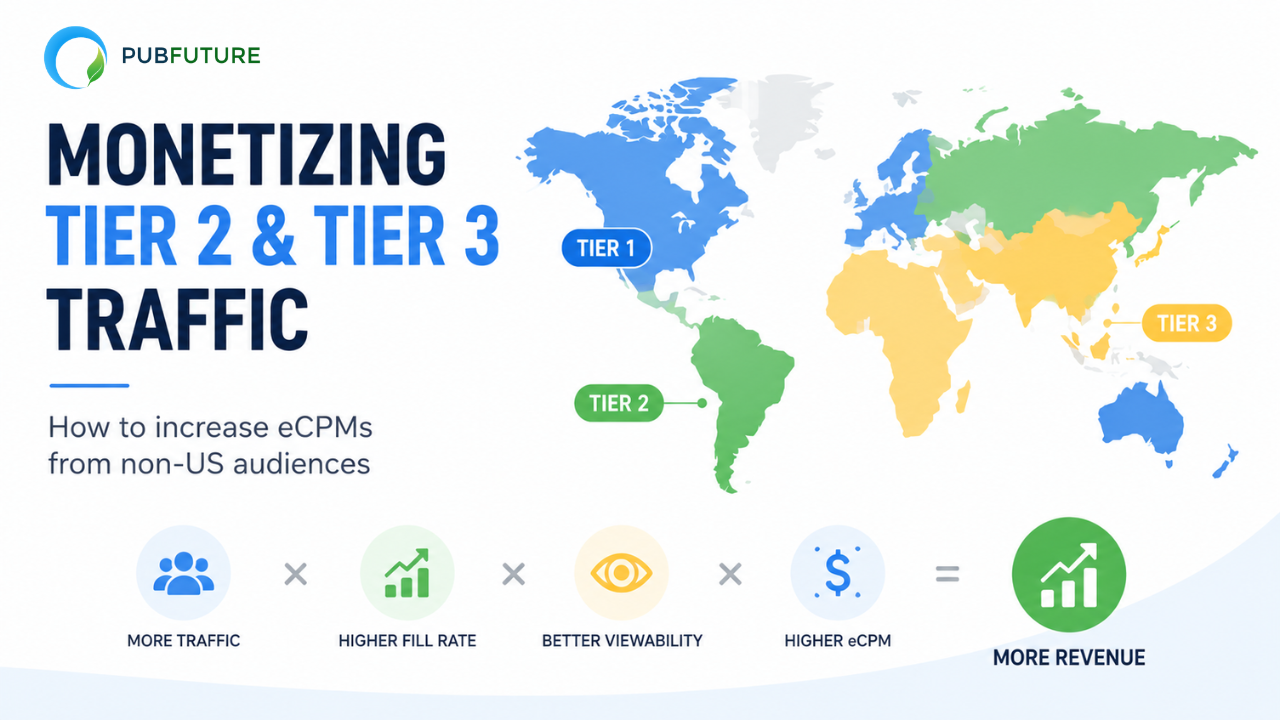
For publishers, success isn’t determined by eCPM alone. Total revenue depends on several factors working together, including traffic volume, fill rate, viewability, and advertiser competition. Even if international traffic generates lower average bids, improving these metrics can significantly increase overall earnings.
Higher revenue comes from optimizing multiple metrics together, not simply increasing eCPM.
Understanding Traffic Tiers
Although there is no universal classification, publishers commonly group audiences into three traffic tiers based on advertiser demand and market maturity.
| Traffic Tier | Example Markets | Typical Characteristics |
| Tier 1 | United States, United Kingdom, Canada, Australia | Highest advertiser demand and premium CPMs |
| Tier 2 | Brazil, Mexico, Poland, Thailand, Vietnam | Growing digital ad spend and strong traffic potential |
| Tier 3 | India, Pakistan, Bangladesh, Nigeria, Egypt | Large mobile-first audiences with significant scale |
Traffic tiers should be viewed as monetization characteristics rather than measures of audience quality. The key is matching each market with the right demand partners, pricing strategy, and ad formats to maximize revenue.
► Read more: Understanding Traffic Tier Classifications: A Detailed Breakdown
Why monetizing Tier 2 Tier 3 often generates lower eCPMs
Several factors influence advertiser demand and bidding across international markets:
Advertiser demand is different across markets
Advertiser demand varies significantly by region. In Tier 1 markets, many brands compete for visibility through premium CPM campaigns, driving higher auction prices. In contrast, advertisers targeting Tier 2 and Tier 3 audiences often prioritize measurable outcomes such as app installs, online purchases, or lead generation.
This difference doesn’t reduce the value of international traffic. It simply means publishers need to align their inventory with the type of campaigns buyers are actively running in each market.
Lower competition means lower auction pressure
Programmatic advertising relies on competition. When fewer advertisers bid for the same impression, the winning bid is naturally lower.
Many emerging markets have fewer premium buyers participating in open auctions than the United States or Western Europe. As a result, publishers may see lower average eCPMs even when their traffic quality is strong. Increasing demand competition, rather than simply chasing higher bids, is often the more effective way to improve overall revenue.
A one-size-fits-all ad setup limits revenue
Many publishers apply the same monetization settings across every country, including identical demand partners, price floors, and ad layouts. While this approach is simple to manage, it rarely delivers the best results for a global audience.
Each market has different advertiser demand, network conditions, and user behavior. Ad settings that perform well in one region may reduce fill rates or limit bidding opportunities in another. Adapting your monetization strategy by geography allows each audience to generate revenue based on its own market conditions rather than being constrained by a single global setup.
How to increase eCPMs for monetizing Tier 2 Tier 3 traffic
The following strategies can help publishers improve revenue from international audiences:
Diversify your demand sources
Many publishers rely primarily on one monetization platform or a limited number of global demand partners. While this provides broad advertiser access, it doesn’t always create enough competition in emerging markets.
Adding regional demand partners alongside premium global demand can increase auction participation and improve fill rates. A more diversified demand stack gives publishers access to advertisers that specifically target local audiences, helping maximize the value of each impression.
Choose ad formats that match local user behavior
The best-performing ad formats often depend on how users consume content in each market. Since Tier 2 and Tier 3 audiences are largely mobile-first, publishers should prioritize formats that maintain high viewability without disrupting the browsing experience.
Sticky mobile ads, native placements, and well-timed in-content units generally perform well across international audiences. Some publishers also test formats such as In-Page Push or Social Bar where they fit both user expectations and local advertiser demand, but these should always be balanced with a positive user experience.
Build geo-specific ad stacks
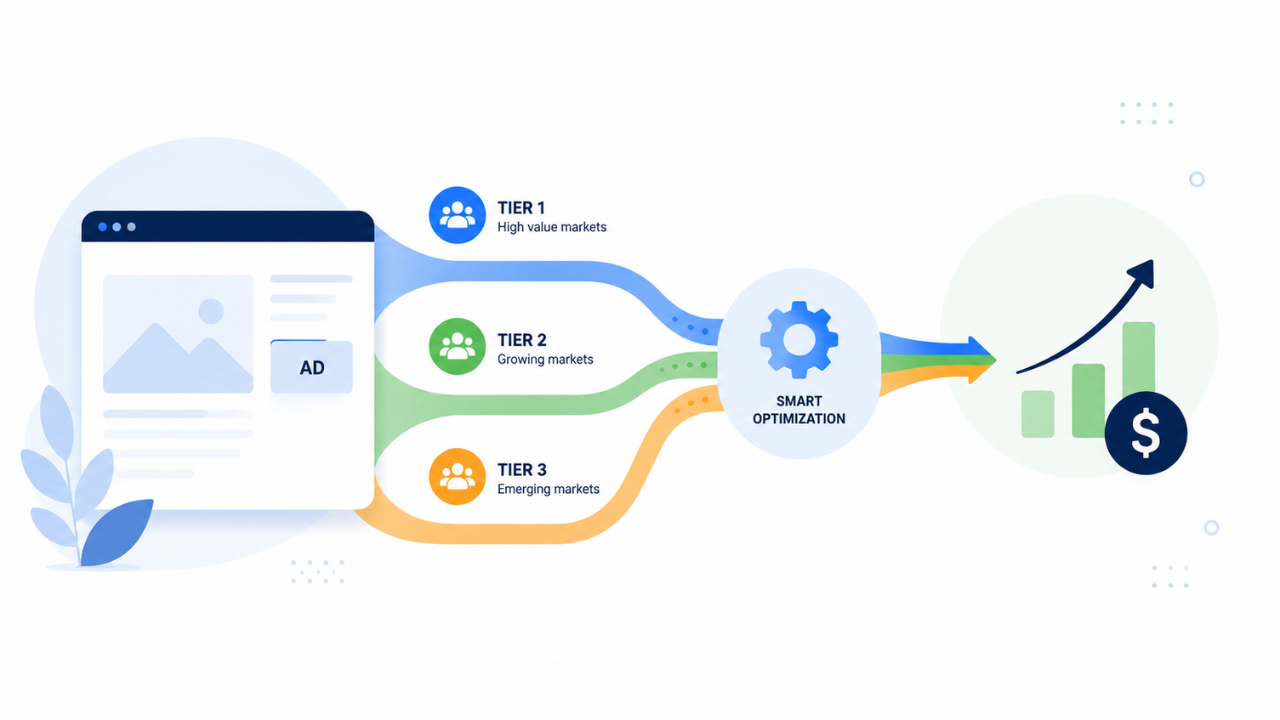
Treating every visitor the same limits monetization opportunities. Instead, publishers can segment traffic by geography and deliver different demand partners, pricing rules, and ad formats based on each market.
For example, Tier 1 traffic may benefit from premium header bidding and higher price floors, while Tier 2 and Tier 3 audiences often perform better with lighter ad stacks, regional demand, and mobile-focused formats. Matching the monetization strategy to each audience improves both fill rate and overall yield.
Managing these regional optimizations manually can quickly become complex as international traffic grows. PubFuture helps publishers maximize revenue across different markets through geo-specific optimization, premium demand partnerships, and continuous yield management, making it easier to unlock the full value of global traffic.
Use flexible price floors
Applying one floor price across every country is one of the most common monetization mistakes. A price floor that works well in the United States may leave a significant number of impressions unfilled in markets where advertiser competition is lower.
Using geo-specific pricing rules allows publishers to balance eCPM with fill rate. Accepting slightly lower bids often generates more filled impressions, resulting in higher total revenue over time.
► Read more: How to Set Up Google Ad Manager Unified Pricing Rules
Optimize for mobile performance
Page speed has a direct impact on both user engagement and advertising performance, especially in mobile-first markets. Slow-loading pages can reduce viewability, limit auction participation, and decrease revenue.
Publishers should regularly optimize Core Web Vitals, enable lazy loading, reduce unnecessary JavaScript, and use responsive ad sizes. These improvements help increase viewability and create a better experience for users, while also making inventory more attractive to advertisers.
Tier 1 vs. Tier 2 and Tier 3: Key monetization differences
The most effective monetization strategy depends on the market you’re serving. Rather than applying the same settings everywhere, publishers should adapt their demand sources, pricing, and ad formats to match regional advertiser demand and user behavior.
The table below summarizes the key differences between Tier 1 and Tier 2/3 monetization strategies.
| Strategy | Tier 1 Traffic | Tier 2 & Tier 3 Traffic |
| Primary advertiser goal | Brand awareness | Performance and conversions |
| Auction competition | Very high | Moderate |
| Recommended ad formats | Premium display, video, rich media | Sticky ads, native ads, mobile-first formats |
| Demand strategy | Premium SSPs and Header Bidding | Hybrid global and regional demand |
| Pricing strategy | Higher floor prices | Flexible geo-specific pricing |
| Primary KPI | eCPM | Fill Rate + Revenue per Session |
| Primary devices | Desktop and mobile | Mostly mobile |
| Optimization focus | Yield maximization | Revenue efficiency and inventory utilization |
While Tier 1 traffic typically delivers higher average eCPMs, Tier 2 and Tier 3 audiences often provide greater opportunities to scale. Publishers that tailor their monetization strategy to each market are more likely to maximize total revenue rather than focusing on eCPM alone.
Common mistakes that limit international ad revenue
Many publishers reduce international revenue by making a few avoidable optimization mistakes:
Applying the same settings worldwide
Using identical demand partners, price floors, and ad layouts across every country may simplify operations, but it rarely delivers the best results. Adapting your monetization strategy by geography allows each market to perform according to its own advertiser demand and user behavior.
Optimizing only for eCPM
A higher eCPM doesn’t always translate into higher revenue. Publishers should also monitor metrics such as fill rate, viewability, and Revenue per Session to understand how effectively their inventory is being monetized. Balancing these metrics usually produces stronger long-term results than focusing on CPM alone.
Prioritizing revenue over user experience
Aggressive monetization can increase short-term earnings, but it may also reduce engagement and return visits. Maintaining fast page speeds, reasonable ad density, and well-placed formats helps protect user experience while supporting sustainable revenue growth.
Ready to unlock more value from your global traffic?
Improving international monetization isn’t about replacing your existing traffic. It’s about making better use of the audience you already have through smarter demand strategies, geo-specific optimization, and continuous performance improvements.
Looking to increase your website’s revenue? Create a free PubFuture account and receive a personalized monetizing Tier 2 Tier 3 review.
Traffic from monetizing Tier 2 Tier 3 markets may generate lower average eCPMs than Tier 1 audiences, but that doesn’t make it less valuable. Publishers who optimize demand sources, pricing strategies, ad formats, and mobile performance can unlock significantly more revenue from their existing international traffic. The goal isn’t to match Tier 1 benchmarks, but to maximize the potential of each market based on its own characteristics.
Whether you’re looking to optimize your existing setup or explore new monetization opportunities, PubFuture can help. Contact our team to discuss a strategy tailored to your global audience.