


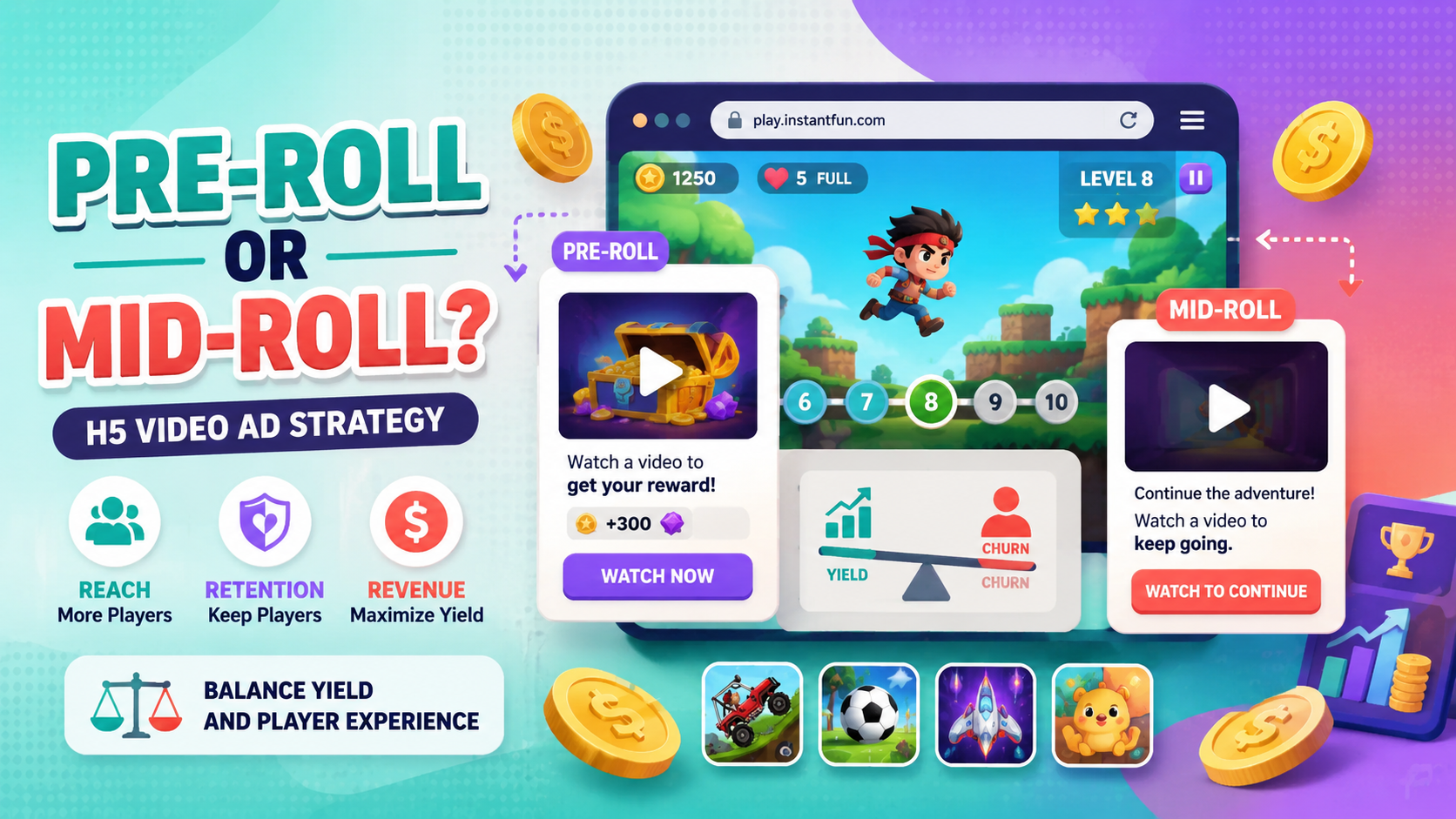
Video can be one of the highest-value ad formats available to H5 game publishers, but higher monetization potential also creates more friction. A strong H5 game video ads strategy needs to generate enough impressions without interrupting the first moments that convince a player to stay.
Pre-roll captures users before gameplay begins. Mid-roll waits until they are already engaged. Both can work, but both can also increase churn when timing, duration, or frequency is poorly controlled.
The real decision is not simply which format earns more per impression. Publishers need to balance impression opportunities, H5 video eCPM, session depth, completion rate, and the point at which an ad becomes disruptive.
Table of Contents
Navigating the H5 game video ads dilemma in browser gaming
H5 games are built around low-friction access. Users can open a browser game, press Play, and begin within seconds without installing an app. That convenience also means the cost of leaving is extremely low.
Video ads introduce a trade-off. They can attract stronger advertiser demand than standard display placements, but they also occupy the entire player’s attention for several seconds. Actual H5 video eCPM can vary widely based on GEO, device, demand quality, ad format, viewability, and advertiser competition, so publishers should avoid treating one CPM range as universal.
The central question is therefore simple: should publishers monetize players immediately with a pre-roll, or allow them to engage with the game before introducing a mid-roll?
For most H5 portals, the answer depends on when the player has received enough value from the game to tolerate an interruption.
Pre-roll video ads: Early yield vs immediate bounce risk
Pre-roll video appears after a player selects a game but before normal gameplay starts. It may run immediately after the Play action or alongside the period when game assets, Canvas elements, or WebGL resources are loading.
Higher impression coverage
Pre-roll reaches players before session depth becomes a factor. Even users who would otherwise leave after a short game session can generate an ad opportunity.
This makes pre-roll attractive for portals with high traffic but relatively shallow sessions. Publishers are monetizing the entry point instead of relying entirely on players reaching later stages.
Monetizing loading time
Games with noticeable loading periods create a natural window for video. Instead of showing a static loading screen for several seconds, publishers can use part of that time for monetization.
The experience still needs to feel predictable. A player who expects the game to begin immediately but receives a long forced video may perceive the ad as an additional delay rather than part of the loading process.
The main risk is first-session churn
Pre-roll creates friction before the player has experienced the game. This is particularly risky for users arriving from search, social, game directories, or paid acquisition who have little commitment to the title.
Skippable video can reduce that friction. Google Ad Manager’s standard skippable implementation, for example, displays a skip option after five seconds by default.
Publishers also need to account for browser autoplay restrictions. Modern browsers may restrict video with sound from autoplaying, so implementations should correctly detect autoplay and muted-play capabilities instead of assuming every device behaves the same way.
Best fit: heavier Canvas or WebGL games with real loading time, multiplayer titles with an existing audience, or portals where users intentionally select a specific game before launch.
Mid-roll video ads: Higher engagement vs mid-session churn
Mid-roll video appears after gameplay has already started. In H5 game video ads, the most effective browser game ad placement is usually connected to a natural break such as Level Clear, Stage Complete, Game Over, or a transition between rounds.
Players are already engaged
The main advantage of mid-roll is timing. A player who has completed a level has already invested attention in the game and may be more willing to tolerate a short interruption than someone who has not played yet.
That can support stronger video completion and viewability. However, publishers should evaluate the result using their own VCR, session length, abandonment rate, and revenue data rather than assuming mid-roll automatically produces a higher eCPM.
Natural gameplay pauses reduce disruption
A video between Level 2 and Level 3 usually feels less disruptive than the same video appearing during active gameplay. The player has finished one action and has not yet started the next.
This principle is especially relevant for casual, puzzle, arcade, card, racing, and other games built around short rounds.
Frequency becomes the main risk
The advantage disappears when every level triggers another forced video. A game with 15-second levels could theoretically create several ad opportunities within a few minutes, but maximizing impressions this way can shorten the session itself.
Google Ad Manager supports frequency caps that limit how often an ad or line item is served to the same user over a defined period.
For game publishers, the key principle is to control time between interruptions, not simply count levels.
Pre-roll vs mid-roll for HTML5 games
The differences become clearer when both formats are compared across the full player session.
| Metric / Dimension | Pre-Roll Video Ads | Mid-Roll Video Ads |
|---|---|---|
| Placement timing | Before gameplay or during loading | Between levels, stages, or after Game Over |
| Impression volume | High because most game starts can qualify | Depends on session depth |
| H5 video eCPM potential | Depends on demand, GEO and completion | Can benefit from stronger engagement and completion |
| Video completion rate | More vulnerable to early skip or exit | Often stronger once the player is engaged |
| Player churn risk | Beginning of session | During the active session |
| Best game types | Heavy Canvas/WebGL, multiplayer, known titles | Casual, puzzle, arcade, level-based games |
| Main optimization lever | Ad duration and skip experience | Timing and frequency |
Neither format is automatically better.
Pre-roll primarily monetizes reach. Mid-roll primarily monetizes session depth.
A portal with thousands of short game visits may gain more from controlled pre-roll coverage. A game where users regularly complete multiple levels has more opportunities to move monetization deeper into the session.
The strongest setup can therefore use both, but not at maximum frequency.
The golden hybrid framework for H5 game video ads
A hybrid H5 game video ads strategy works best when each ad opportunity is tied to player progression rather than simply maximizing the number of calls:
1. Give players a first-session grace period
Avoid serving a forced mid-roll immediately after a pre-roll. A useful starting test is to protect approximately the first 60 seconds of gameplay.
Let the player complete an early objective, understand the controls, or experience the first win before another interruption.
This is not a universal threshold. Fast arcade titles and slower strategy games have very different session structures, so publishers should test the grace period against Level 1 completion and early-exit rates.
2. Control interstitial ad frequency by time
Do not trigger a mid-roll simply because another level has finished.
A starting test of around 90 to 120 seconds between forced video opportunities is more sensible than serving one after every level. The final interstitial ad frequency for a game should depend on average level duration, session length, repeat visits, and churn data.
Frequency controls are technically supported by major ad-serving platforms, but the correct business threshold needs to come from publisher-side testing.
3. Make the ad state clear
Players should know when an ad is playing and when gameplay will resume. Use a visible countdown when supported and provide a clear skip or close action when the format allows it.
The game state should also pause correctly while the video is active. Google IMA exposes events for ad start, pause, resume, skip, close, midpoint, and completion states, which developers can use to coordinate content behavior around the ad lifecycle.
4. Replace some forced mid-rolls with rewarded video
Not every monetization moment needs to interrupt the player.
At Game Over or another high-intent point, publishers can offer an optional rewarded video in exchange for another life, a score multiplier, bonus currency, an extra attempt, or another in-game benefit.
Rewarded ads are supported on the web through Google Publisher Tag and are designed around an explicit exchange where the user receives a reward for viewing the ad.
For larger H5 portfolios, this hybrid model also gives monetization teams more room to test demand and ad placement separately. PubFuture can support publishers in evaluating video inventory, demand performance, and placement strategy without relying on a single forced-video setup across every game.

Common technical pitfalls that cause H5 game ad lag
Revenue optimization can fail even when the placement strategy is correct if the ad implementation creates technical friction:
Audio conflicts
Game audio should not continue playing loudly underneath an ad. Developers should coordinate the game’s audio state with ad playback so users do not hear two audio sources at once.
Browser autoplay rules also need to be handled correctly, particularly when video playback begins without a direct user gesture.
Broken game state after video
The game loop, timers, animation, and input state should resume correctly after the ad closes or completes. Poor integration can leave a Canvas frozen even though the ad itself has finished.
Using an established HTML5 video ad SDK and listening to its lifecycle events is safer than attaching unrelated synchronous scripts directly to the gameplay loop. Google’s IMA SDK is specifically designed to integrate client-side video advertising with HTML5 players.
Poor mobile controls
Close, skip, and interaction areas need to work reliably on small touch screens. A player should not need several attempts to exit an ad or accidentally trigger the advertiser’s landing page while trying to return to the game.
Test browser game ad placement across real mobile screen sizes instead of validating the implementation only on desktop.
Final verdict and H5 game video ads action plan
Pre-roll and mid-roll solve different monetization problems. Pre-roll captures more players near the start of the funnel, while mid-roll creates additional opportunities from users who stay longer. A strong H5 game video ads strategy combines those advantages while controlling the number and timing of interruptions.
The goal is not to serve the maximum possible number of videos. It is to find the point where incremental video revenue remains greater than the revenue lost when shorter sessions, lower retention, or player churn reduce future ad opportunities.
A practical starting setup is:
- Use pre-roll selectively: Place it during a meaningful loading period and support a clear skip experience where the ad format allows it.
- Protect early gameplay: Avoid a forced mid-roll during roughly the first minute, then adjust based on player behavior.
- Cap mid-roll frequency: Start by testing approximately 90 to 120 seconds between interruptions rather than triggering ads after every level.
- Use natural breaks: Level Clear, Stage Transition, and Game Over are safer than interrupting active gameplay.
- Add rewarded opportunities: Replace selected forced mid-rolls with optional rewarded video at moments where the reward has real value.
- Measure both revenue and retention: Track video impressions, H5 video eCPM, VCR, session length, level progression, early exits, and revenue per session together.
Ready to put this H5 game video ads strategy into practice? Sign up with PubFuture to access more demand and start optimizing your game inventory for stronger video yield.

There is no universal winner in H5 Game Video Ads pre-roll vs. mid-roll HTML5 games. The best configuration depends on how quickly players engage, how long they stay, and how much interruption each game can tolerate.
Publishers looking to improve video yield across an H5 portfolio can use PubFuture’s contact form to discuss their current inventory, player flow, and monetization setup and identify where additional video demand can be introduced without sacrificing the game experience.