


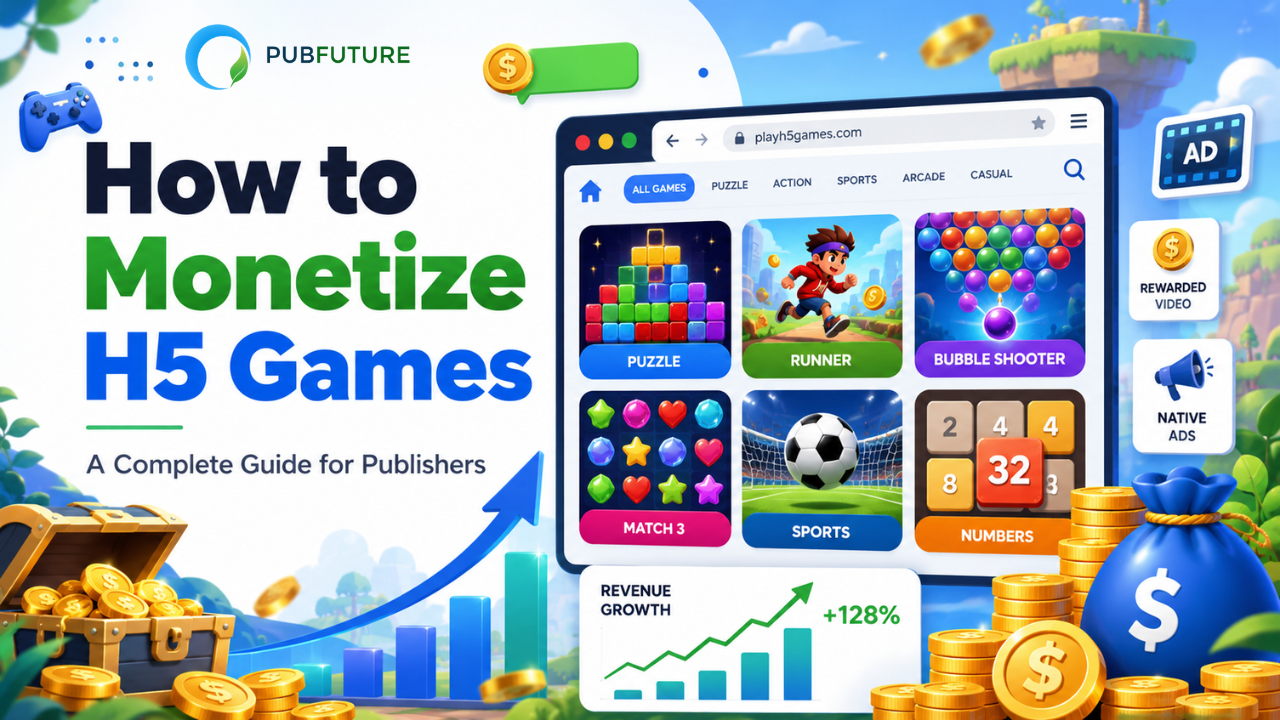
H5 Game Monetization becoming an important monetization opportunity for publishers, game portals, and mobile web platforms. Unlike native mobile games, H5 games can be played directly in a browser without requiring users to download an app. This makes them easy to access across mobile, desktop, tablets, and other connected devices. Clickio also describes H5 games as lightweight, browser-based games that do not require app installation and can work across multiple devices.
Table of Contents
For publishers, this creates a valuable opportunity: casual players can discover a game from search, social media, messaging links, content platforms, or game portals and start playing almost instantly. Every visit can become a session. Every session can create impressions. Every impression can become revenue if the monetization setup is designed correctly.
However, H5 game monetization is not as simple as placing ads anywhere on the page. Games are interactive environments. Players expect fast loading, smooth controls, and minimal interruptions. If ads appear at the wrong time, cover gameplay, slow down the browser, or feel too aggressive, users may leave before the session generates meaningful value.
That is why publishers need a monetization strategy built specifically for H5 game behavior.
The goal is not only to show ads. The goal is to show the right ad, at the right moment, with the right demand behind it.
What Are H5 Games?
H5 games, also known as HTML5 games, are games built with web technologies such as HTML5, JavaScript, and CSS. They run directly inside a browser, which means users can play without installing an app from the App Store or Google Play.
This makes H5 games especially attractive for casual players. A user can click a link, open a browser, play a short game, and move on within minutes. The experience is fast, lightweight, and low-friction.
H5 games are commonly used by:
- Online game portals
- Entertainment websites
- Casual gaming platforms
- Media publishers
- Mobile web communities
- Apps that embed lightweight games
- Websites looking to increase engagement
PubScale also highlights that H5 games can help increase user engagement and open different monetization opportunities, including ads, in-app purchases, subscriptions, and sponsorships.
For many publishers, advertising is the most practical monetization model because it allows users to play for free while the publisher earns revenue from impressions, clicks, video views, or rewarded interactions.
Why H5 Game Monetization Is Different from Standard Website Monetization
Monetizing a regular content website is usually more predictable. A publisher can place banner ads, native ads, sticky ads, in-content ads, or video ads around articles and page layouts.
H5 games are different because users are not only reading or scrolling. They are playing.
That means ad monetization must follow the player journey. A user might start a game, wait for assets to load, complete a round, fail a level, pause, replay, claim a reward, or switch to another game. Each of these moments creates a different monetization opportunity.
The strongest H5 game ad placements usually happen during natural breaks, such as:
- Before the game starts
- During loading screens
- Between levels
- After a round ends
- After game over
- During pause moments
- Before replay
- When a user chooses to unlock a reward
- When users browse or switch games
If ads appear during active gameplay, they can feel disruptive. A poorly timed ad may generate one impression, but it can also shorten the session, reduce repeat visits, and damage long-term revenue.
This is the key difference. For H5 games, monetization depends on behavior, not just page space.
Why H5 Games Create Strong Monetization Opportunities
H5 games create monetization opportunities because they combine accessibility, engagement, and repeatable gameplay loops.
A casual player may only play for a few minutes, but those short sessions can happen frequently. A user might return multiple times from mobile browsers, social links, game portals, or shared links. This creates recurring opportunities to serve ads in a way that feels natural.
There are several reasons H5 games can be valuable for publishers.
1. No App Install Friction
One of the biggest advantages of H5 games is that users can play instantly. They do not need to visit an app store, wait for a download, create an account, or install updates.
This makes H5 games ideal for casual players who want quick entertainment.
For publishers, lower friction can mean more accessible traffic and more sessions. Even users who would never download a game app may still play a browser-based game.
2. Cross-Device Reach
H5 games can be played across mobile, desktop, and tablets. This gives publishers more flexibility compared with app-only distribution.
A user may discover a game on mobile, return later on desktop, or access the same game through another browser. This cross-device behavior expands the monetizable audience.
3. Short but Repeatable Sessions
Casual game sessions are often short, but they can be highly repeatable. Players may play during breaks, while commuting, between tasks, or after clicking a social link.
For publishers, this means monetization should not rely on only one ad impression. The setup should support multiple natural ad opportunities across the session journey.
3. Strong Fit for Ad-Supported Models
Many H5 games are free to play, making advertising a natural monetization model. Players are often willing to accept ads when the experience feels fair, especially if the ad appears at a natural break or offers a clear reward.
This is why formats like interstitial ads and rewarded ads can work well in H5 game environments.
Best Ad Formats for H5 Game Monetization
There is no single “best” ad format for every H5 game. The right format depends on the game type, session length, screen layout, user behavior, and traffic source.
A puzzle game, for example, may create strong rewarded ad opportunities around hints or boosters. A runner game may work better with interstitials after a failed round. A game portal may benefit from banners or native placements on browsing pages.
The strongest monetization setups usually combine multiple formats carefully.
1. Banner Ads
Banner ads are one of the most common formats for H5 game monetization. They can appear around the game area, on game selection pages, category pages, or portal pages.
Banner ads are useful because they can generate steady impressions without forcing users to stop playing. They can work especially well on browsing screens, homepage sections, and non-active gameplay areas.
However, banner ads need careful placement. If a banner covers gameplay controls, takes too much space on mobile, or distracts from the main experience, it can hurt engagement.
Best practices for banner ads in H5 games include:
Keep banners away from core gameplay controls
Avoid covering important game elements
Use responsive layouts for mobile screens
Test placement performance across devices
Monitor viewability and user behavior
Avoid adding too many banners on small screens
Banner ads are usually best for steady baseline revenue, not necessarily peak monetization.
- Interstitial Ads
Interstitial ads are full-screen ads that appear between content or gameplay moments. In H5 games, they are often used at natural transition points such as between levels, after a round ends, or before a new game starts.
Clickio notes that H5 game interstitial ads are shown at natural transition points in gameplay, such as between levels or during loading screens.
For publishers, interstitial ads can generate strong revenue because they are highly visible and capture user attention. But they must be used carefully.
Poor interstitial timing can damage the user experience. If an interstitial appears while the player is actively controlling the game, it can feel frustrating and cause users to leave.
Good moments for interstitial ads include:
After level completion
After game over
Before restarting a game
During loading screens
Between game sessions
When users switch from one game to another
Interstitials should not appear:
During active gameplay
While users are tapping or swiping controls
Too frequently within short sessions
Before users understand the game
Immediately after every failure
The key is frequency control. Even if an interstitial performs well, showing it too often can reduce retention and lower long-term revenue.
- Rewarded Ads
Rewarded ads are one of the most effective formats for game environments because they are based on player choice.
Instead of forcing users to watch an ad, rewarded ads offer a clear value exchange:
The player watches an ad and receives a benefit.
That benefit could be:
Extra lives
Bonus coins
Hints
Boosters
Extra time
A second chance
Unlockable content
Double rewards
Clickio describes rewarded ads as opt-in ads where users voluntarily watch a full-screen ad in exchange for an in-game reward such as extra lives, hints, or coins.
This format works well because the player understands why the ad is appearing. The ad becomes part of the gameplay decision instead of an interruption.
Rewarded ads can work especially well around moments such as:
Continue after failure
A player loses a round and wants one more chance. Watching an ad to revive can feel natural because it helps them continue.
Double reward after a round
After completing a level or mission, users may choose to watch an ad to double their coins, score, or points.
Unlock hints or boosters
Puzzle, quiz, and logic games can offer hints or boosters through rewarded ads. This works when players are stuck and willing to trade time for help.
Extend limited-time gameplay
Timed games can offer extra seconds or moves through rewarded ads when users are close to winning.
Rewarded ads should be designed carefully. The reward must feel valuable enough, the timing must be natural, and the frequency must be controlled. If the reward feels weak or the ad appears too often, players may ignore it.
- Video Ads
Video ads can be used in rewarded or interstitial placements. They are often more engaging than static ads and may generate stronger advertiser demand, especially when the placement has high viewability and user attention.
Some H5 game ad environments support video formats such as TrueView video and VAST video creatives.
However, video ads can also be heavier than display ads. They may affect loading speed, data usage, and user experience if not implemented carefully.
For mobile web H5 games, video ads should be optimized with:
Reasonable frequency caps
Fast loading behavior
Clear user controls
Proper timing
Strong demand quality
UX-friendly placement
Video ads can work well, but they should never make the game feel slow or overloaded.
- Sticky or Anchor Ads
Sticky ads can remain visible while users browse a game portal, select games, or navigate between pages. They can be useful for mobile web environments because screen space is limited and users may scroll quickly.
However, sticky ads should be controlled carefully. They should not cover gameplay controls, block important UI elements, or create accidental clicks.
Sticky ads are usually more suitable for:
Game portal pages
Category pages
Game selection screens
Browsing sections
Non-active gameplay areas
They are less suitable for active gameplay screens unless the layout is specifically designed to support them.
Key Factors That Affect H5 Game Revenue
Traffic is important, but it is not the only factor that determines H5 game revenue.
Two publishers can have similar traffic and similar game categories, but very different monetization results. The difference usually comes from setup quality.
The most important factors include demand, placement, fill rate, viewability, ad format mix, session design, and user experience.
Demand Quality and Competition
Every impression needs demand behind it.
If a publisher relies on a limited demand setup, impressions may not receive enough buyer competition. This can limit CPM potential and reduce revenue efficiency.
More demand competition can help improve:
CPM potential
Fill rate stability
Revenue per session
Buyer diversity
Monetization consistency across geos
This does not mean publishers should connect to any demand source without quality control. Low-quality demand can introduce poor creatives, redirects, slow ads, or bad user experiences.
The goal is not just more demand.
The goal is quality demand that competes effectively for the right inventory.
Fill Rate
Fill rate is one of the most important metrics in ad monetization.
A publisher may have strong CPMs, but if many ad requests remain unfilled, total revenue can still be lower than expected.
For example, a site may generate 100,000 eligible ad requests, but if only 65,000 are filled, 35,000 potential impressions are lost. This can create a hidden revenue gap.
Improving fill rate requires the right demand setup, pricing strategy, ad format selection, and traffic quality.
Viewability
Advertisers are more willing to pay for impressions that are actually seen.
In H5 games, viewability depends on where the ad appears, how long it stays visible, whether users are engaged, and whether the placement fits naturally into the game flow.
Ads that load below the fold, disappear too quickly, or appear in low-attention areas may underperform.
High-viewability placements often include:
Transition screens
Rewarded ad moments
Pause screens
Game over screens
Loading screens
Visible browsing areas
Good viewability should not come at the expense of user experience. The best placements are visible without feeling intrusive.
Ad Placement Strategy
Placement strategy is one of the biggest drivers of H5 game revenue.
A publisher can have strong traffic and good demand, but poor placement can still reduce performance. If ads are shown too early, too often, or during active gameplay, players may leave.
Good placement strategy starts with understanding the game loop.
A simple H5 game session may look like this:
User opens game → Game loads → Player starts round → Player finishes or fails → Player chooses replay, reward, or another game → Session continues or ends
Each step creates a different monetization opportunity.
The best ad placements are connected to natural breaks, not random screen space.
User Experience
H5 games are built around instant access. Users expect the game to load quickly and start smoothly.
If monetization makes the experience heavy, slow, or disruptive, users can leave immediately.
User experience problems that hurt monetization include:
Slow ad loading
Heavy scripts
Too many pop-ups
Ads covering controls
Poor mobile layout
Aggressive interstitial timing
Low-quality creatives
Excessive ad frequency
A good monetization setup protects the player experience while still creating revenue opportunities.
This is especially important for mobile web H5 games because casual users often have low patience. They may leave after one bad interaction.
Common H5 Game Monetization Mistakes
Many publishers underperform not because their games lack traffic, but because the monetization strategy is not aligned with player behavior.
Here are common mistakes to avoid.
Showing Ads During Active Gameplay
This is one of the fastest ways to frustrate players.
If a player is tapping, swiping, aiming, solving, or controlling the game, an ad interruption can break the flow. Even if the ad generates one impression, it may reduce session length and repeat visits.
Ads should appear when the player is ready for a break.
Relying on Only One Ad Format
Some publishers rely only on banners because they are easy to implement. Others rely too heavily on interstitials because they generate high visibility.
Both approaches can limit revenue.
A stronger setup usually combines formats based on gameplay moments:
Banners for browsing and portal pages
Interstitials for transitions
Rewarded ads for value exchange moments
Video ads for high-engagement moments
Sticky ads for controlled mobile visibility
The format mix should match the site structure and game behavior.
Ignoring Reward Design
Rewarded ads do not work simply because they are rewarded.
They work when the reward is meaningful.
If the reward is too small, users will not opt in. If the reward is too generous, it may affect game balance. If the reward appears at the wrong time, it may feel random.
Publishers need to test different rewards, timings, and user segments.
Overloading Mobile Screens
Mobile screens are limited. Too many ads can make the experience feel crowded and unprofessional.
This is especially risky for H5 games because controls, gameplay areas, and UI elements already take up screen space.
Ad layout should be tested on actual mobile devices, not just desktop previews.
Treating Every Impression the Same
Not every impression has the same value.
A rewarded video impression from an engaged player may be more valuable than a banner impression from a user who is about to bounce. A high-viewability ad during a natural break may perform better than a poorly placed display ad.
Publishers should think about impression quality, not only impression quantity.
How to Build a Strong H5 Game Monetization Strategy
A successful H5 game monetization strategy should connect traffic, player behavior, ad formats, demand, and UX into one system.
Here is a practical framework.
Step 1: Understand the Player Journey
Before placing ads, publishers should map how users move through the site and game experience.
Important questions include:
Where do users enter the site?
Which devices do they use most?
How long do they play?
When do they drop off?
Which games have the highest engagement?
Where do natural breaks occur?
Which moments create reward opportunities?
This helps publishers identify where ads can fit naturally.
Step 2: Choose Formats Based on Game Moments
Each ad format should have a clear role.
For example:
Use banners on game selection pages
Use interstitials after rounds or between levels
Use rewarded ads for extra lives or boosters
Use video ads when engagement is high
Use sticky ads carefully on browsing pages
The goal is to design ad placement around player behavior, not simply fill empty space.
Step 3: Control Frequency
Frequency control helps protect the player experience.
Even if an ad format performs well, showing it too often can reduce retention. For example, if a user fails a level five times in a short period, showing five interstitials may be too aggressive.
Publishers should use logic such as:
Time-based cooldowns
Session-based limits
Level-based triggers
User behavior rules
Reward opt-in controls
This keeps monetization sustainable.
Step 4: Improve Demand Competition
Demand quality and buyer competition directly affect revenue potential.
Publishers should avoid relying on only one demand path if it limits competition. A broader, well-managed demand setup can help more buyers compete for eligible impressions.
This is especially important for H5 game publishers with diverse traffic across geos, devices, and game categories.
Step 5: Optimize Continuously
H5 game monetization is not a one-time setup.
Publishers should continuously monitor:
CPM
eCPM
Fill rate
Viewability
Revenue per session
Session duration
Bounce rate
Ad engagement
Rewarded ad opt-in rate
Device-level performance
Geo-level performance
Small changes in placement, timing, format mix, or demand setup can significantly affect revenue.
How PubFuture Helps H5 Game Publishers Monetize Better
PubFuture helps H5 game publishers turn browser-based game traffic into stronger monetization opportunities.
Instead of simply adding more ads, PubFuture focuses on building a setup that fits the way casual players actually behave.
Quality Demand Access
PubFuture connects publishers with quality demand sources to help increase competition for impressions. More relevant demand can improve the chance that eligible impressions are filled and valued properly.
For H5 game publishers, this matters because traffic can vary across geos, devices, and session types. A stronger demand setup helps publishers capture more value from different traffic segments.
Flexible Ad Formats
Different H5 game moments need different ad formats.
PubFuture supports publishers in exploring the right mix of formats such as banners, interstitials, video ads, rewarded ads, and other suitable placements depending on the game flow and site layout.
The goal is to avoid a one-size-fits-all approach.
Smarter Placement Strategy
PubFuture helps publishers think strategically about where and when ads should appear.
Instead of placing ads randomly, PubFuture supports monetization around moments such as:
Loading screens
Game transitions
Pause moments
Reward opportunities
Replay loops
Game browsing pages
Session endings
This helps publishers create ad experiences that feel more natural and less disruptive.
UX-Aware Optimization
H5 game users can leave quickly if the experience feels slow, heavy, or interrupted.
PubFuture helps publishers optimize monetization with user experience in mind. This includes balancing ad visibility, format selection, demand quality, and placement timing.
The goal is not only short-term revenue.
The goal is sustainable revenue that protects player engagement.
Performance Monitoring and Optimization
H5 game monetization requires ongoing improvement.
PubFuture helps publishers review monetization performance and identify opportunities to improve fill rate, CPM, eCPM, ad layout, and demand performance.
For publishers, this means monetization can evolve with traffic behavior instead of staying fixed.
Final Thoughts
H5 games create a strong opportunity for publishers because they are easy to access, mobile-friendly, and built for casual gameplay. Users can discover a game through search, social links, messaging apps, content platforms, or game portals and start playing almost instantly.
But successful H5 game monetization requires more than adding ads to a page.
Publishers need to understand how players behave, where natural breaks happen, which ad formats fit each moment, and how demand competition affects revenue potential.
The strongest H5 game monetization strategies combine:
Quality demand
Smart ad placement
Flexible ad formats
Rewarded ad opportunities
Strong fill rate
High viewability
Frequency control
UX-aware optimization
For publishers, the real question is not only:
“How much traffic does my H5 game site have?”
The better question is:
“Is each game session being monetized in the right way?”
PubFuture helps H5 game publishers build smarter monetization setups for browser-based game traffic, with quality demand, flexible formats, placement strategy, and optimization support designed for casual game environments.
Ready to monetize your H5 game traffic with PubFuture?
Sign up here: https://pubfuture.com/auth/signup
For partnership inquiries or more information: [email protected]