



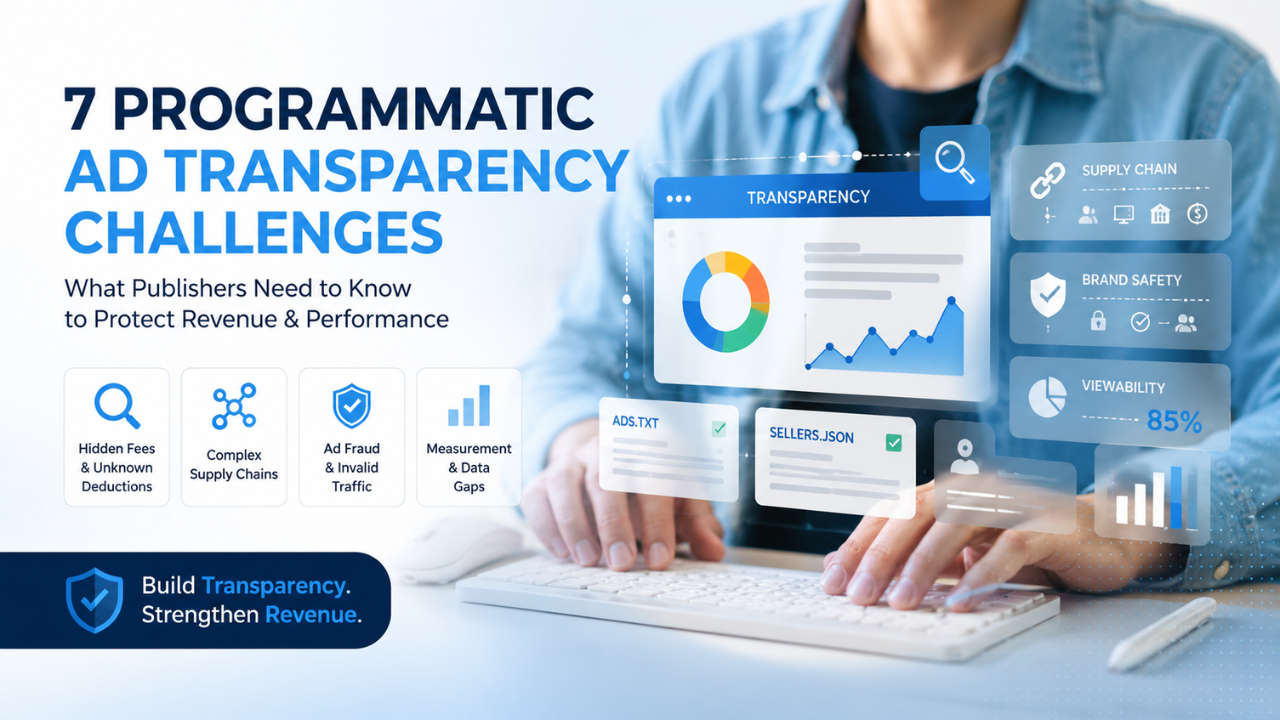
Programmatic advertising transparency has become one of the most important issues in digital media buying. Automation has made campaigns faster, more scalable, and easier to optimize, but it has also made the advertising supply chain harder to understand.
Advertisers can track impressions, clicks, and conversions, yet many still struggle to see where budgets go, which intermediaries participate in each transaction, and how campaign results are calculated.
This article examines, PubFuture will show 7 major programmatic advertising transparency challenges and the steps advertisers and publishers can take to improve visibility, accountability, and media performance.
Table of Contents
What Is Programmatic Advertising Transparency?
Programmatic advertising transparency refers to the ability to understand how campaigns are bought, delivered, priced, and measured across the media supply chain.
A transparent programmatic environment should provide clear visibility into:
- Where inventory is purchased
- Which publishers, apps, and placements display the ads
- Which DSPs, SSPs, exchanges, and resellers participate
- How fees are distributed between intermediaries
- How impressions, clicks, viewability, and conversions are measured
- How much advertiser spend becomes working media
Transparency is not simply about having access to more dashboards. It depends on whether the data is detailed, consistent, and independently verifiable.
Without that visibility, advertisers may have extensive reporting while still lacking the information needed to evaluate supply quality, media costs, and campaign performance accurately.
The 7 Biggest Programmatic Advertising Transparency Challenges
The programmatic ecosystem includes multiple buying platforms, supply partners, measurement vendors, and data providers. Each participant can add value, but every additional layer also increases complexity.
The following seven challenges explain why programmatic advertising transparency remains difficult to achieve.
1. Complex Supply Chains Reduce Programmatic Advertising Transparency
A programmatic transaction rarely takes place directly between an advertiser and a publisher.
A single impression may pass through an agency, DSP, ad exchange, SSP, reseller, data provider, and verification vendor before reaching the publisher. Some inventory is also offered through multiple supply paths at the same time.
This complexity makes it difficult to identify:
- Which intermediaries are necessary
- Which supply path delivered the impression
- Whether the inventory was purchased directly or through a reseller
- How many platforms applied fees
- Whether multiple auctions represented the same impression
The longer the supply chain becomes, the harder it is for advertisers to understand what they are paying for. Publishers also lose visibility into which buyers are accessing their inventory and how demand is routed through the ecosystem.
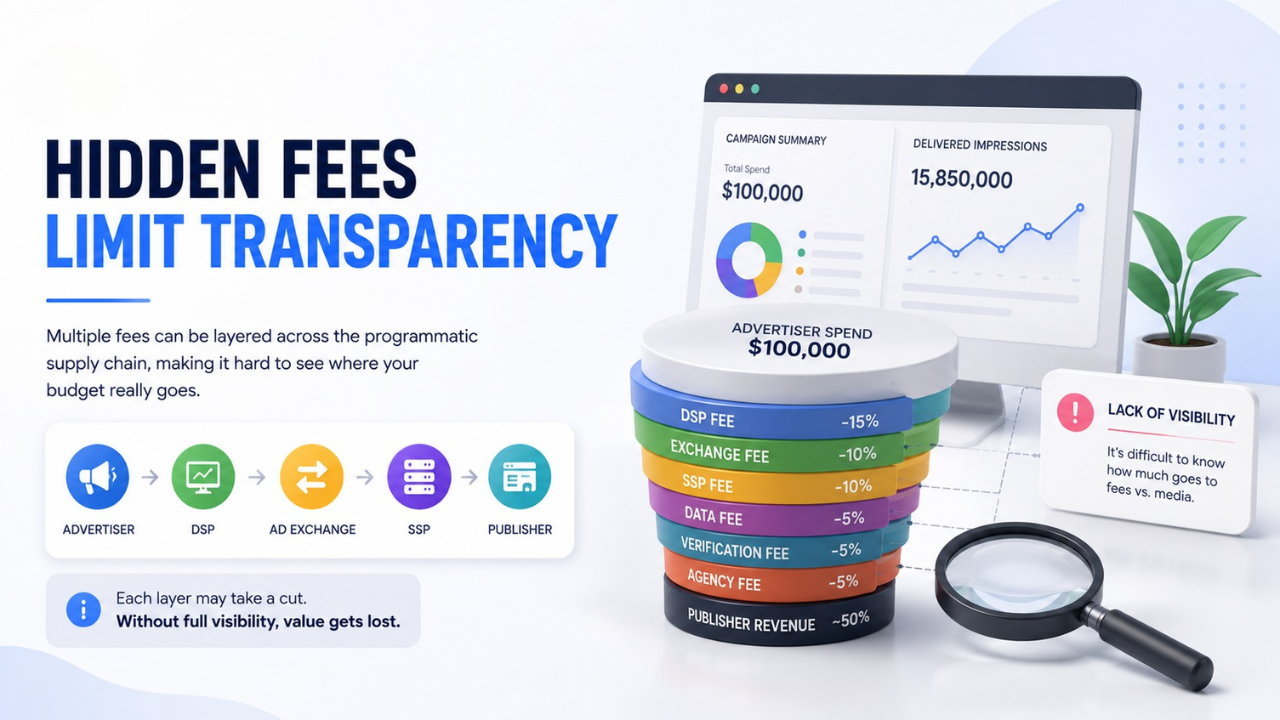
2. Hidden Fees Limit Programmatic Advertising Transparency
Programmatic campaigns can include DSP fees, SSP fees, data charges, verification costs, agency fees, platform access fees, and reseller margins.
These costs are not always presented separately in campaign reporting. Advertisers may see total spend and delivered impressions without a clear explanation of how much budget was allocated to media, technology, data, and other services.
The 2020 ISBA and PwC Programmatic Supply Chain Transparency Study found that publishers received an average of 51% of advertiser spend, while 15% could not be attributed across the supply chain. A follow-up study published in 2023 showed improvement, with a larger share reaching publishers and the unknown delta falling to 3%.
The exact percentages vary between campaigns and partners, but the underlying concern remains relevant. Advertisers need to know how much they are paying, who receives each fee, and whether those services provide measurable value.
Fees are not automatically a problem. Lack of visibility into those fees is.
3. Inventory Quality Affects Programmatic Advertising Transparency
Not every impression provides the same level of value.
Two placements may have similar CPMs while differing significantly in audience quality, viewability, engagement, brand suitability, and fraud risk. Without domain-level, app-level, or placement-level reporting, advertisers may struggle to distinguish quality inventory from low-value supply.
This challenge is particularly significant in open programmatic marketplaces, where campaigns can reach a wide range of websites and apps.
Limited inventory transparency may expose advertisers to:
- Made-for-advertising websites
- Low-viewability placements
- Excessive ad density
- Duplicate inventory
- Poor user experiences
- Inventory sold through unauthorized resellers
Advertisers should therefore evaluate quality-adjusted outcomes, not only impression volume or low CPMs.
4. Ad Fraud Undermines Programmatic Advertising Transparency
Ad fraud remains one of the most serious threats to programmatic media buying. Fraudulent activity can include:
- Bot-generated impressions
- Fake clicks
- Domain spoofing
- App spoofing
- Ad stacking
- Pixel stuffing
- Invalid traffic
- Manipulated conversion activity
These practices can make campaign reports appear stronger while delivering little or no genuine audience value.
Fraud detection technology has improved, but fraud methods continue to evolve. Advertisers that depend entirely on platform reporting may have limited ability to verify whether impressions and conversions came from real users.
Independent verification, traffic quality monitoring, and placement-level reporting are therefore essential parts of programmatic advertising transparency.
5. Fragmented Measurement Weakens Programmatic Advertising Transparency
Most advertisers run campaigns across several platforms, including search, social media, retail media, connected TV, and open programmatic marketplaces.
Each environment may use different:
- Attribution windows
- Conversion definitions
- Viewability standards
- Audience methodologies
- Reporting systems
- Optimization models
As a result, the same conversion may be claimed by more than one platform. One channel may report a view-through conversion, while another credits the same action to a click.
This makes cross-platform comparison difficult and can lead to double counting, inflated performance, and incorrect budget decisions.
Programmatic advertising transparency requires more than access to individual platform reports. Advertisers also need a consistent framework for comparing results across channels.
6. Walled Gardens Restrict Programmatic Advertising Transparency
Large advertising platforms often operate as closed ecosystems. Within these environments, the platform may control:
- Inventory
- Audience data
- Bidding algorithms
- Campaign optimization
- Attribution
- Performance reporting
This structure can provide scale and operational efficiency, but it limits independent verification.
Advertisers may see strong reported results without being able to inspect the underlying data, compare attribution methods, or fully understand how audiences and placements were selected.
The core concern is not that closed platforms cannot deliver performance. It is that the same company may manage campaign delivery, optimization, and measurement.
That creates an accountability gap that advertisers must address through independent analysis, incrementality testing, and broader cross-channel measurement.
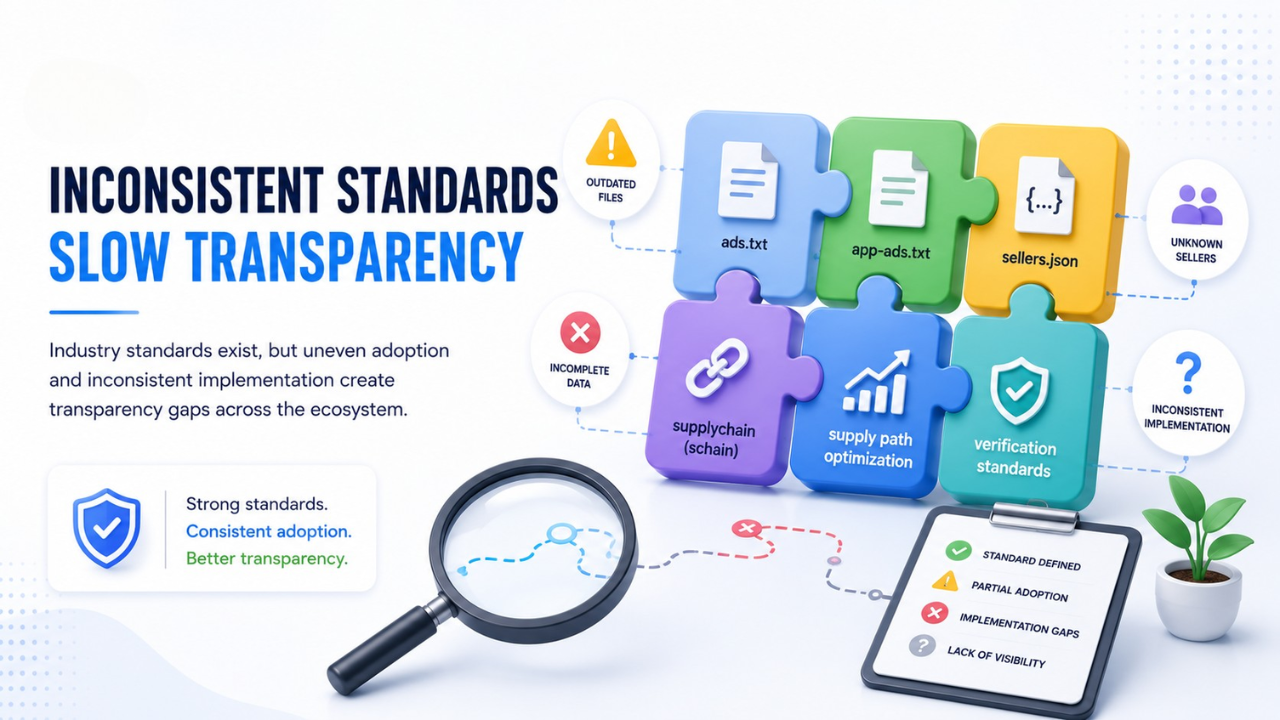
7. Inconsistent Standards Slow Programmatic Advertising Transparency
The industry has introduced several standards to improve visibility across the programmatic supply chain.
These include:
- ads.txt and app-ads.txt to identify authorized inventory sellers
- sellers.json to disclose information about sellers and resellers
- SupplyChain Object, or schain, to identify the participants in a transaction
- Supply Path Optimization to reduce unnecessary intermediaries
- Independent verification tools for viewability, fraud, and brand safety
These initiatives have improved transparency, but adoption and implementation remain inconsistent.
Files may be outdated. Seller identities may remain confidential. Supply chain records may be incomplete. Different platforms may also interpret the same standards differently.
Industry standards are useful, but they do not replace active governance, partner evaluation, and regular supply chain audits.
How to Improve Programmatic Advertising Transparency
Improving programmatic advertising transparency requires both technology and operational discipline.
Advertisers can begin by mapping the full supply chain and identifying every agency, DSP, SSP, exchange, reseller, data provider, and verification vendor involved in campaign delivery.
They should also request reporting that includes:
- Publisher domain or app
- Placement information
- Supply path
- Gross spend
- Net media cost
- Technology and data fees
- Viewability
- Invalid traffic
- Brand safety results
- Conversion methodology
Supply Path Optimization can help reduce duplicate auctions and unnecessary intermediaries. Advertisers should also compare performance using metrics such as viewable CPM, fraud-free CPM, cost per qualified impression, and incremental conversion cost.
Independent verification is equally important. Platform-reported results should be compared with external measurement, analytics, and business data whenever possible.
Transparency requirements should also be included in commercial agreements, particularly around fee disclosure, data access, reporting detail, and audit rights.
Choosing the Right Partners for a More Transparent Supply Chain
Technology alone cannot solve transparency challenges. The partners involved in the programmatic supply chain also play an important role. Advertisers and publishers should look beyond campaign performance and evaluate how openly partners share data, reporting, and optimization insights.
1. Prioritize Transparent Reporting
A reliable partner should provide clear visibility into supply paths, inventory quality, fee structures, and campaign performance. Detailed reporting makes it easier to identify optimization opportunities and build confidence in media investments.
2. Support Industry Best Practices
Partners that adopt standards such as ads.txt, sellers.json, SupplyChain Object, and Supply Path Optimization help improve accountability across the programmatic ecosystem while reducing unnecessary complexity.
3. Focus on Long-Term Collaboration
Transparency is an ongoing process, not a one-time audit. Publishers benefit most from partners that provide continuous optimization, diversified demand, and practical performance insights.
PubFuture supports this approach by helping publishers improve monetization through transparent reporting, quality demand, and long-term optimization, enabling more informed decisions and sustainable revenue growth.
Ready to make your programmatic strategy more transparent? Start monetization today by signing up now.
Why Programmatic Advertising Transparency Matters
Programmatic advertising transparency directly affects cost efficiency, campaign quality, and decision-making.
For advertisers, better transparency helps reduce wasted spend, identify stronger supply paths, improve brand safety, and evaluate performance more accurately.
For publishers, it provides clearer insight into demand sources, reseller activity, auction performance, and inventory value. This can support better yield decisions and stronger relationships with buyers.
Transparency also creates accountability. When advertisers and publishers understand how inventory, data, fees, and measurement move through the ecosystem, they can evaluate partners based on real value rather than topline reporting alone.
Ready to make your programmatic strategy more transparent? Start building stronger demand and sustainable revenue today.

Programmatic advertising transparency remains difficult because the ecosystem includes complex supply paths, hidden costs, inconsistent measurement, fraud risks, and closed platforms.
Improvement depends on clearer reporting, independent verification, stronger standards, and more accountable partnerships.
Advertisers and publishers that prioritize transparency are better positioned to protect media quality, reduce inefficiency, and make more informed decisions across the programmatic supply chain.
Now that you’ve explored the key programmatic advertising transparency challenges, the next step is putting those insights into practice. If you’re looking to build a more transparent and sustainable monetization strategy, our team is here to help.
Contact us at [email protected] to learn more.


I’m really impressed with your writing skills and also
with the layout on your blog. Is this a paid theme
or did you modify it yourself? Anyway keep up the nice quality writing, it is
rare to see a great blog like this one these days.