


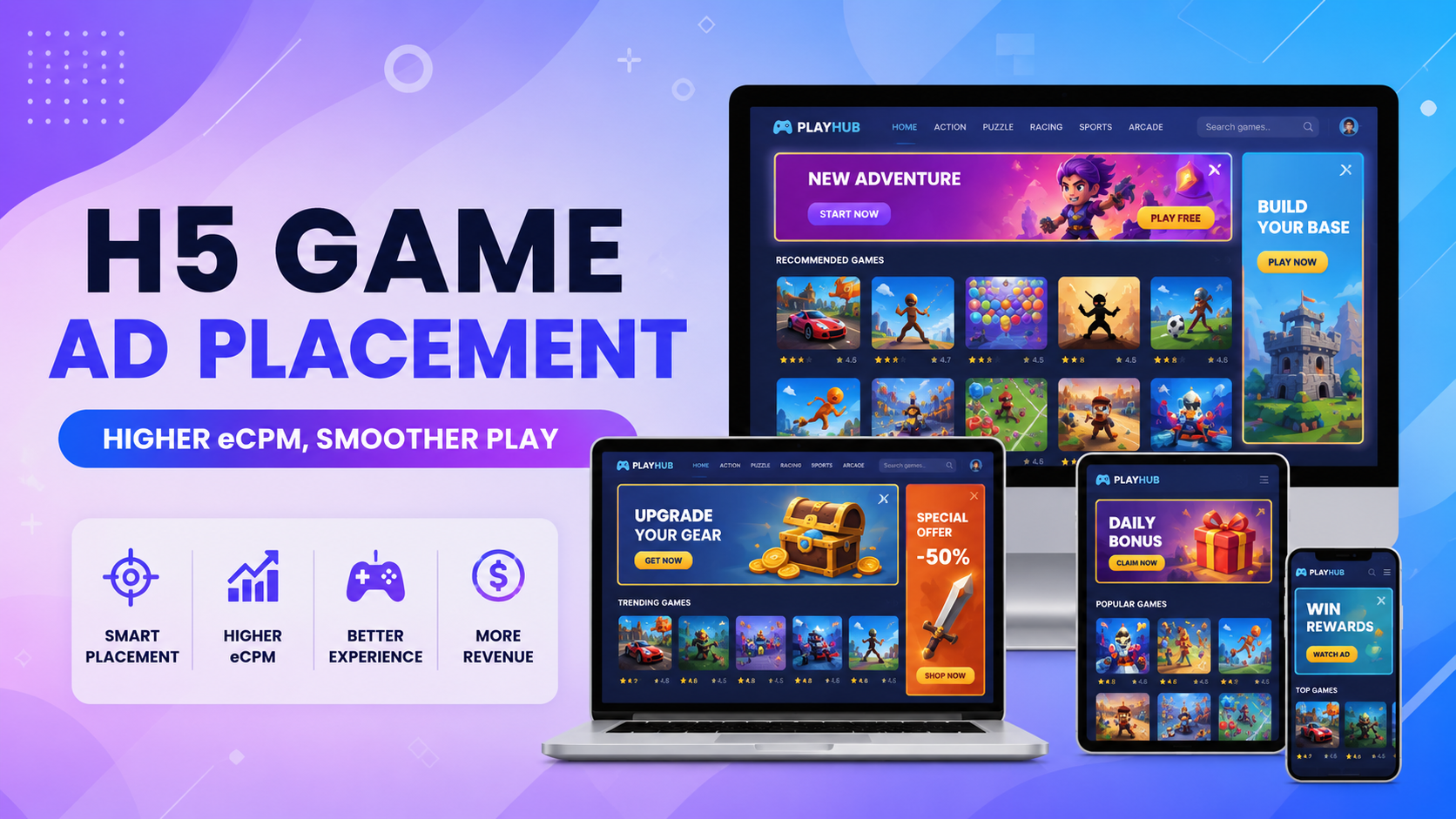
H5 games thrive on speed, responsiveness, and uninterrupted gameplay. Even a small drop in frame rate or a poorly timed advertisement can cause players to quit before completing a level, reducing both engagement and monetization opportunities. That’s why effective H5 game ad placement is about much more than adding extra ad slots.
The most successful HTML5 game publishers treat advertising as part of the game experience rather than an interruption. Every placement, timing decision, and ad format should generate revenue while keeping gameplay smooth across different devices and network conditions.
This guide explains where to place ads throughout the player journey, which formats work best at each stage, and how to maximize H5 eCPM without sacrificing FPS or user retention.
Table of Contents
Why H5 game ad placement matters more than ad quantity
Adding more ad slots does not automatically increase revenue. In H5 games, every advertisement competes with the gameplay itself. Poorly positioned ads can block controls, reduce frame rates, or interrupt key moments, causing players to leave before generating meaningful ad revenue.
A successful H5 game ad placement strategy focuses on delivering high-quality impressions instead of maximizing the number of impressions. Publishers who prioritize user experience often see better engagement metrics, longer sessions, and higher eCPMs because advertisers value inventory that keeps players actively engaged.
Gameplay performance directly affects monetization
Unlike content websites, H5 games require constant interaction and smooth rendering. Players expect immediate responses to every tap, swipe, or action. If ads increase loading time or lower FPS during gameplay, frustration builds quickly and retention drops.
Lower retention also reduces the number of monetization opportunities. Players who exit after a few seconds never reach high-value placements such as rewarded videos or end-of-level interstitials, limiting your overall revenue potential.
Better user experience creates more valuable inventory
Advertisers increasingly evaluate inventory quality alongside traditional metrics like CTR and viewability. A game that delivers stable performance and keeps users engaged generates more premium impressions than one overloaded with intrusive advertising.
This creates a positive cycle:
- Longer sessions: Players complete more levels, creating additional opportunities for rewarded and interstitial ads.
- Higher viewability: Ads remain on screen long enough to deliver measurable value to advertisers.
- Improved engagement: Better player experience increases interaction with non-intrusive ad formats.
- Stronger advertiser demand: High-quality inventory attracts more competitive bidding, helping maximize H5 eCPM.
Publishers should think of advertising as part of the overall game design rather than an isolated monetization feature. The goal is to create placements that feel natural within the player journey, allowing revenue to grow without disrupting gameplay.
The ideal H5 game ad placement blueprint
A high-performing H5 game monetization strategy maps ad placements to the player’s journey. Instead of showing ads whenever space is available, each placement should appear when it is least disruptive and most likely to generate value for both players and advertisers.
Pre-game loading screen
The loading screen is one of the safest places to display advertising because players already expect a short wait before gameplay begins. A lightweight banner or static display ad can monetize this idle time without affecting the actual game experience.
Avoid heavy video ads during loading unless the loading process naturally takes several seconds. Extending the waiting time simply to serve an advertisement often increases abandonment before the first session even starts.
Gameplay HUD banners
Persistent banner ads work best when placed outside the active gameplay area. The ideal position is along the top or bottom edge of the screen, leaving controls, score indicators, and action buttons completely unobstructed.
When designing your HTML5 game ad layout, always consider different screen sizes. A banner that looks harmless on a tablet may overlap critical controls on smaller mobile devices.
Good HUD banner placement should:
- Protect control areas: Never cover joysticks, attack buttons, or navigation controls.
- Maintain visibility: Keep banners consistently visible without distracting animations.
- Use responsive sizing: Adapt to different resolutions and orientations automatically.
Level completion screens
The period immediately after finishing a level is often the highest-value monetization opportunity in an H5 game. Players naturally pause to review scores, rewards, or progression, making this an ideal moment for higher-impact formats.
Depending on your game design, this screen can support:
- Rewarded video ads: Players voluntarily watch an ad in exchange for extra coins, lives, or bonuses.
- Interstitial ads: Display between completed levels rather than during gameplay.
- Native recommendations: Promote related games or sponsored content without interrupting progression.
Because gameplay has already paused, these formats generally achieve strong engagement while preserving the overall player experience.
Pause menu monetization
Many publishers overlook the pause menu even though it offers another natural break in gameplay. Since players intentionally stop the game themselves, lightweight advertising can be introduced without creating frustration.
Small banners, native recommendation units, or cross-promotion widgets usually perform better here than full-screen formats. The objective is to provide additional monetization while allowing players to resume the game instantly.
Game over screen
The game over screen creates one final opportunity before a player leaves or starts another session. Since the action has ended, publishers can introduce higher-value ad formats without disrupting gameplay.
This screen works particularly well for rewarded ads that offer an extra life, interstitials before restarting, or recommendations for similar games that encourage continued engagement across your gaming portfolio.
Best ad formats for different gameplay moments
Different moments in the player journey call for different advertising formats. Choosing the right format at the right time improves engagement, protects gameplay, and helps maximize revenue without frustrating players.
Rewarded video ads
Rewarded videos consistently deliver some of the highest eCPMs because players choose to watch them in exchange for an in-game benefit. This opt-in experience creates strong completion rates while keeping the experience positive.
The best opportunities include:
- Before claiming bonus rewards
- After completing difficult levels
- To earn an extra life after losing
- To unlock premium items or temporary boosts
Since players actively decide to watch the ad, rewarded videos rarely damage retention when the reward feels worthwhile.
Sticky banner ads
Sticky banners provide continuous monetization throughout a gaming session without requiring players to stop playing. They work best when they remain outside the active gameplay area and avoid excessive animation.
To keep them non-intrusive:
- Place banners at the very top or bottom of the screen.
- Avoid expanding creatives during gameplay.
- Use responsive sizes for different devices.
- Refresh ads conservatively instead of every few seconds.
Properly implemented sticky banners generate consistent impressions while maintaining a stable user experience.
Interstitial ads
Interstitials can generate excellent revenue, but timing determines whether they help or hurt performance. Showing them during combat, puzzle solving, or timed challenges almost always leads to player frustration.
Instead, trigger interstitials only during natural breaks such as:
- Between completed levels
- Before loading a new stage
- After returning to the main menu
- Following a completed mission
Players are already expecting a transition during these moments, making the interruption feel much more natural.
Native recommendation units
Native ads blend into the interface and are especially effective on menus or post-game screens. Rather than interrupting gameplay, they encourage players to discover related games or sponsored content while remaining visually consistent with the game’s design.
These units are particularly valuable for publishers managing multiple H5 games because they can increase both advertising revenue and cross-game traffic.
Playable and interactive ads
Playable ads allow users to experience a short preview before installing another game. Although they are less common than traditional formats, they often attract premium advertiser demand because of their high engagement rates.
They perform best after gameplay has ended or when players voluntarily explore additional content. Using playable ads during active gameplay should generally be avoided, as they require more resources and can negatively affect responsiveness on lower-end devices.
How to maximize H5 eCPM without reducing FPS
Increasing revenue should never come at the expense of gameplay quality. The most successful H5 publishers optimize both monetization and performance together, ensuring ads load efficiently without introducing noticeable lag. A few technical improvements can significantly increase revenue while maintaining a smooth player experience.
Load ads asynchronously
Ads should load independently from the game engine whenever possible. Asynchronous loading prevents advertising resources from blocking gameplay, allowing players to continue interacting with the game even if an ad request takes longer than expected.
This approach reduces loading delays, improves responsiveness, and creates a more consistent experience across different network conditions.
Use lazy loading for non-visible ad slots
There is no reason to request every advertisement as soon as the game starts. Loading ads only when players are about to reach a placement reduces unnecessary network activity and memory usage.
For example, an interstitial displayed after Level 5 should not begin loading during the initial game launch. Delaying requests until they are actually needed helps reduce ad lag in H5 games while improving overall efficiency.
Limit concurrent ad requests
Sending multiple ad requests at the same time can overwhelm low-end devices and slower mobile networks. Instead of loading every placement simultaneously, prioritize the next upcoming ad opportunity.
This strategy helps maintain stable FPS while allowing demand partners enough time to compete for impressions.
Optimize creative quality and refresh frequency
Heavy creatives consume additional CPU, GPU, and network resources. Large video files or complex rich media units may generate higher CPMs individually but can reduce long-term revenue if they slow the game and shorten player sessions.
Similarly, refreshing banner ads too frequently increases rendering work without always producing meaningful revenue gains. A balanced refresh strategy often delivers better overall yield than aggressive refresh intervals.
Remove slow demand partners
Not every demand source contributes equally to revenue. Some partners consistently introduce higher latency while generating relatively few winning bids, reducing the efficiency of the entire monetization stack.
Regularly reviewing bidder response times and auction performance helps identify partners that are slowing down gameplay without adding enough value. Removing consistently underperforming demand sources can improve both FPS and overall monetization efficiency.
Publishers working with multiple demand sources often face the challenge of balancing revenue, latency, and player experience. A monetization partner such as PubFuture can help evaluate your H5 inventory, optimize demand quality, and reduce unnecessary latency while maintaining competitive bidding across your ad stack.
Create a free PubFuture account to receive a personalized monetization review and discover opportunities to improve both eCPMs and gameplay performance.
Finding Optimal Prebid Timeout Settings
Common H5 game ad placement mistakes
Even well-designed games can struggle to generate strong ad revenue if advertisements are introduced at the wrong time or in the wrong place. Avoiding a few common mistakes can improve both player satisfaction and long-term monetization performance.
Ads covering gameplay controls
One of the fastest ways to frustrate players is placing advertisements over interactive elements. Banners that overlap virtual joysticks, attack buttons, or navigation controls make the game difficult to play and often lead to accidental ad clicks.
Instead, reserve dedicated safe zones around gameplay controls and test layouts across different screen sizes to ensure every button remains fully accessible.
Interrupting players during active gameplay
Interstitial ads shown in the middle of combat, racing sequences, or puzzle-solving moments create a poor user experience. Players expect uninterrupted gameplay during these high-focus moments, so unexpected full-screen ads often result in immediate exits.
A better approach is to trigger interstitials only during natural transitions, such as after completing a level or returning to the main menu.
Applying the same layout to every game genre
There is no universal H5 game ad placement blueprint that works for every title. A casual puzzle game, an endless runner, and a multiplayer strategy game all have different gameplay rhythms and player expectations.
For example:
- Puzzle games: Rewarded videos after completing difficult stages often perform well.
- Action games: Sticky banners should remain outside fast-moving gameplay areas.
- Idle games: Longer pauses allow more flexibility for interstitial placements.
Ad layouts should always reflect how players interact with each specific game.
Refreshing ads too aggressively
Frequent ad refreshes increase rendering work and network requests, especially on lower-end mobile devices. While the goal may be to generate more impressions, excessive refresh rates can reduce FPS, increase battery usage, and shorten player sessions.
A moderate refresh strategy usually produces stronger long-term revenue because players remain engaged for longer periods, creating more high-quality impressions.
Ignoring lower-end devices
Not every player owns the latest smartphone or has access to high-speed internet. Heavy creatives, multiple simultaneous ad requests, and complex animations may perform well on flagship devices but struggle on older hardware.
Testing your HTML5 game ad layout across a range of devices and connection speeds helps ensure consistent gameplay while preserving monetization opportunities for your entire audience.
How to measure whether your ad layout is actually working
A successful ad layout is not measured by eCPM alone. Strong monetization comes from balancing revenue, player retention, and game performance. Monitoring the right KPIs helps identify whether your current H5 game ad placement strategy is creating sustainable growth or simply increasing short-term ad impressions.
eCPM
Effective CPM remains one of the most important indicators of monetization efficiency. A higher eCPM usually reflects stronger advertiser competition, better viewability, and higher-quality inventory.
However, eCPM should always be evaluated alongside engagement metrics. A temporary increase caused by aggressive interstitials may not translate into higher overall revenue if players leave the game sooner.
Revenue per session
Revenue per session measures how much each gameplay session generates on average. This metric often provides a clearer picture than eCPM because it considers both monetization efficiency and player engagement.
If revenue per session continues to increase while session length remains stable, your ad placement strategy is likely improving rather than disrupting the player experience.
Session length and retention
Longer sessions create more opportunities to serve high-value ad formats such as rewarded videos and post-level interstitials. If average session duration drops after introducing new placements, the advertising experience may be interfering with gameplay.
Retention metrics are equally valuable. Players who return regularly generate significantly more lifetime revenue than those who abandon the game after a single session.
FPS and ad latency
Technical performance should be monitored just as closely as revenue metrics. Frame rate drops or slow ad loading times often indicate that creatives, bidder response times, or concurrent requests need optimization.
Useful performance indicators include:
- Average FPS: Measures gameplay smoothness across different devices.
- Ad latency: Time required for advertisements to load before display.
- Creative load time: Indicates whether heavy assets are affecting performance.
- Auction response time: Helps identify slow demand partners.
Tracking these metrics makes it easier to balance monetization with gameplay quality.
Viewability and engagement
High viewability improves inventory quality and attracts stronger advertiser demand. Ads that remain visible during natural gameplay pauses typically perform better than placements players immediately dismiss or scroll past.
You should also monitor engagement metrics such as CTR, rewarded video completion rates, and interaction with native recommendation units. Together, these metrics reveal whether players are accepting your advertising strategy rather than trying to avoid it.
Best practices for H5 game ad placement
Building a profitable ad strategy is an ongoing optimization process rather than a one-time setup. These best practices help publishers improve monetization while maintaining a smooth, enjoyable gameplay experience.
Test one placement at a time
Avoid changing multiple ad placements simultaneously. Testing one adjustment at a time makes it easier to identify what actually improves eCPM, engagement, or retention. Running structured A/B tests also produces more reliable data for future optimization.
Optimize by game genre
Different genres require different monetization strategies. Puzzle games often benefit from rewarded videos after completing challenging levels, while endless runners and action games usually perform better with unobtrusive sticky banners and carefully timed interstitials.
Design your H5 game ad placement strategy around player behavior instead of applying the same layout across every title.
Prioritize smooth gameplay
A higher eCPM means little if players abandon the game because of poor performance. Monitor FPS, loading speed, and ad latency regularly to ensure advertising never becomes more noticeable than the gameplay itself.
Fast, responsive games naturally create better user engagement, stronger advertiser demand, and more valuable inventory over time.
Review player feedback regularly
Analytics reveal what players do, while feedback explains why they do it. App store reviews, community discussions, and in-game surveys often highlight issues that performance metrics alone cannot detect.
If multiple players report intrusive ads or unexpected interruptions, reviewing your placement strategy should become a priority.
Continue optimizing as demand evolves
Advertiser demand, devices, and player expectations constantly change. A layout that performs well today may not deliver the same results several months later. Regular reviews of ad performance, latency, and player engagement help maintain long-term revenue growth without sacrificing user experience.
Publishers looking to refine their monetization strategy can also benefit from working with an experienced monetization partner. PubFuture helps H5 game publishers evaluate inventory quality, optimize demand sources, and identify new revenue opportunities while preserving a fast and enjoyable gameplay experience.
Create a free PubFuture account to receive a personalized monetization review and discover how your H5 game inventory can generate greater long-term value.
Effective H5 game ad placement is not about showing more ads. It is about placing the right ad format at the right moment without disrupting gameplay. By aligning ad placements with the player journey, optimizing loading behavior, and continuously monitoring both revenue and performance metrics, publishers can maximize H5 eCPM while maintaining smooth gameplay and strong player retention.
Optimizing H5 game monetization is an ongoing process. If you’re looking to increase revenue while maintaining a smooth player experience, the PubFuture team can help evaluate your inventory and identify new optimization opportunities. Fill out our contact form to get in touch with our monetization experts.