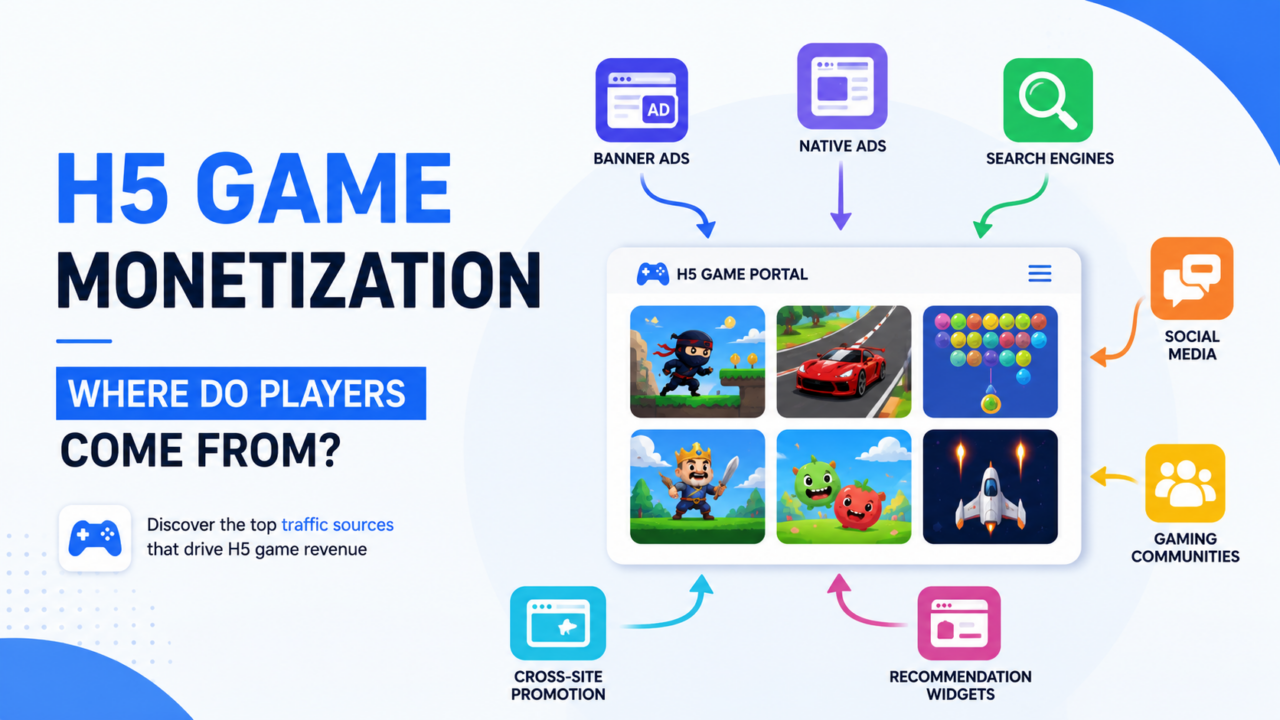




H5 game monetization gives browser game publishers several ways to generate advertising revenue from users who can start playing directly on the web. However, the same qualities that make HTML5 games accessible also make monetization more sensitive. Players interact continuously with the screen, sessions can be short, and many users arrive from mobile devices or embedded environments.
A setup that simply increases the number of ad impressions can quickly create interruptions, slower loading, or accidental interactions. Publishers therefore need to consider where ads appear, when requests are made, which formats suit each opportunity, and how much demand competes for the inventory.
A strong H5 monetization strategy combines suitable ad formats, controlled delivery, competitive demand, performance optimization, and traffic-quality protection to increase revenue while keeping the browser game experience usable.
Why H5 game monetization needs a different strategy
Traditional websites usually have relatively predictable areas for ads, such as article sidebars, content feeds, headers, or spaces between sections. H5 game pages are more interactive. A large part of the screen may be occupied by the game itself, while users regularly click, tap, or use controls.
This makes placement more sensitive. Google specifically warns publishers against positioning ads close to interactive elements, navigation, play buttons, game windows, and other areas where accidental clicks can occur.
H5 inventory can also appear in different structures. Google Ad Manager recognizes fullscreen games, games running inside an iframe or WebView, and games embedded within a larger page. Its dedicated H5 gaming formats currently include interstitial and rewarded inventory.
The monetization setup therefore has to account for the environment around each impression rather than applying one layout across every game page.
Best H5 game monetization strategies for browser publishers
Most H5 publishers benefit from combining several monetization methods:
Use display ads around stable page areas
Standard display units can provide a consistent revenue layer around the game container, game directory, category pages, or other non-interactive page areas. They work best where users can clearly distinguish advertising from gameplay controls.
Publishers should avoid placing banners immediately beside play buttons, directional controls, navigation, or other frequently clicked elements. The goal is to create visible inventory without making an ad look like part of the game interface. Clear spacing also reduces the risk of accidental clicks and policy problems.
Add H5 gaming interstitial ads at suitable breaks
Interstitials create fullscreen inventory that can attract stronger advertiser attention than a small banner. Google Ad Manager supports dedicated H5 gaming interstitials, which publishers manually trigger at a defined ad break within eligible gaming inventory. The format is currently limited access and specifically restricted to gaming inventory.
Timing has a major effect on the experience. Interstitial opportunities are generally easier to manage when the user has reached a clear pause in activity instead of while they are actively controlling the game.
Frequency also needs control. Google’s web interstitial implementation includes frequency caps and clear exit controls to reduce excessive interruption.
Use rewarded ads for voluntary monetization
Rewarded advertising creates a different type of H5 game monetization opportunity because the user chooses whether to participate. Google supports rewarded ads on desktop, mobile, and tablet web inventory, including both video and display demand.
For H5 publishers, the value comes from the opt-in model. The user understands what action is required and what non-monetary benefit is offered before the ad begins.
Google requires clear disclosure and, in most implementations, an affirmative opt-in from the user. Rewards must also comply with its rules, including restrictions on direct monetary rewards and requirements around non-transferable benefits.
Use video inventory selectively
Video can create premium advertising opportunities, but H5 publishers need to consider where attention is actually available. A video ad competing with active gameplay can create a poor experience, especially on smaller mobile screens.
Video inventory generally fits better where the user is already outside an active interaction period or has chosen to enter a rewarded experience. Publishers should also avoid autoplay experiences with sound in ordinary mobile web environments, which appear among the ad experiences identified negatively under the Better Ads Standards.
Build a format mix instead of depending on one unit
Different impressions have different monetization potential. A persistent display unit can create baseline revenue, while an interstitial can monetize a suitable transition and a rewarded ad can capture value from an opt-in opportunity.
Using several appropriate formats gives publishers more flexibility than trying to increase revenue through one placement alone. It also creates more room to adjust monetization by device, GEO, game page type, traffic source, and session behavior.
Protect gameplay continuity through better ad timing
Ad timing directly affects whether monetization feels integrated or disruptive.
Publishers should define clear rules for when high-impact formats are eligible to appear. These rules can be based on publisher-defined breaks, user actions, page states, or other appropriate H5 events supported by the monetization setup.
Several principles can help:
- Keep ads away from active controls: Ad units should have enough separation from game controls and navigation to reduce accidental interaction.
- Use frequency caps for high-impact formats: A user who encounters repeated fullscreen ads in a short period may leave before generating more valuable impressions.
- Give users a clear exit: Interstitial and rewarded experiences should make dismissal or opt-out behavior easy to understand.
- Review the mobile layout separately: A placement that feels well spaced on desktop can become intrusive when the same game is loaded on a smaller mobile viewport.
The Coalition for Better Ads identifies experiences such as mobile pop-ups, prestitials, large sticky units, excessive ad density, and several intrusive video implementations among the least preferred mobile web experiences.
Increase H5 revenue through stronger demand competition
Placement is only one part of H5 game monetization. The value of an impression also depends on how many suitable buyers can compete for it.
Publishers relying heavily on one source of demand can see large differences in fill and eCPM across GEOs, devices, formats, and traffic types. Adding broader programmatic demand can improve competition without requiring additional ad slots.
A more diversified setup may include direct Google demand, programmatic partners, header bidding connections, video demand, or other approved demand sources. The exact mix should depend on the publisher’s traffic and technical setup.
Floor prices also need testing. An aggressive floor can increase the value of some winning bids while leaving more inventory unfilled. A very low floor may protect fill while reducing yield. H5 publishers should therefore evaluate eCPM together with fill rate and total revenue instead of optimizing one metric in isolation.
This is especially useful for global H5 traffic because advertiser demand can vary substantially between markets.
Keep H5 ad delivery lightweight
H5 games already use browser resources for scripts, assets, animations, and user interactions. Advertising adds more requests and third-party code to the same environment.
Publishers should load ad technology in a way that limits unnecessary pressure on the browser. Google recommends asynchronous loading for Google Publisher Tag so the ad library can load in parallel with page content rather than blocking execution.
Lazy loading can also help with placements that users may never see. Google recommends delaying below-the-fold ad requests until slots approach the viewport, which helps conserve bandwidth and browser resources, particularly on mobile devices.
Publishers should also reserve appropriate space for display units. Dynamically inserted ads can create layout movement when the available space does not match the creative that eventually loads.
For H5 publishers, the practical objective is to avoid letting ad delivery compete unnecessarily with the resources needed to keep the page responsive.
Protect H5 monetization from IVT and poor ad quality
Traffic quality has a direct effect on sustainable H5 monetization. Browser games can receive traffic from multiple referrers, mobile browsers, WebViews, embedded environments, social sources, and game distribution partners. That makes monitoring traffic patterns important.
Publishers should review unusual changes in requests, sessions, devices, GEOs, referrers, and engagement patterns instead of looking only at gross traffic volume. Suspicious activity can affect advertiser trust, demand access, and finalized revenue.
Creative quality needs similar attention. Redirects, misleading creatives, abusive experiences, or ads that interfere with the page can damage the user experience even when the placement itself is correctly configured. Google Publisher Policies specifically prohibit ads that obstruct content, interfere with interaction, or create misleading behavior.
A strong H5 monetization stack therefore needs both demand optimization and controls around traffic and creative quality.
Measure H5 monetization with the right metrics
Revenue should be evaluated alongside the conditions that produced it.
Useful H5 monetization metrics include:
- eCPM: Shows how much revenue is generated for every thousand impressions and helps compare inventory value across formats or traffic segments.
- Fill rate: Shows how much eligible inventory actually receives an ad. Strong eCPM can still produce weak total revenue when a large share of requests remains unfilled.
- Viewability: Helps identify whether impressions have a realistic opportunity to be seen by users.
- Revenue per session: Connects advertising revenue to the overall value of a game visit rather than counting impressions alone.
- Rewarded ad opt-in rate: Shows how frequently users voluntarily choose the rewarded experience when that format is available.
- Performance by GEO and device: Helps publishers identify markets or devices where demand coverage, layout, or format performance should be adjusted.
These metrics should be reviewed together. For example, increasing interstitial frequency may temporarily raise impression volume while changing session value or user behavior elsewhere.
Build a scalable H5 game monetization setup
As H5 traffic grows, publishers usually need more than additional ad placements. The monetization stack has to coordinate formats, demand competition, delivery rules, traffic quality, ad quality, and performance across different markets and devices.
A monetization partner can become useful when managing these components internally starts requiring significant ad ops resources. PubFuture works with H5 publishers across areas such as multi-demand monetization, suitable ad formats, yield optimization, ad delivery, and traffic-quality protection, allowing publishers to manage browser game inventory through a broader monetization setup.
For publishers that need broader demand access and more control over H5 inventory, working with a monetization partner can simplify this process. PubFuture supports H5 publishers with multiple demand sources, display and high-impact ad formats, yield optimization, ad quality controls, and traffic-quality protection across different GEOs and devices.
Instead of increasing ad density, the focus is on improving the value of existing monetization opportunities through stronger demand competition, suitable formats, smarter delivery, and ongoing optimization. This gives H5 publishers a more scalable setup as traffic and inventory grow.
Final thoughts on H5 game monetization
Effective H5 game monetization depends on the complete setup around each impression. Display ads can provide consistent inventory, interstitials can monetize appropriate breaks, rewarded ads add voluntary value exchanges, and stronger demand competition can improve the value of existing ad opportunities.
Publishers should combine those formats with controlled timing, lightweight ad delivery, IVT monitoring, creative-quality controls, and performance analysis. This creates a more sustainable path for generating revenue from browser game traffic while preserving gameplay continuity.
Publishers looking to strengthen their H5 game monetization setup can work with PubFuture to expand demand coverage, optimize ad formats, improve inventory quality, and build a more scalable revenue strategy for browser game traffic.
Ready to monetize your H5 game traffic with PubFuture? Sign up for PubFuture to explore monetization opportunities for your inventory.