


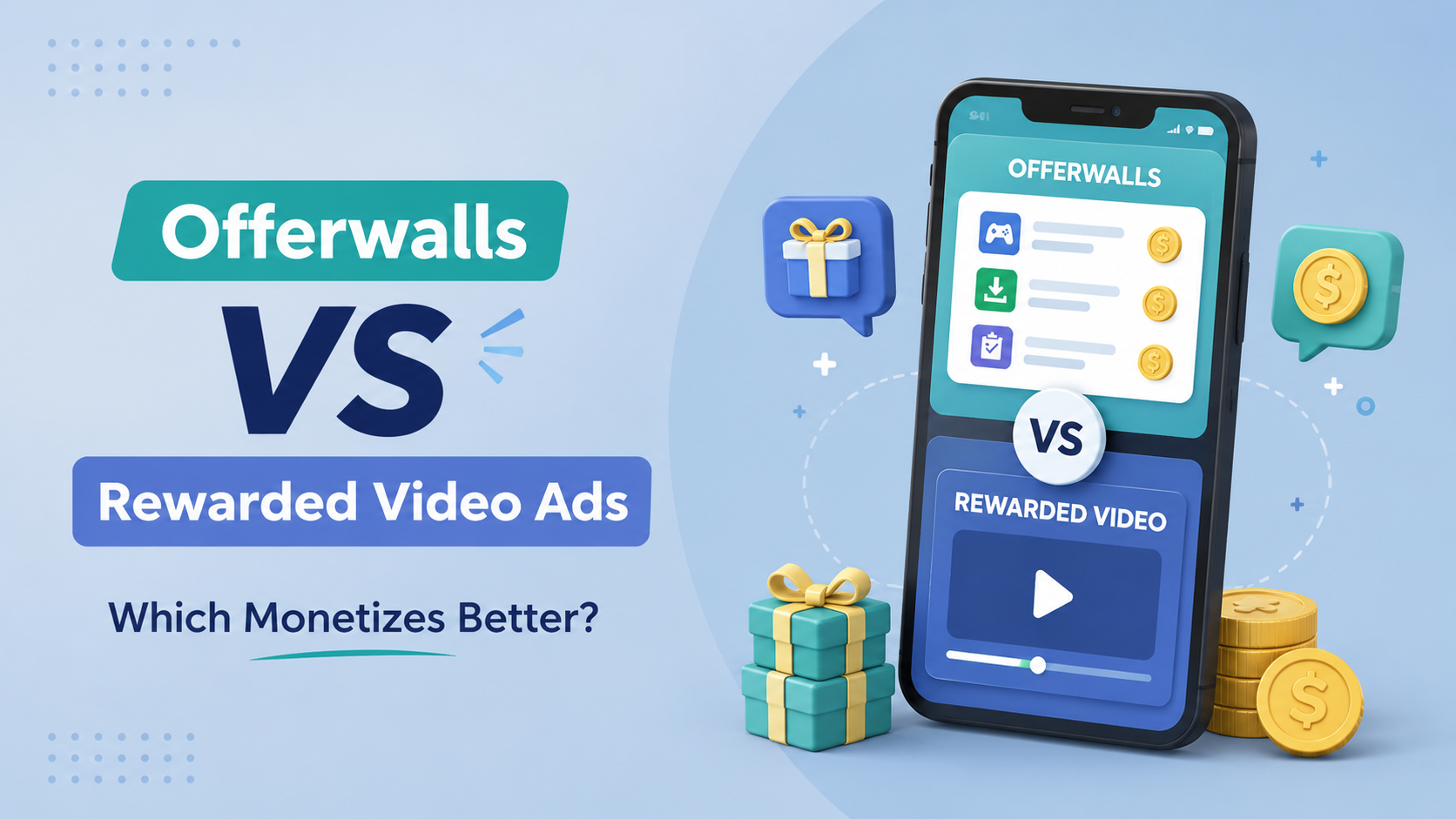
Mobile game monetization has shifted significantly over the past few years. Instead of interrupting gameplay with mandatory ads, developers increasingly rely on opt-in experiences that give players a clear choice and an immediate reward. This approach improves user satisfaction while creating stronger revenue opportunities. As a result, Rewarded video ads vs offerwalls has become one of the most common comparisons for studios looking to optimize ad monetization.
Although both formats follow the same value exchange principle, they serve different player behaviors and generate revenue in different ways. Rewarded Video Ads encourage quick engagement with minimal effort, while Offerwalls ask players to complete higher-value tasks in exchange for larger in-game rewards. Choosing the wrong format, or relying too heavily on one, can limit both revenue growth and long-term player value.
This guide compares Rewarded Video Ads and Offerwalls using real monetization benchmarks, including eCPM, ARPDAU, engagement rates, and player retention. You’ll also learn when each format performs best and how combining both can create a stronger hybrid monetization strategy.
Table of Contents
The rise of opt-in advertising in mobile gaming
The mobile gaming industry has gradually moved away from forced advertising toward value exchange advertising. Rather than interrupting gameplay with unexpected ads, developers now allow players to decide when advertising becomes worthwhile by offering meaningful in-game rewards.
Rewarded Video Ads and Offerwalls are both examples of this opt-in model. Players voluntarily interact with advertising because they receive something valuable in return, such as extra lives, premium currency, boosters, or exclusive items. This creates a better balance between monetization and player experience.
However, despite sharing the same philosophy, these formats are designed for completely different situations. Rewarded videos focus on convenience and scale, while Offerwalls prioritize high-value conversions. This raises an important question for every monetization manager: which format delivers higher revenue, and which one contributes more to long-term player value?
Rewarded video ads: Broad reach and predictable revenue
Rewarded Video Ads remain the most widely adopted opt-in ad format because they combine strong engagement with minimal friction.
How rewarded video ads work
Rewarded videos typically appear during natural pauses in gameplay, making them feel like part of the player journey rather than an interruption. Common placements include:
- Game Over: Watch a short video to continue playing.
- Extra Rewards: Double coins, experience points, or loot.
- Energy Recovery: Refill lives or stamina.
- Level Completion: Earn bonus rewards before progressing.
Since the interaction usually requires only watching a 15 to 60-second video, nearly every player is willing to participate at least occasionally.
Strong engagement across game genres
One of the biggest strengths of Rewarded Video Ads is their consistently high engagement rate.
Industry benchmarks show impressive opt-in rates across multiple genres:
- Word Games: approximately 38.4%
- RPG Games: approximately 37.6%
- Casual Games: approximately 36%
Because players choose to watch the ad at moments when they already need additional resources, completion rates are significantly higher than most traditional mobile advertising formats.
Consistent revenue with healthy eCPMs
Rewarded Video Ads also outperform many standard display formats from a revenue perspective.
Average industry benchmarks show:
- Banner Ads: approximately $0.42 eCPM
- Interstitial Ads: approximately $9.18 eCPM
- Rewarded Video Ads: approximately $14.65 eCPM
While these values vary by geography and demand quality, Rewarded Video consistently ranks among the highest-performing advertising formats that can be shown to virtually every player.
The predictable nature of rewarded inventory also makes forecasting revenue easier compared to more specialized monetization methods.
Advantages and limitations
Rewarded Video Ads offer several clear advantages:
- Low friction encourages broad adoption across almost every player segment.
- Simple SDK integration makes implementation relatively straightforward.
- Suitable for nearly every mobile game genre.
- Stable and predictable monetization throughout the player lifecycle.
Their primary limitation is revenue per converting user. Although engagement is high, the average monthly revenue generated by an individual rewarded user is relatively modest, around $0.15 per month, making Rewarded Video a volume-driven monetization strategy rather than a high-value one.
Offerwalls: Premium revenue through high-value actions
Unlike Rewarded Video Ads, Offerwalls generate revenue from completed advertiser actions instead of video impressions.
How offerwalls work
An Offerwall functions as a marketplace of rewarded tasks. Players can browse multiple offers and choose the activities they want to complete in exchange for large amounts of premium currency.
Common tasks include:
- Installing another mobile game
- Reaching a specific game level
- Completing surveys
- Registering for online services
- Purchasing subscription trials
Because advertisers only pay after meaningful actions are completed, each successful conversion is significantly more valuable than a video view.
Why offerwall eCPMs are dramatically higher
Offerwalls are famous for producing exceptionally high eCPMs.
Average benchmarks often reach around $400 eCPM, while premium campaigns can exceed $1,500 eCPM.
This does not mean Offerwalls magically generate more advertising demand. Instead, advertisers pay based on CPA or CPL outcomes rather than impressions. A completed registration or qualified app install is far more valuable than a simple ad view, allowing publishers to earn substantially higher revenue per completed action.
A powerful ARPDAU booster
Offerwalls are particularly effective at monetizing players who enjoy the game but rarely spend money.
Industry data shows that converting these engaged non-paying users through Offerwalls can generate approximately $4.04 per month per converted user, representing nearly 30% of the average value of an in-app purchaser, estimated at around $13.27.
Several real-world implementations have also reported ARPDAU improvements exceeding 66% after introducing Offerwalls to players who had already demonstrated long-term engagement but had never made an in-app purchase.
Instead of replacing IAP, Offerwalls create a new monetization path for players who otherwise would contribute little revenue.
Advantages and limitations
Offerwalls provide several important benefits:
- Extremely high revenue potential.
- Better monetization of non-paying users.
- Additional support for healthy in-game economies.
- Strong performance in mid-core and long-session games.
The main challenge is player effort. Completing surveys or downloading another app requires considerably more commitment than watching a short video. As a result, participation rates are naturally lower, making Offerwalls unsuitable as a primary monetization format for every player.
Rewarded video ads vs offerwalls: Side-by-side comparison
| Metric | Rewarded Video Ads | Offerwalls | Winner |
|---|---|---|---|
| Format | Short opt-in videos | Task marketplace | Depends on game design |
| Player effort | Very low | High | Rewarded Video |
| Engagement | 25% to 38%+ | Lower overall | Rewarded Video |
| Average eCPM | ~$14.65 | ~$400 to $1,500+ | Offerwalls |
| Revenue per converted user | ~$0.15/month | ~$4.04/month | Offerwalls |
| Best genres | Casual, Puzzle, Hyper-casual, Action | RPG, Strategy, Casino, Simulation | Context dependent |
The comparison highlights a simple reality. Rewarded Video Ads maximize participation because nearly every player is willing to watch a short advertisement. Offerwalls, meanwhile, generate significantly more revenue from a much smaller group of highly engaged users. The most successful monetization strategies recognize that these formats complement each other rather than compete directly.
A hybrid monetization strategy delivers the best long-term results
Leading mobile games rarely depend on a single rewarded format. Instead, they match monetization opportunities to player behavior throughout the lifecycle.
Rewarded videos for new and casual players
New users are still learning game mechanics and building habits. Asking them to complete complex advertising tasks too early creates unnecessary friction.
Rewarded Video Ads work much better during this stage because they provide instant value while maintaining a smooth onboarding experience.
Offerwalls for engaged non-paying users
Offerwalls become significantly more effective after players have demonstrated long-term commitment.
Typical activation rules include:
- Reaching Level 10 or higher.
- Session lengths exceeding 15 minutes.
- Multiple return visits.
- Consistent gameplay without making purchases.
At this stage, players have developed enough investment in the game to complete higher-value advertising tasks.
Optimize placements throughout the player journey
Placement is just as important as choosing the right format.
A practical hybrid strategy includes:
- Game Over: Rewarded Video for extra lives.
- Pause Menu: Rewarded Video for temporary boosts.
- Shop or Store: Offerwall as an alternative source of premium currency.
- Economy Screens: Offerwall positioned alongside IAP without replacing purchases.
As hybrid monetization strategies become more common, continuously reviewing player behavior, engagement patterns, and ad performance is just as important as selecting the right formats. Teams looking to improve revenue without sacrificing player experience can work with PubFuture to evaluate monetization opportunities, optimize user segmentation, and build a balanced advertising strategy tailored to their games.
Common implementation mistakes to avoid
Several implementation mistakes can reduce the effectiveness of both Rewarded Video Ads and Offerwalls.
Replacing IAP instead of supporting it
Offerwalls should complement in-app purchases rather than replace them. If premium rewards become too easy to obtain through advertising, paying users may lose the motivation to purchase premium currency directly.
Choosing low-quality offerwall providers
Poor-quality Offerwall partners may display misleading offers, low-quality surveys, or fraudulent tasks. These experiences damage player trust and can negatively affect long-term retention.
Selecting reputable demand partners with strict quality controls is essential.
Poor rewarded video integration
Technical issues can quickly ruin the player experience.
Common problems include:
- Slow video loading
- Audio conflicts
- Frozen game screens
- SDK timeout errors
- H5 canvas performance issues
Careful SDK optimization and continuous testing help maintain both player satisfaction and advertising performance.
► Read more: Offerwall for Web Publishers: How to Monetize Content via Micro-Tasks and Surveys
Rewarded video ads vs offerwalls: Which one should you choose?
Rewarded Video Ads are the better choice if:
- Your game has a large casual audience.
- You want stable revenue across the entire player base.
- Fast, low-friction engagement is a priority.
- Your primary goal is maintaining player retention while generating consistent ad revenue.
Offerwalls are the better choice if:
- Your game has a strong in-game economy.
- Most users are engaged but rarely make purchases.
- You want to maximize ARPDAU from non-paying players.
- Players are willing to complete higher-value tasks for premium rewards.
A hybrid strategy delivers the strongest long-term results.
Rather than choosing one format over the other, many successful mobile games combine both. Rewarded Video Ads monetize the largest portion of the player base through quick, repeatable interactions, while Offerwalls unlock additional revenue from highly engaged non-paying users. Together, they create a balanced monetization strategy that improves both short-term revenue and long-term player lifetime value.
Actionable checklist for choosing between Rewarded video ads vs offerwalls
Before deciding between Rewarded video ads vs offerwalls, review your monetization strategy against the following best practices. Rather than focusing on a single metric like eCPM, evaluate how each format contributes to player engagement, ARPDAU, retention, and long-term lifetime value.
- Integrate Rewarded Video Ads at natural “rescue” moments, such as Extra Life, Continue, Bonus Rewards, or Energy Refills, where players are already motivated to exchange a short video view for immediate in-game value.
- Place Offerwalls within your in-game Store or Economy section as an alternative way to earn premium currency, ensuring they complement rather than replace in-app purchases.
- Segment players based on engagement and spending behavior instead of showing the same rewarded experience to everyone. Rewarded Video Ads work best for new and casual users, while Offerwalls are more effective for engaged non-paying players.
- Monitor key monetization metrics regularly, including eCPM, ARPDAU, retention, completion rate, and Offerwall conversion rate, then adjust placements and reward values based on player behavior.
- Continuously test and optimize your hybrid monetization strategy, as the ideal balance between Rewarded video ads vs offerwalls will vary depending on your game’s genre, economy, audience, and monetization goals.

Rewarded Video Ads vs Offerwalls are not competing solutions. They address different player behaviors and monetization opportunities throughout the game lifecycle. Choosing the right combination allows developers to increase eCPM, improve ARPDAU, and build a healthier in-game economy without compromising the player experience. A thoughtful Rewarded video ads vs offerwalls strategy is ultimately about matching the right ad format to the right player at the right time.
As player behavior and advertiser demand continue to evolve, reviewing your rewarded monetization strategy should become part of your ongoing optimization process. If you’re looking to increase mobile game revenue while maintaining a great player experience, get in touch with the PubFuture team through our contact form to discuss your monetization goals and explore a strategy tailored to your game.