



A low ad fill rate means a meaningful share of your available ad requests are ending without an ad being served. For publishers, that can translate into unused inventory and lower revenue, especially when the problem affects placements or traffic segments with significant volume.
The cause is rarely visible from one metric alone. Demand availability, floor prices, GEO mix, technical configuration, consent signals, inventory quality, and ad format can all influence whether an impression receives an eligible bid.
A useful investigation starts by identifying where fill dropped, then checking demand and pricing before making broader changes to the ad stack. This guide explains the most common causes and the signals publishers should review first.
Table of Contents
What does a low ad fill rate actually mean?
Ad fill rate shows how much available advertising inventory successfully receives an ad.
At a basic level, publishers can think of it as the percentage of ad requests that result in an ad being served. When requests increase faster than filled impressions, the fill rate falls and more inventory remains unfilled.
A low ad fill rate becomes more useful when broken down by segment. An overall site average can hide large differences between countries, devices, ad units, formats, or traffic sources.
For example, desktop inventory in the United States may receive strong competition while mobile traffic from another GEO receives fewer eligible bids. Looking only at the site-wide fill rate makes those differences difficult to diagnose.
Publishers should therefore investigate fill at the smallest useful level before changing the whole monetization setup.
1. Demand coverage is too limited
Demand availability is one of the first areas to check when fill drops:
Weak demand in certain GEOs
Advertiser demand varies significantly by country. Some markets have deeper programmatic demand, larger advertiser budgets, and more buyers actively targeting publisher inventory.
A publisher can therefore see healthy fill in one country and a low ad fill rate in another even when the same ad unit and technical setup are used. Compare fill, bid activity, CPM, and traffic volume by GEO to identify markets where demand coverage is thin.
Device or browser demand is different
Demand can also vary between desktop, mobile web, WebView environments, operating systems, and browsers.
Break reporting down by device and browser. A sharp difference between segments can reveal whether the problem is connected to buyer coverage rather than the ad placement itself. This is particularly useful when overall traffic has recently shifted toward mobile or another device category.
The ad format has limited buyer coverage
Some inventory types naturally attract more demand sources than others.
Standard display formats usually have broad compatibility, while specific video, rich media, native, or uncommon banner sizes may have fewer eligible campaigns. Publishers should compare fill by ad format and size instead of expecting every placement to reach the same fill level.
Adding relevant demand sources can improve auction coverage when strong traffic exists but too few buyers are competing for it.
2. Floor prices are blocking too many bids
Floor prices directly affect which bids are eligible to win an impression:
Floors are set above market demand
A high floor price can increase the minimum value required from buyers, but it can also remove bids that would otherwise fill the impression.
Imagine an ad unit regularly receiving bids between $0.80 and $1.20 CPM while the floor is set at $1.50. Demand exists, yet much of that demand becomes ineligible. The result can be more unfilled impressions.
Review fill rate together with bid CPM distribution and revenue rather than evaluating floor price independently.
One floor is applied across very different traffic
The same pricing rule can produce different outcomes across GEOs, devices, placements, and inventory types.
A floor that performs well for premium desktop traffic may be too aggressive for lower-demand mobile inventory. Segmenting pricing rules can give publishers more control over how aggressively inventory is priced.
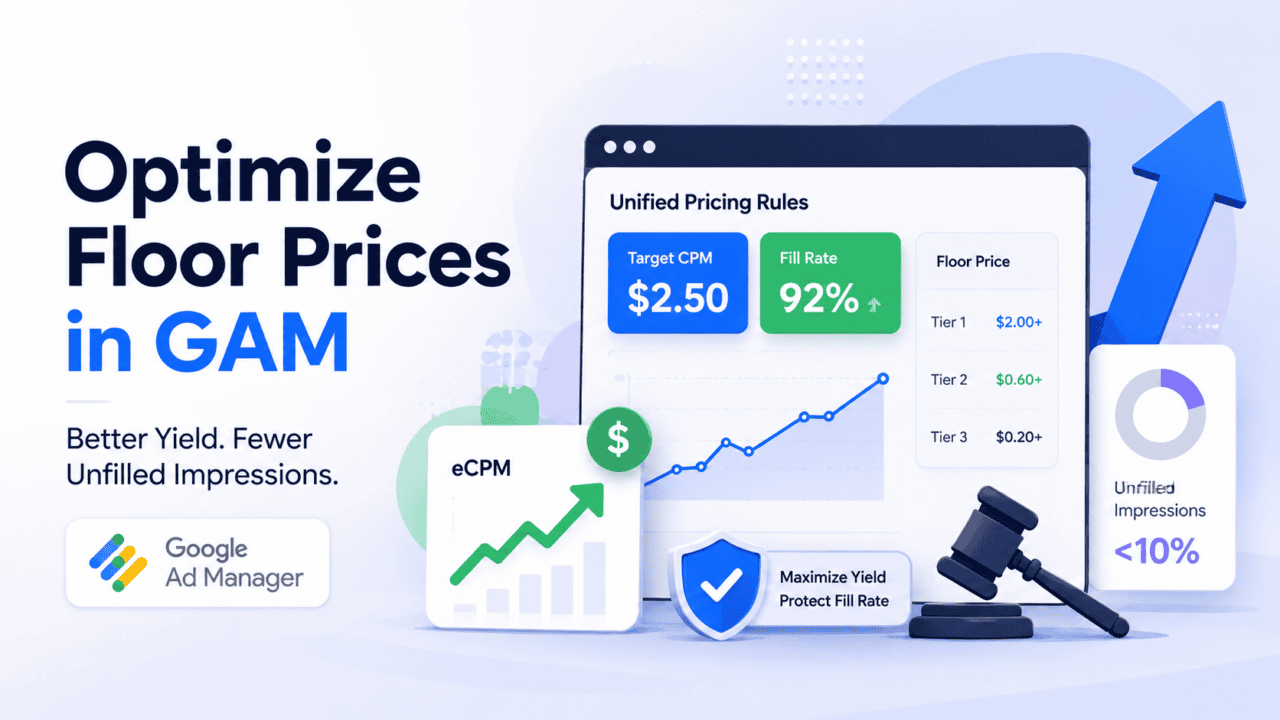
The objective of floor price optimization is to find a level that protects inventory value while allowing sufficient competition to reach each impression.
Read more: Google Ad Manager floor price optimization
3. Technical configuration is preventing ads from serving
Technical issues can reduce fill even when advertiser demand is available:
Ad unit or size mapping is incorrect
Incorrect ad unit definitions, unsupported sizes, broken responsive mappings, or mismatched inventory settings can stop eligible demand from reaching an ad request.
Compare low-fill placements with healthy placements and check whether sizes, targeting parameters, device mappings, and ad unit configurations are consistent with the intended setup. Problems isolated to one placement often point toward configuration rather than site-wide demand.
ads.txt or seller information needs review
Programmatic buyers increasingly rely on supply-chain information to understand whether inventory is being sold through authorized channels.
Missing, outdated, or incorrect ads.txt entries can reduce access to certain demand sources. Publishers should regularly confirm that active monetization partners and authorized seller relationships are represented correctly.
Changes to partners or account configurations should also be reflected in the file when required.
Consent signals are reducing eligible demand
Privacy requirements can affect the information buyers are allowed to use for advertising.
If consent signals are missing, incorrectly passed, or unavailable for certain users, some demand may become ineligible. A sudden fill change following a CMP update, consent configuration change, or regional traffic shift deserves closer investigation.
The correct response is to verify signal transmission and compliance setup rather than attempting to bypass consent requirements.
4. Inventory quality is reducing buyer interest
Buyer competition depends partly on the quality of the advertising opportunity:
Low viewability
An ad request can technically be available while offering limited value to advertisers if the placement is rarely seen.
Placements far below the content, hidden behind interface elements, or quickly moved out of the viewport can receive weaker buyer interest over time. Review viewability alongside fill, CPM, and placement-level performance to identify inventory that buyers value less.
Improving placement quality can strengthen competition without increasing the number of ad units.
Read more: More impressions without more ad slots? Start with viewability
Invalid or low-quality traffic signals
Inventory quality can also be affected by suspicious traffic patterns, invalid traffic, automated activity, or traffic sources that buyers consider risky.
When buyers or demand platforms apply stricter quality filters, fewer campaigns may become eligible for those impressions. Publishers should monitor unusual traffic spikes, source changes, invalid traffic indicators, and demand-side restrictions when investigating a sudden decline in fill.
Traffic quality should be reviewed together with monetization performance rather than treated as a separate reporting issue.
5. Traffic mix has changed
A fill-rate decline can happen even when the advertising setup remains unchanged.
Suppose a site normally receives most of its traffic from GEOs with strong advertiser competition. A sudden traffic spike from lower-demand markets can increase total ad requests much faster than available demand.
The site now records more unfilled impressions and a lower overall fill rate, even though performance within existing high-value segments remains stable.
Check recent changes in:
- GEO distribution: A larger share of traffic from lower-demand countries can reduce the site-wide fill rate.
- Device mix: A shift from desktop toward mobile or another environment can change the pool of eligible demand.
- Traffic sources: New referral, search, social, or direct traffic can bring different user and inventory characteristics.
- Page distribution: Traffic moving toward pages with different ad layouts can change how many requests are generated and filled.
Comparing current traffic composition with an earlier stable period often reveals whether the fill problem began with the ad stack or with the inventory entering it.
6. Latency is affecting auction participation
Demand needs enough time and technical stability to respond to an ad opportunity:
Auction timeouts are too short
In header bidding environments, buyers usually have a limited period to return their bids.
A timeout that is too aggressive can exclude bidders before their responses arrive. This can reduce competition and sometimes contribute to unfilled inventory, particularly for users with slower network connections or demand partners with longer response times.
Review bidder response rates and timeout patterns before making changes.
Page or ad scripts are failing
JavaScript errors, slow page resources, blocked scripts, tag conflicts, or failed network calls can interrupt the ad-serving process.
If fill drops suddenly after a website release, tag update, CMP change, or monetization configuration update, technical troubleshooting should become a priority. Browser developer tools and ad delivery diagnostics can help identify requests that fail before reaching the expected auction.
Technical stability supports both monetization performance and user experience.
7. What should publishers check first?
A low ad fill rate is easier to troubleshoot when publishers follow a consistent order instead of changing multiple variables at once:
- Find where fill is falling: Break the report down by GEO, device, ad unit, format, browser, and traffic source. Identify whether the decline is site-wide or limited to specific segments.
- Compare demand activity: Check whether fewer bidders, campaigns, or monetization partners are competing for the affected inventory.
- Review floor prices: Look for pricing rules that may be excluding too many bids in lower-demand segments.
- Check recent technical changes: Review ad tags, size mappings, CMP settings, ads.txt, bidder configuration, and website deployments.
- Review inventory quality: Compare viewability, invalid traffic indicators, placement performance, and traffic source quality.
- Compare traffic mix over time: Determine whether the site is now generating more requests from GEOs, devices, or pages with naturally lower demand.
This sequence helps isolate the cause before optimization begins. Changing floors, adding demand, and modifying placements at the same time can make the original problem harder to identify.
8. How to improve a low ad fill rate
Improving fill usually requires matching each inventory segment with appropriate demand, pricing, and technical conditions.
Publishers can strengthen demand coverage across relevant GEOs and formats, review floor prices using actual bid behavior, maintain accurate ads.txt and consent configurations, monitor inventory quality, and investigate technical failures that interrupt auction participation.
For publishers managing several demand sources, PubFuture can support this process through broader programmatic demand access and ongoing monetization optimization. The goal is to improve competition and total yield across the inventory instead of focusing on fill rate as an isolated metric.
Ready to expand your monetization setup? Sign up with PubFuture to get started.
Fill should also be evaluated together with eCPM and total revenue. A very high fill rate achieved by accepting extremely low-value demand can produce weaker revenue than a slightly lower fill rate with stronger pricing and competition.
Read more: Fill rate vs eCPM optimization
Conclusion
A low ad fill rate can come from limited demand, aggressive floor prices, configuration errors, weaker inventory quality, traffic changes, or technical issues. Start by locating exactly where fill has fallen, then review demand and pricing before making wider changes to the monetization stack.
Publishers looking to strengthen demand coverage and optimize existing web inventory can explore monetization opportunities with PubFuture and discuss a setup based on their traffic, GEO mix, formats, and current ad stack.