


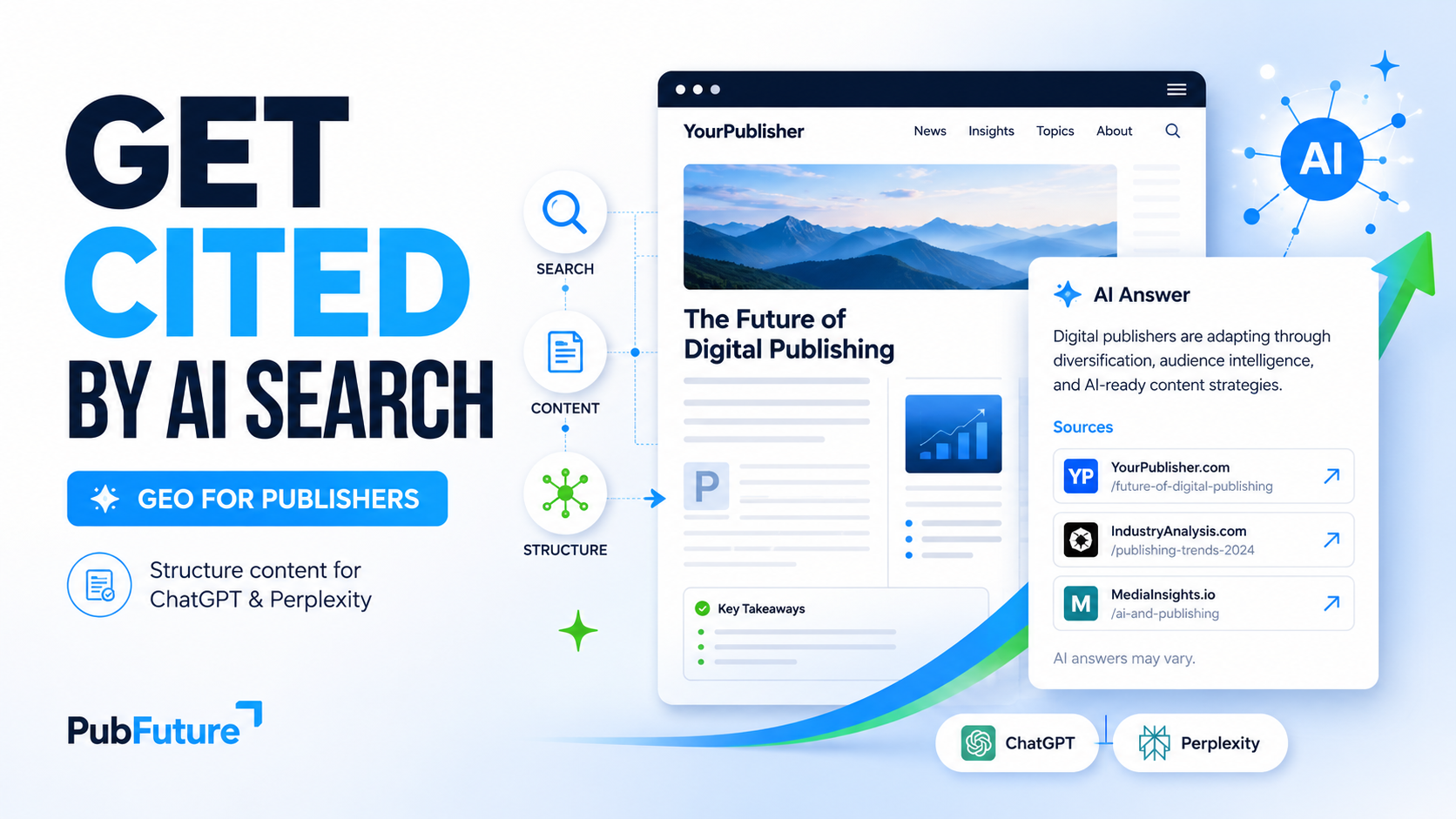
Search visibility is changing. GEO for Publishers is becoming relevant as platforms such as ChatGPT, Perplexity, and Google increasingly answer questions directly while showing selected web sources alongside those answers.
For publishers, this creates another discovery channel beyond traditional rankings. The goal is no longer only to reach page one. Content also needs to be useful enough to become a source that an AI search engine retrieves, understands, and potentially cites.
Generative Engine Optimization does not replace SEO. It extends it. Strong technical SEO, original content, clear structure, reliable sourcing, and useful information remain the foundation. Google explicitly says its existing SEO principles still apply to generative Search experiences.
Table of Contents
From SEO to GEO: Why Discovery Has Changed
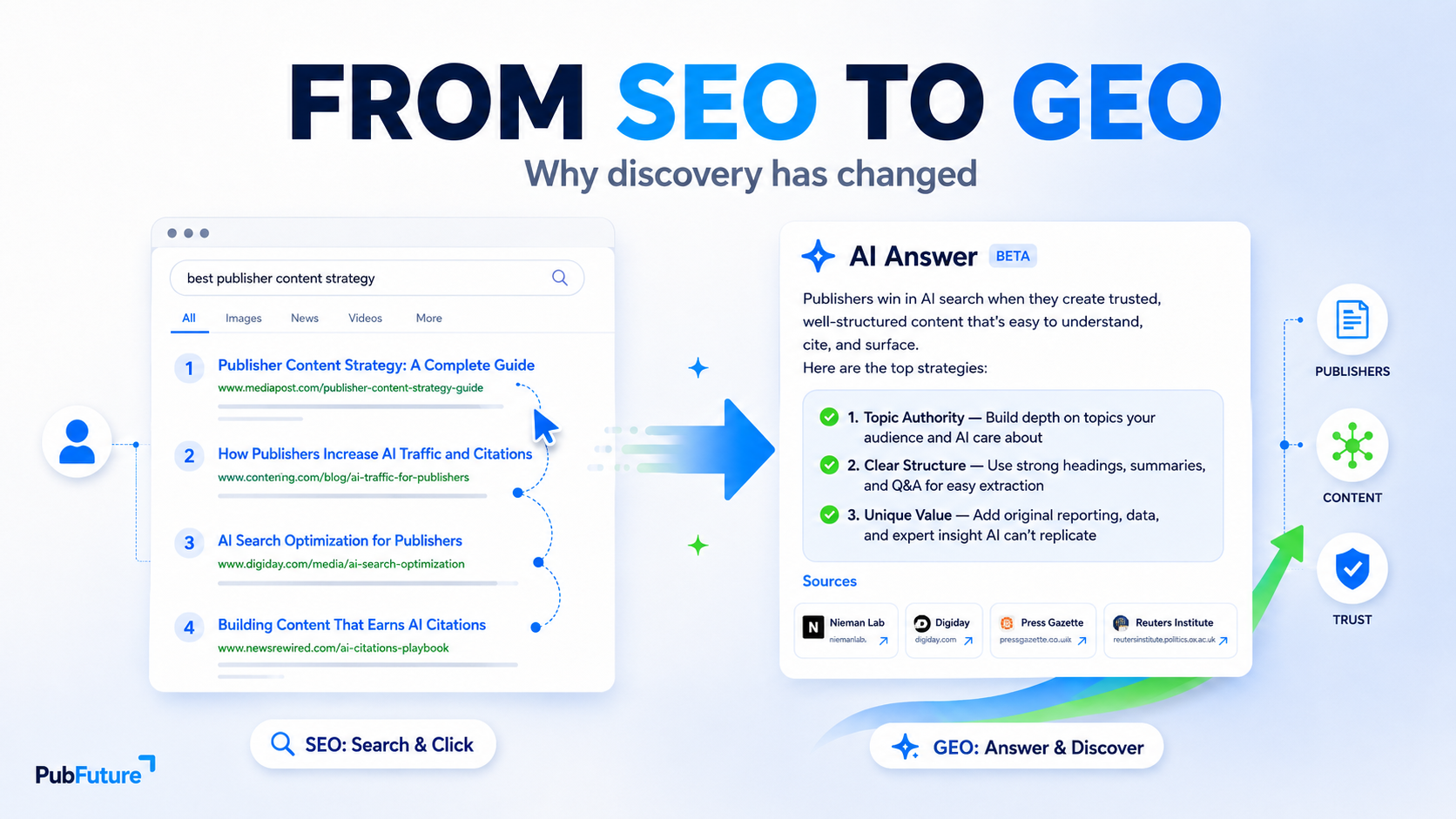
Traditional search usually gives users a list of pages to choose from. AI answer engines can retrieve information from several sources, combine it, and present a direct response before the user visits a website.
Generative Engine Optimization (GEO) focuses on improving a site’s visibility within these generated answers. This includes making content relevant, clear, original, well supported, and easy for retrieval systems to understand.
The original GEO research found that tactics such as adding credible citations, relevant statistics, and stronger source material could improve visibility in controlled generative-engine experiments. However, performance varied significantly between queries and domains, so these techniques should not be treated as guaranteed ranking factors.
For publishers, the opportunity is simple: rank in search when possible, but also build content strong enough to become a referenced source inside AI-generated answers.
How AI Answer Engines Choose Sources
There is no published formula that guarantees a citation. However, three content characteristics consistently make a page more useful for retrieval and answer generation:
Direct answer density: Important questions should have clear answers without forcing readers or retrieval systems to interpret several paragraphs first.
Original information: First-party research, proprietary data, expert observations, case studies, and unique examples give a page something competing articles may not have.
Clear semantic structure: Descriptive headings, focused paragraphs, lists, and comparison tables help organize information into understandable sections.
This does not mean publishers need to break every article into artificial “LLM chunks.” Google specifically advises against unnecessary content chunking or special AI markup created solely for generative search.
The better principle is simpler: each section should answer one clear question and provide enough context to stand on its own.
5 Content Structuring Rules to Improve AI Citations
Publishers can apply GEO without completely changing their existing editorial workflow:
1. Put the Direct Answer First
Do not spend three paragraphs introducing a question before answering it.
Place a concise answer directly below the relevant H2 or H3, then add examples, evidence, or deeper explanation.
For example:
What is header bidding?
Header bidding is a programmatic advertising method that allows multiple demand partners to bid for publisher inventory before the ad server makes its final selection.
That definition can then be followed by implementation details.
A practical editorial target is around 40 to 60 words for the initial answer when the topic allows it. This is not an AI platform requirement. It is simply a useful way to keep important information focused and easy to retrieve.
2. Use Tables and Lists for Structured Information
Do not turn every comparison into several paragraphs.
Use tables when readers need to compare:
- Products or platforms
- Ad formats
- Features
- Technical requirements
- Pricing or payment models
Use numbered lists for processes and bullets for clearly separated recommendations.
Structured formatting does not automatically increase citations. Google does not require special tables, Markdown, or AI-specific markup for its generative Search features. The benefit is clarity, especially when the information contains multiple attributes or relationships.
3. Replace Vague Claims With Specific Evidence
Avoid statements such as:
Video ads usually generate much higher revenue.
A stronger version would identify the dataset, period, sample, geography, or original source behind the claim.
Useful evidence can include:
- Original publisher benchmarks
- Survey results
- Case studies
- First-party experiments
- Exact dates and figures
- Quotes from authoritative sources
This is especially valuable for niche publishers. Original information gives AI systems and human readers a reason to reference your page instead of another article repeating the same general explanation.
Foundational GEO research also found that citations and quantitative information improved source visibility in its experimental environment.
4. Make Authorship and Sources Clear
Readers should quickly understand who produced the content and where important claims originated.
Publisher articles should clearly display:
- Author name
- Publication or update date
- Publisher or organization
- Sources for important statistics
- Relevant author expertise where appropriate
Publishers can also implement standard Article, Author, and Organization structured data where relevant.
Schema should still be treated as conventional technical SEO, not a GEO shortcut. Google currently says no special structured data is required to appear in AI Overviews or AI Mode.
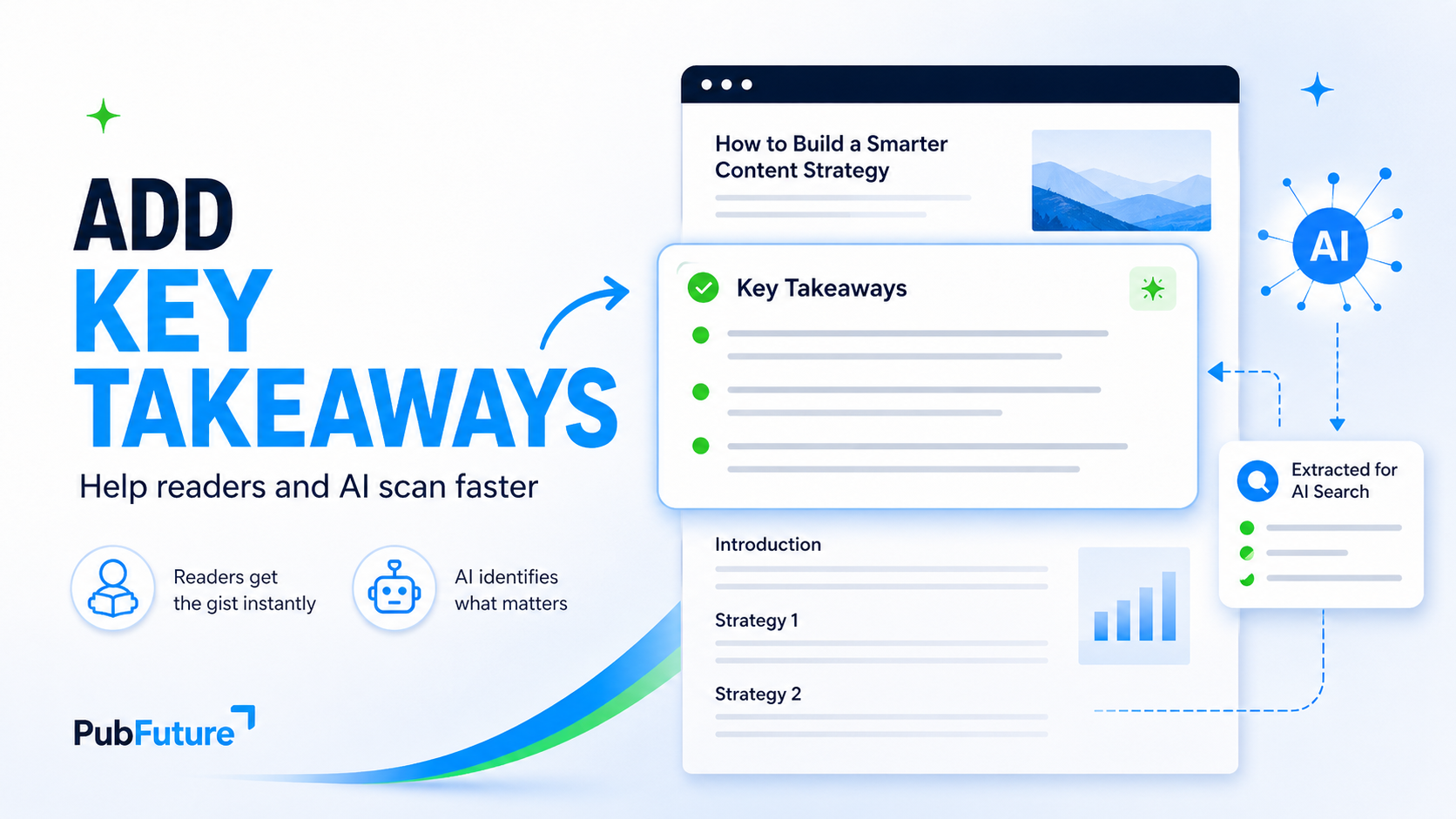
5. Add Key Takeaways to Long Articles
Long articles can benefit from a short Key Takeaways block near the beginning.
Keep it to three or four useful conclusions rather than rewriting the introduction as bullets.
For example:
- Rewarded ads work best around natural game milestones.
- Frequency should be controlled to prevent user fatigue.
- Revenue should be measured alongside retention.
- Placement tests should separate new and returning users.
This gives readers an immediate overview while making the article’s core conclusions easier to identify.
The objective is information density, not keyword density.
Traditional SEO vs. Generative Engine Optimization
SEO and GEO overlap heavily, but publishers may measure success differently.
| Dimension | Traditional SEO | GEO |
|---|---|---|
| Primary visibility | Search rankings | Sources inside AI answers |
| Main focus | Relevance, quality, authority, technical SEO | Relevance, evidence, originality, answer clarity |
| Content structure | Search-intent focused pages | Clear, self-contained sections |
| Typical outcome | Organic click | Citation, mention, or referral |
| Measurement | Rankings, impressions, clicks | Citations, AI referrals, visibility share |
| Crawler access | Search engine bots | Search bots plus AI search crawlers |
Google itself treats optimization for AI Overviews and AI Mode as part of SEO rather than a completely separate discipline. Existing crawling, indexing, quality, and Search fundamentals continue to apply.
For publishers, GEO is best treated as an additional layer of content optimization rather than a replacement for existing SEO work.
Technical Checklist for AI Search Crawlers
Good content still needs to be accessible before an AI search platform can surface it:
Check robots.txt: Decide which legitimate AI search crawlers should access your editorial content.
OpenAI uses OAI-SearchBot for surfacing websites in ChatGPT search. It is separate from GPTBot, which OpenAI identifies for potential model training. Publishers can therefore manage the two independently.
A simple configuration could look like:
User-agent: OAI-SearchBot
Allow: /

User-agent: PerplexityBot
Allow: /
Perplexity also provides specific robots.txt controls for its crawlers.
Keep editorial content crawlable: Important text should not depend unnecessarily on complex interactions or client-side elements before it becomes available.
Maintain semantic HTML: Use descriptive H1, H2, and H3 headings, readable paragraphs, lists, and standard page elements instead of relying entirely on generic containers.
Do not chase unnecessary GEO files: Google says llms.txt and special AI markup are not required for visibility in its generative Search features.
How to Measure AI Referral Traffic and Citations
GEO measurement should look beyond normal keyword rankings:
Track AI referrals in GA4. Create reports for identifiable AI referral sources and compare sessions, engagement, conversions, and monetization performance. ChatGPT automatically adds utm_source=chatgpt.com to referral URLs from ChatGPT Search.
Monitor Google AI visibility. Google Search Console now includes a Generative AI performance report for measuring visibility from Google’s generative Search experiences.
Test important prompts. Build a fixed list of commercial and informational questions in your niche. Check whether your domain appears in ChatGPT, Perplexity, and other relevant AI search platforms.
Track citation share of voice. A simple internal metric is:
Queries where your domain is cited ÷ Total monitored queries × 100
Run the same query set regularly rather than treating one AI response as definitive. Generated answers and source selections can vary between platforms and individual runs.
For monetized publishers, also connect AI referrals with page RPM, session depth, and ad impressions. PubFuture can help evaluate whether changes in acquisition channels are translating into stronger monetization performance.
As AI search brings new discovery opportunities, publishers can also sign up with PubFuture to turn that traffic into sustainable ad revenue.
GEO for Publishers: What to Do Next
GEO for Publishers is not about rewriting websites for robots. Strong SEO fundamentals still apply, but publishers now have another reason to create clear, original, evidence-rich content that can support specific questions inside AI search experiences.
Start with three priorities: improve direct answers on high-value pages, add original evidence where possible, and check whether legitimate AI search crawlers can access your content. If AI-driven traffic is becoming part of your acquisition mix, contact the PubFuture team through our website form to explore opportunities to improve the revenue generated from that traffic.