


Table of Contents
Programmatic advertising is entering a more mature phase in 2026. Automation is already standard, and programmatic buying now accounts for most digital display spending. The next stage of growth will depend less on scale and more on data quality, transparency, measurement, and inventory performance.
For publishers, this shift changes how advertising value is created. Traffic alone is no longer enough. Advertisers increasingly prioritize reliable audience signals, efficient supply paths, measurable outcomes, and high-quality environments.
The following six programmatic advertising trends will shape how publishers build sustainable advertising revenue in 2026.
Why Programmatic Advertising Trends Matter in 2026
Programmatic advertising has evolved from an automated buying method into the backbone of digital media. Today, advertisers can buy display, video, native, mobile, audio, and Connected TV inventory through programmatic platforms, making efficiency and scalability the new industry standard.
Recent industry data shows just how dominant programmatic advertising has become. According to SearchLab’s Programmatic Advertising Statistics 2026, programmatic buying now accounts for 91.5% of all digital display advertising, while the global programmatic market is expected to reach $725 billion in 2026. At the same time, rapid growth in AI, Connected TV (CTV), retail media, and privacy-first targeting is reshaping how advertisers evaluate inventory and allocate budgets. Rather than simply buying more impressions, advertisers are increasingly investing in higher-quality inventory, trusted audience data, and transparent buying paths.
However, greater automation has also created more complexity. Publishers and advertisers must deal with fragmented identity signals, opaque supply chains, privacy restrictions, cross-channel measurement, and increasing pressure to prove real business value.
The most important programmatic advertising trends in 2026 reflect a clear change in priorities. The market is moving from buying more impressions to creating more value from each impression.
Programmatic Advertising Trend #1 First-Party Data Becomes the Foundation of Targeting
First-party data is becoming one of the most valuable assets in programmatic advertising.
As third-party cookies and external tracking signals become less reliable, advertisers need new ways to understand and reach relevant audiences. Publishers are well positioned to provide these signals because they have direct relationships with their users.
First-party data can include:
- Content interests
- Browsing behavior
- Registration information
- Newsletter activity
- Subscription status
- Purchase history
- Session frequency
- Engagement patterns
Unlike third-party data, these signals come directly from interactions on a publisher’s own properties. They are often more current, more relevant, and easier to manage within a privacy-compliant framework.
For advertisers, stronger audience signals reduce uncertainty. A buyer is more likely to bid competitively when an impression is connected to a clear audience segment, content interest, or behavioral pattern.
This can support higher CPMs, stronger bid competition, and more valuable private marketplace opportunities.
The challenge is no longer simply collecting data. Publishers need to consolidate it across systems and turn it into usable audience segments. Data stored separately in analytics platforms, newsletter tools, CRM systems, and subscription databases has limited value if it cannot be activated in programmatic campaigns.
A strong first-party data strategy should therefore focus on three areas:
- Collecting data through clear value exchanges
- Connecting user signals across owned channels
- Activating audience segments through advertising platforms
Publishers do not need millions of logged-in users to benefit. Even basic segmentation based on content categories, returning visitors, or engagement levels can improve the way inventory is packaged and sold.
In 2026, first-party data will not replace every external signal. Instead, it will become the foundation that supports contextual targeting, identity solutions, audience modeling, and privacy-safe activation.
Programmatic Advertising Trend #2 AI Moves From Automation to Decision Intelligence
Artificial intelligence is already used throughout programmatic advertising, but its role is becoming more practical in 2026.
The main value of AI is no longer simply automating repetitive tasks. It is helping platforms make faster and more accurate decisions across millions of impressions.
AI is increasingly applied to:
- Bid optimization
- Dynamic floor pricing
- Demand forecasting
- Audience modeling
- Fraud detection
- Creative selection
- Inventory allocation
- Performance prediction
For publishers, AI can help identify which demand source, format, or placement is most likely to generate the best result for a particular impression.
Dynamic pricing is one example. Instead of applying one fixed floor price across all traffic, AI systems can adjust pricing based on geography, device, audience quality, time of day, historical demand, and advertiser behavior.
AI can also improve forecasting. Publishers can use historical data to anticipate seasonal demand, traffic spikes, or changes in fill rate. This makes it easier to adjust inventory strategies before revenue is affected.
However, AI is only as effective as the data it receives. Poor audience signals, incorrect ad-server priorities, duplicated auctions, and low-quality traffic can limit performance regardless of how advanced the technology is.
This is why AI and first-party data are closely connected. Better data improves prediction, while better prediction improves monetization.
By 2026, AI will become an operational layer across the programmatic ecosystem. It will be less of a unique competitive advantage and more of a basic requirement for managing complex advertising environments efficiently.
Programmatic Advertising Trend #3 Supply Path Optimization Becomes a Buying Standard
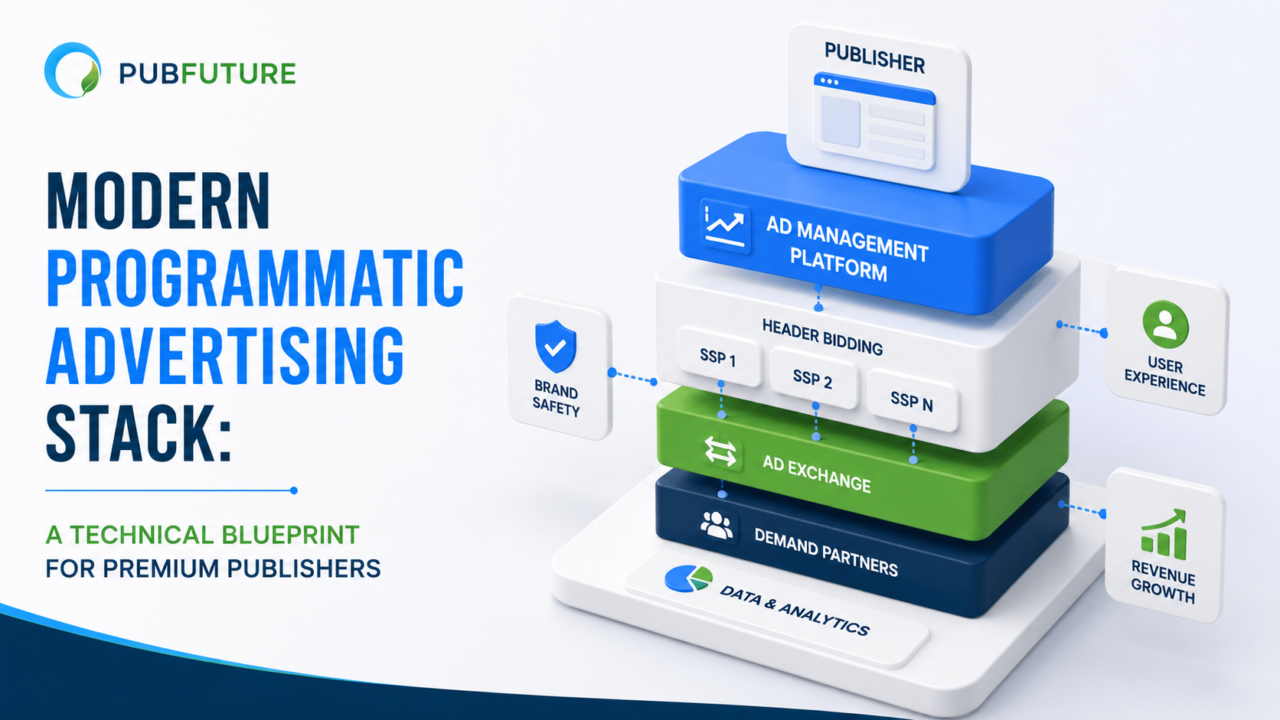
Programmatic supply chains often involve multiple SSPs, exchanges, resellers, and intermediaries between the publisher and the advertiser.
Each additional step can increase fees, duplicate inventory, reduce transparency, and create uncertainty about where advertising budgets are going.
Supply Path Optimization, commonly known as SPO, helps advertisers identify the most efficient and transparent routes to publisher inventory.
Instead of bidding through every available supply source, buyers increasingly prioritize paths that offer:
- Direct publisher relationships
- Fewer intermediaries
- Transparent fees
- Reliable inventory
- Strong brand safety
- Clear authorization
- Consistent performance
This has an important impact on publishers.
Connecting to more partners does not always create more competition. If several SSPs offer the same impression through duplicated paths, buyers may see the inventory as inefficient or difficult to evaluate.
In 2026, publishers will need to review their ad stacks more carefully. The goal is not to remove competition, but to eliminate unnecessary complexity.
A cleaner supply strategy can include:
- Reducing low-value or redundant partners
- Prioritizing direct integrations
- Reviewing reseller relationships
- Maintaining accurate ads.txt and sellers.json records
- Monitoring fees and auction duplication
- Creating clearer inventory packages
Supply transparency is also becoming a commercial advantage. Premium advertisers want confidence that they are buying legitimate inventory through approved channels.
Publishers that can provide clear information about inventory, placement, audience, and supply paths will be more attractive to buyers. They may also be better positioned to secure private marketplace and preferred deals.
The broader trend is consolidation. Both advertisers and publishers are becoming more selective about their technology partners. In 2026, a smaller and more efficient ecosystem may deliver more value than a large but poorly controlled one.
Programmatic Advertising Trend #4 Video and CTV Capture More Programmatic Budgets
Digital video and Connected TV will remain major growth areas in programmatic advertising.
Advertisers continue to move budgets toward formats that combine strong visibility, storytelling, and audience engagement. CTV also gives buyers access to television-style environments with programmatic targeting and measurement capabilities.
For publishers, the opportunity extends beyond traditional in-stream video.
Relevant formats include:
- In-stream video
- Outstream video
- In-content video
- Vertical video
- Rewarded video
- CTV inventory
- Programmatic video sponsorships
Video inventory often attracts stronger demand than standard display because it offers more creative space and higher attention potential. However, adding video placements does not automatically generate premium revenue.
Advertisers still evaluate:
- Viewability
- Completion rate
- Player quality
- Placement type
- Content relevance
- Page performance
- Brand safety
- User experience
Publishers should avoid inserting heavy video players that slow pages or interrupt content. Poor implementations may increase short-term impressions while reducing engagement and long-term traffic value.
The strongest opportunities will come from video that fits naturally within the user journey. For example, publishers can use outstream video inside relevant articles, short-form video around high-interest content, or CTV extensions for audiences that already engage with their brands.
Measurement remains a challenge, particularly across devices and platforms. Advertisers want to understand whether video exposure contributes to attention, engagement, or conversion rather than simply generating a completed view.
In 2026, CTV and video will continue to grow, but quality and measurement will determine which publishers capture premium budgets.
Programmatic Advertising Trend #5 Measurement Moves Beyond Impressions and Clicks
Traditional programmatic reporting has focused heavily on impressions, clicks, CTR, and conversions.
These metrics remain useful, but they do not provide a complete view of performance.
A user may see an ad on CTV, revisit the publisher through mobile web, read several articles, and convert later on a different device. A simple last-click model may fail to connect these interactions.
As media becomes more fragmented, advertisers need measurement that reflects the full customer journey.
Programmatic advertising trends in 2026 will place greater emphasis on:
- Attention
- Viewability
- Session quality
- Interaction depth
- Frequency
- Returning visitors
- Incrementality
- Revenue per session
- Revenue per user
- Cross-device outcomes
For publishers, this means inventory value will depend partly on the quality of engagement around the ad impression.
Two placements may deliver the same number of impressions but very different results. One may appear below the fold on a short session, while the other appears within high-quality content viewed by a returning reader.
Advertisers increasingly want to distinguish between these environments.
Identity resolution will also support better measurement. Connecting hashed emails, mobile identifiers, and household signals can improve reach analysis, frequency management, and cross-device attribution. Without these connections, the same user may be counted several times across separate platforms.
Publishers should therefore avoid evaluating success through CPM or fill rate alone. Strong measurement combines revenue data with engagement, viewability, latency, user behavior, and advertiser outcomes.
The objective is not to collect more metrics. It is to identify the metrics that explain why inventory performs.
Programmatic Advertising Trend #6 Inventory Quality Becomes the Main Competitive Advantage
In the early stages of programmatic advertising, scale was often the main priority. More traffic created more impressions, and more impressions created more revenue opportunities.
In 2026, this relationship is less direct.
Advertisers have access to enormous amounts of inventory. The real challenge is finding placements that deliver attention, relevance, safety, and measurable performance.
This makes inventory quality a central programmatic advertising trend.
High-quality inventory is influenced by several factors:
- Original and relevant content
- Strong audience engagement
- Clear placement structure
- High viewability
- Fast page load times
- Low invalid traffic
- Reasonable ad density
- Brand-safe environments
- Accurate inventory signals
- Transparent supply paths
User experience is part of inventory quality.
A page overloaded with banners, sticky units, pop-ups, and autoplay video may generate more ad requests, but it can also increase bounce rate and reduce session duration. Over time, this can weaken both audience trust and advertiser demand.
Core Web Vitals and site performance also matter. Slow ad delivery can reduce viewability and cause users to leave before impressions are fully rendered.
Publishers should therefore evaluate revenue per session rather than simply maximizing the number of ad slots. A cleaner page with better placements may produce stronger long-term results than a crowded page with more impressions.
Context is another important factor. Advertisers are increasingly using contextual signals to understand the content surrounding an impression. Well-structured pages, clear topics, and reliable content categories can improve relevance without depending on third-party identifiers.
Premium inventory also creates opportunities beyond open auctions. Publishers with strong content, reliable audiences, and transparent measurement can package inventory through PMPs, preferred deals, and programmatic guaranteed campaigns.
In 2026, traffic volume will remain important, but it will not be enough to separate one publisher from another. Inventory quality will become the factor that determines who attracts premium demand and who competes primarily on price.
How Publishers Can Prepare for These Programmatic Advertising Trends
Publishers should begin by reviewing how data, technology, inventory, and demand work together.
First-party data must be organized and activated rather than left across disconnected systems. Ad stacks should be simplified to remove redundant partners and unclear supply paths. AI should be used to support pricing, forecasting, and optimization, but not as a replacement for strong operational foundations.
Publishers should also invest in video carefully, improve measurement beyond basic delivery metrics, and protect user experience as part of their monetization strategy.
The objective is not to adopt every new technology. It is to build a stable system that can adapt as advertiser expectations change.
For publishers looking to accelerate this process, PubFuture can support diversified demand, transparent programmatic operations, and continuous yield optimization designed to improve long-term advertising revenue.
Conclusion
Programmatic advertising in 2026 will be shaped by better data, smarter AI, cleaner supply paths, stronger video demand, advanced measurement, and higher inventory standards.
Publishers that respond to these programmatic advertising trends with clear strategies and disciplined execution will be better positioned to attract premium buyers, improve revenue per impression, and build more sustainable monetization models.