



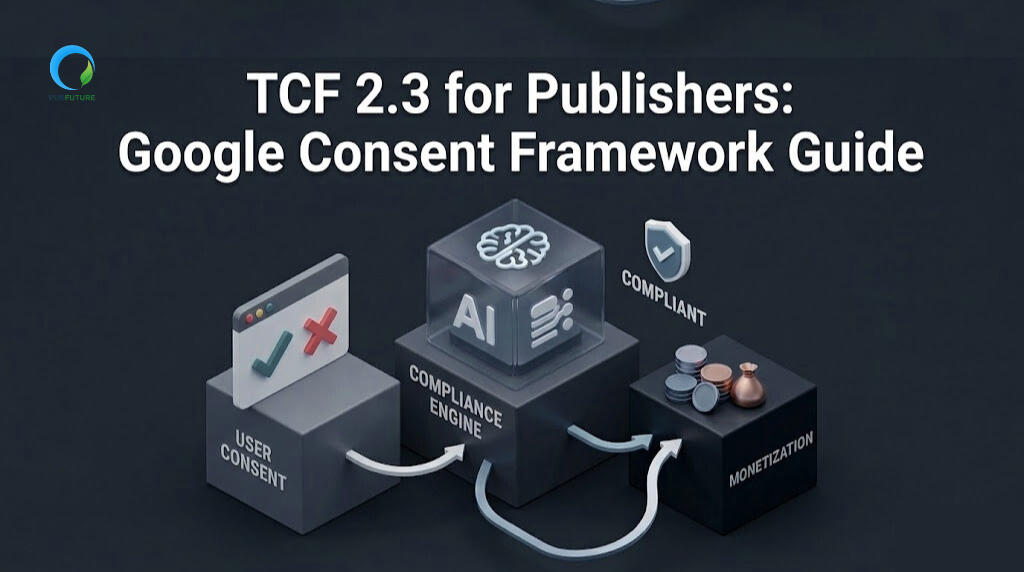
TCF 2.3 for publishers has become an important topic in the programmatic advertising ecosystem. As advertisers demand higher standards for data transparency and user consent, frameworks like the Transparency and Consent Framework (TCF) are increasingly adopted across the industry.
But one question continues to confuse many website owners:
Is the TCF actually required for your website?
The short answer is: not always.
Whether your website needs TCF largely depends on how you monetize traffic and how advertising is implemented on your site.
In this guide, we’ll break down:
- When publishers must implement TCF 2.3
- When a standard consent solution is enough
- How CMPs impact programmatic ad revenue
- What changes come with the new TCF v2.3 update
Understanding these factors can help publishers stay compliant while maintaining access to premium advertising demand.rs stay compliant while maintaining access to premium advertising demand.
1. Why TCF Matters in Programmatic Advertising for Publishers
The Transparency and Consent Framework (TCF) was created by the digital advertising industry to standardize how user consent signals are shared between websites, ad platforms, and demand partners.
In the programmatic ecosystem, many different companies participate in a single ad auction:
- DSPs
- SSPs
- Data providers
- Measurement partners
- Brand safety vendors
Without a standardized consent signal, these partners cannot reliably determine whether they are allowed to process user data.
The TCF solves this problem by allowing Consent Management Platforms (CMPs) to collect user consent and transmit that information across the ad tech ecosystem in a standardized format.
For publishers, this means advertisers can safely bid on inventory while respecting privacy regulations like GDPR.
2. Advertisers vs Publishers: Who Actually Needs TCF 2.3?
One of the biggest misconceptions about the Transparency and Consent Framework (TCF) is that every website collecting cookies must implement it.
In reality, the framework mainly applies to publishers participating in the programmatic advertising ecosystem.
The table below highlights the key differences between advertisers and publishers, and when TCF is required.
| Category | Advertisers | Publishers |
|---|---|---|
| Primary Role | Promote products or services through paid advertising | Monetize website traffic by displaying ads |
| Advertising Model | Buy advertising traffic | Sell advertising inventory |
| Where Ads Appear | Ads appear on other websites | Ads appear directly on their own website |
| Common Platforms | Google Ads, Meta Ads, TikTok Ads | Google AdSense, Google Ad Manager, AdMob, SSPs |
| Example Businesses | Ecommerce stores, SaaS platforms, corporate websites | News sites, blogs, download sites, content platforms |
| Third-Party Ads on Site | No | Yes |
| Programmatic Advertising Participation | Usually no | Yes |
| TCF / CMP Requirement | Typically not required | Required when running ads through Google advertising technologies |
| Impact on Revenue | Mainly affects marketing performance | Directly impacts ad revenue and advertiser demand |
In short:
- Advertisers buy traffic
- Publishers monetize traffic
When a website displays third-party ads through Google advertising technologies, implementing a TCF-compatible CMP becomes essential.
Without a valid consent signal, many advertising partners may limit or stop bidding on the inventory, which can directly reduce publisher revenue.
For publishers working with monetization partners like PubFuture, a properly configured CMP ensures access to a larger pool of programmatic demand, helping maximize ad performance and compliance.
3. When Do Publishers Need TCF 2.3 and a CMP?
The need for a TCF cookie banner depends primarily on your advertising setup.
Publishers typically need the TCF if their website:
- Displays third-party ads
- Uses Google Ad Manager or AdSense
- Participates in the programmatic advertising ecosystem
- Shares data with multiple ad tech vendors
In these cases, your CMP must also be part of the Google CMP Partner Program to ensure compatibility with Google demand.
However, if your website does not display ads from advertisers, a standard consent solution may be sufficient.
For example, websites that only use cookies for:
- Analytics
- marketing attribution
- customer tracking
Do not necessarily need the full TCF framework.
4. TCF vs Standard CMP: What Publishers Should Know
Another important consideration is the level of customization available in your consent banner.
Standard CMP implementations often allow greater flexibility, including:
- Custom welcome messages
- Custom descriptions for consent purposes
- More flexible UI design
- Rich media elements such as videos
| Feature | Standard CMP | TCF-Compatible CMP |
|---|---|---|
| Primary Purpose | Manage cookies and user consent for analytics or marketing | Standardize consent signals for programmatic advertising |
| Typical Users | Ecommerce sites, SaaS platforms, corporate websites | Publishers running programmatic ads |
| Third-Party Advertising Support | Limited | Full support |
| Integration with Ad Tech Vendors | Not required | Required |
| Google Advertising Compatibility | Not required | Required for Google Ad Manager / AdSense |
| Vendor Consent Signals | Basic consent tracking | Standardized TC_String for ad tech partners |
| Customization Flexibility | High (design, messaging, UX) | Limited due to compliance rules |
| Impact on Programmatic Demand | Minimal | Critical for accessing advertiser demand |
| Best For | Websites that do not display ads | Publishers monetizing traffic with ads |
By contrast, the TCF framework requires standardized wording and structure to ensure consistency across the advertising ecosystem.
This means publishers implementing TCF may experience less design flexibility, but gain greater compatibility with ad tech partners.
For websites monetizing traffic through programmatic ads, this trade-off is usually necessary to maintain advertiser demand and compliance.
5. What’s Changing in TCF 2.3 for Publishers?
The latest update to the framework, TCF version 2.3, introduces a clarification related to legitimate interest and special purposes.
Starting February 28, 2026, organizations currently using TCF v2.2 must migrate to TCF v2.3.
The update primarily affects how vendors interpret consent signals when relying on legitimate interest as a legal basis for data processing.
Several TCF purposes may rely on legitimate interest, including:
- Selecting limited data for advertising
- Measuring ad performance
- Measuring content performance
- Understanding audience insights
- Improving services
- Selecting limited data for content delivery
Users can choose to object to these purposes through the consent banner.
However, the framework also defines special purposes, which include:
- Ensuring security and fraud prevention
- Delivering and presenting advertising or content
- Saving and communicating privacy preferences
For these purposes, users cannot opt out through CMP interfaces.
6. Key Update in TCF 2.3: Vendor Disclosure Explained
The most important technical change in TCF 2.3 is the introduction of a mandatory element called the Disclosed Vendor Section.
This section is now required in the TC_String, which is the signal transmitted by CMPs to advertising partners.
It indicates whether a vendor is explicitly disclosed in the CMP’s vendor list shown to users.
Previously, this information was optional, which created uncertainty for vendors relying on legitimate interest.
With TCF v2.3, vendors can clearly determine whether they are permitted to rely on special purposes, reducing ambiguity in the consent signal.
For publishers, the change mainly requires ensuring their CMP provider supports TCF v2.3.
Most modern CMP solutions already provide this support.
7. How Privacy Compliance Affects Programmatic Ad Revenue
For publishers monetizing traffic with programmatic advertising, privacy compliance is no longer optional.
A properly configured CMP and TCF setup helps ensure:
- Access to Google demand
- Participation in programmatic auctions
- Compatibility with SSP and DSP partners
- Compliance with GDPR privacy regulations
Without valid consent signals, advertisers may reduce bidding on your inventory, which can negatively impact eCPM and overall ad revenue.
Final Thoughts: Do Publishers Really Need TCF 2.3?
The Transparency and Consent Framework (TCF) isn’t required for every website, but it plays a critical role in the programmatic advertising ecosystem, especially for publishers monetizing traffic with third-party ads.
Key takeaways:
- TCF is required for publishers displaying ads through Google advertising platforms such as Google Ad Manager or AdSense.
- Websites that only run marketing or acquisition campaigns typically do not need TCF.
- TCF v2.3 becomes mandatory on February 28, 2026.
- Publishers should ensure their CMP supports the updated consent string structure to remain compliant and maintain advertiser demand.
For publishers focused on maximizing ad revenue while staying privacy-compliant, implementing the right consent framework is an essential part of a sustainable monetization strategy.
👉 Looking to increase your ad revenue while staying compliant with privacy regulations?
Partner with PubFuture, a full-stack monetization platform designed to help publishers optimize programmatic demand, improve fill rates, and unlock higher eCPMs.
Get started here: https://pubfuture.com
With the right setup—TCF-compliant consent, strong demand partners, and optimized ad placements—publishers can maintain compliance while unlocking the full value of their website traffic. 🚀