


Ad blockers create a difficult revenue gap for publishers. Every blocked impression removes an opportunity to monetize traffic, but aggressive attempts to force ads back onto the page can push the same readers away. Effective ad blocker monetization strategies therefore need to protect both revenue and audience retention.
The opportunity is larger than simply convincing users to disable an extension. Publishers can combine lighter advertising, voluntary value exchanges, direct sponsorships, affiliate monetization, and carefully designed recovery messaging based on how different readers prefer to support a site.
The strongest strategy treats adblock users as a separate audience segment rather than lost inventory. Publishers should measure the size of that segment, test several recovery paths, and optimize for revenue per visitor without rebuilding the intrusive experience that encouraged users to block ads in the first place.
Table of Contents
The ad blocker monetization reality: How much revenue is slipping through the cracks?
Ad blocking remains a significant issue, although the impact varies widely by geography, device, audience, and website vertical.
GWI reports that nearly one in three global consumers use ad-blocking tools either regularly or occasionally. An earlier large-scale Blockthrough analysis measured an average adblock rate of 21% across more than 10 billion pageviews from 9,453 websites.
For a publisher, however, a 20% adblock rate does not automatically mean exactly 20% less revenue. Adblock users may have different session depths, GEO mixes, device usage, and page consumption patterns. The real loss depends on how many monetizable impressions those users would have generated.
The bigger mistake is treating every blocked user as someone who must be forced back into the standard ad experience.
Hard adblock walls can create significant friction. In a Blockthrough survey of 5,423 US internet users, 68% said they would leave a website when presented with an adblock wall. For publishers with easily replaceable content, that trade-off can be particularly damaging.
A better model focuses on value exchange and alternate monetization. Instead of asking, “How do we defeat the blocker?”, publishers should ask, “What monetization experience will this audience accept?”
Read more: Ad density optimization: How to maximize mobile yield without Google penalties
Anchor: optimizing ad density without hurting user experience
Measure your adblock revenue gap before choosing a strategy
Adblock recovery should start with measurement, not implementation.
The most useful number is not simply the percentage of visitors running an ad blocker. Publishers need to estimate the economic value of those sessions.
Compare blocked and non-blocked audiences across:
- Pageviews per session: A small adblock audience with high engagement may represent more lost inventory than its traffic share suggests.
- GEO and device: Revenue impact changes significantly when blocked traffic comes from higher-value markets or desktop users.
- Page type: Articles, tools, gaming pages, forums, and resource libraries can produce very different numbers of monetization opportunities.
- Returning users: Loyal readers may be more receptive to subscriptions, whitelist requests, or other value exchanges than first-time visitors.
A practical metric is revenue opportunity per adblock visitor, not just adblock detection rate.
Publishers can estimate what similar non-blocked sessions currently earn, then establish a recovery baseline. This makes it possible to compare strategies based on incremental revenue without losing sight of retention, pages per session, and return visits.
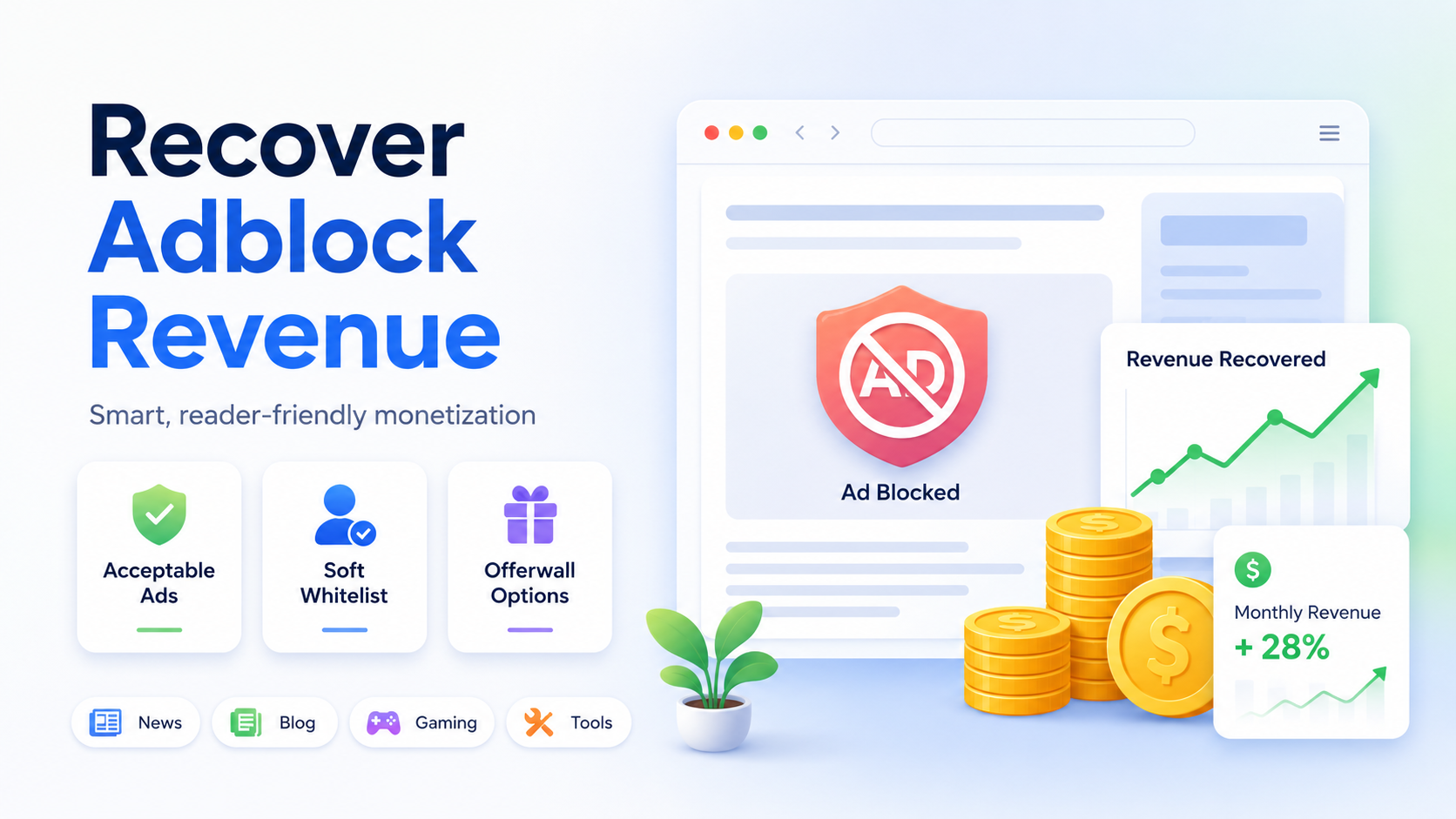
4 non-intrusive ad blocker monetization strategies for publishers
Most publishers can combine four low-friction approaches:
1. Use Acceptable Ads where it fits
Acceptable Ads provides a middle ground between unrestricted advertising and a completely ad-free experience.
Ads that meet its criteria must remain non-intrusive, clearly distinguishable from editorial content, and comply with placement and size restrictions. Users retain control and can disable Acceptable Ads entirely.
For publishers, this creates an opportunity for programmatic adblock recovery without first forcing users through a whitelist prompt.
The potential audience is meaningful. Eyeo reported in 2025 that around 350 million global ad-filtering users were consenting to Acceptable Ads.
Acceptable Ads will not recover every blocked impression, but it can monetize users who have already indicated that they accept a lighter advertising experience.
2. Test soft whitelist messaging with a fair value exchange
Soft adblock walls for publishers work differently from hard blocks. Content remains accessible, while a dismissible banner or message explains why advertising supports the website.
Keep the request short and specific. Instead of blaming the visitor, explain the exchange: free content is funded partly by advertising, and allowing a limited number of ads helps support continued access.
Publishers can also explain what will happen after allowlisting. Promising a lighter experience is only useful when the site actually delivers one.
Test messaging against retention and revenue, not just whitelist rate. A version that produces fewer allowlists but keeps substantially more readers may create better long-term value.
3. Offer voluntary micro-engagement or ad-light access
Not every reader wants traditional display advertising. Some may still accept a different exchange.
A publisher could allow users to watch a rewarded video, complete a short survey, subscribe, or select another defined option in return for access. Depending on the implementation, that access could cover a premium article, a session, or a temporary ad-light experience.
This model is particularly relevant for websites where users arrive with strong intent, such as tools, gaming portals, research resources, or specialist content.
The important word is voluntary. Users should understand what they receive, how long the benefit lasts, and how to decline.
Read more: Google offerwall & rewarded ads: Implementing alternative monetization via GAM
4. Add contextual affiliate and direct sponsorship revenue
Adblock users can still create commercial value without generating conventional programmatic impressions.
Relevant affiliate recommendations can work particularly well on comparison pages, buying guides, software tutorials, travel content, and other high-intent pages. The recommendation should remain useful even when no conversion occurs.
Direct sponsorships provide another option. A publisher might sell branded content, newsletter sponsorships, sponsored sections, or clearly labeled first-party placements directly to advertisers.
These formats should not be disguised as editorial content or engineered specifically to bypass a user’s explicit blocking preference. The goal is to build additional revenue streams, not recreate blocked advertising under another name.
Hard adblock walls vs soft ad blocker monetization approaches
Different strategies create very different levels of reader friction:
| Strategy | Reader friction | Retention risk | Revenue opportunity | Best suited for |
|---|---|---|---|---|
| Hard blocking wall | Very high | High | Depends heavily on user compliance | Highly differentiated or exclusive content |
| Acceptable Ads | Very low | Low | Programmatic recovery from eligible users | Ad-funded publishers with broad traffic |
| Soft whitelist messaging | Low | Low to moderate | Revenue from users who voluntarily allow ads | Sites with loyal or repeat audiences |
| Offerwalls / micro-engagement | Moderate | Moderate | Alternative value exchange | High-intent content, tools, gaming, premium resources |
| Affiliate / sponsorship | Low when relevant | Low | Commerce or direct-sold revenue | Commercially relevant content |
A hard wall may appear attractive because it gives users a clear yes-or-no choice. In practice, it also turns monetization into an access decision.
Soft recovery approaches give publishers more room to segment users. One visitor may accept lighter ads, another may watch a rewarded video, while another may remain ad-free but later generate affiliate or subscription value.
That flexibility is central to monetizing adblock users ethically.
Technical setup for safe ad blocker monetization and recovery
Technical implementation should support recovery without starting an endless battle with filter lists.
Google Ad Manager provides Ad blocking recovery messages through Privacy & messaging. Publishers can detect eligible desktop visitors and ask them to allow ads or offer a custom alternative, such as a subscription. Google currently notes that these recovery messages are limited to desktop web, and its previous one-click allowlisting functionality is no longer supported.
Publishers should also handle blocked slots correctly. If an ad request fails or the container is removed, collapse unused space rather than leaving large blank areas between paragraphs. This keeps the page readable regardless of monetization status.
Avoid relying on continuously renaming CSS classes, obfuscating scripts, or changing delivery paths simply to evade filter lists. These techniques create a maintenance race and undermine the user’s original choice.
First-party infrastructure can still support legitimate monetization. Direct sponsorship assets, subscriber experiences, affiliate components, and other publisher-controlled content can be served through the site’s infrastructure when they are transparently labeled and implemented for business reasons rather than disguised circumvention.
Ad blocker monetization best practices publishers should follow
Successful recovery depends as much on what happens after conversion as on the recovery message itself:
Keep the post-whitelist experience light
A user who voluntarily allows ads has already made a concession. Immediately exposing that reader to pop-ups, aggressive interstitials, autoplay audio, or excessive refresh pressure can quickly reverse the decision.
Use cleaner placements and controlled density for this segment.
Remove broken spaces when ads disappear
Blocked ads should not leave empty 300×250 or 970×250 containers scattered through the page.
Collapsible slots and resilient layouts keep the editorial experience intact whether an impression is served or not.
Make every recovery message dismissible when possible
Do not trap users behind repeated overlays, especially on smaller screens.
Google Ad Manager supports dismissible recovery message formats, including bottom-pinned messaging. This gives publishers a less disruptive option for explaining the value exchange.
Optimize total visitor value, not disable rate
A 20% whitelist conversion rate is not automatically better than 10% if the more aggressive version also reduces pages per session and repeat visits.
Track revenue recovered alongside bounce rate, session depth, return rate, and overall page RPM.
Adblock recovery should also sit inside the publisher’s wider monetization strategy. PubFuture can support publishers looking to optimize the programmatic inventory that remains available while they test ad-light experiences and additional revenue paths, rather than treating adblock recovery as an isolated yield tactic.
Build a sustainable ad blocker monetization strategy
Effective ad blocker monetization strategies do not depend on forcing every reader back into conventional display advertising. Publishers should first quantify the blocked revenue opportunity, then test lighter ads, soft messaging, voluntary value exchanges, and alternative monetization against both incremental revenue and audience retention. Start by measuring blocked traffic, establish a revenue baseline, and test one recovery experience on a controlled traffic segment before expanding it.
For publishers reviewing their broader monetization setup, PubFuture can help identify additional opportunities to improve web revenue while keeping inventory quality and user experience in balance. Explore website monetization opportunities with PubFuture and build a revenue strategy that goes beyond simply serving more ads.