



The programmatic advertising landscape is undergoing a seismic shift. While 2023 served as the year of identification, 2024 through 2026 defines an era of enforcement. Global Demand-Side Platforms (DSPs) are now aggressively de-prioritizing Made-for-Advertising (MFA) sites—domains engineered exclusively to exploit arbitrage and programmatic inefficiencies.
What defines an MFA site, why have they become a critical liability for advertiser ROI, and how will this industry-wide ‘purge’ reshape the future of digital marketing? We analyze the core implications of this crackdown and provide a roadmap for premium publishers to thrive in a post-MFA ecosystem.
1. What is MFA (Made-for-Advertising)?
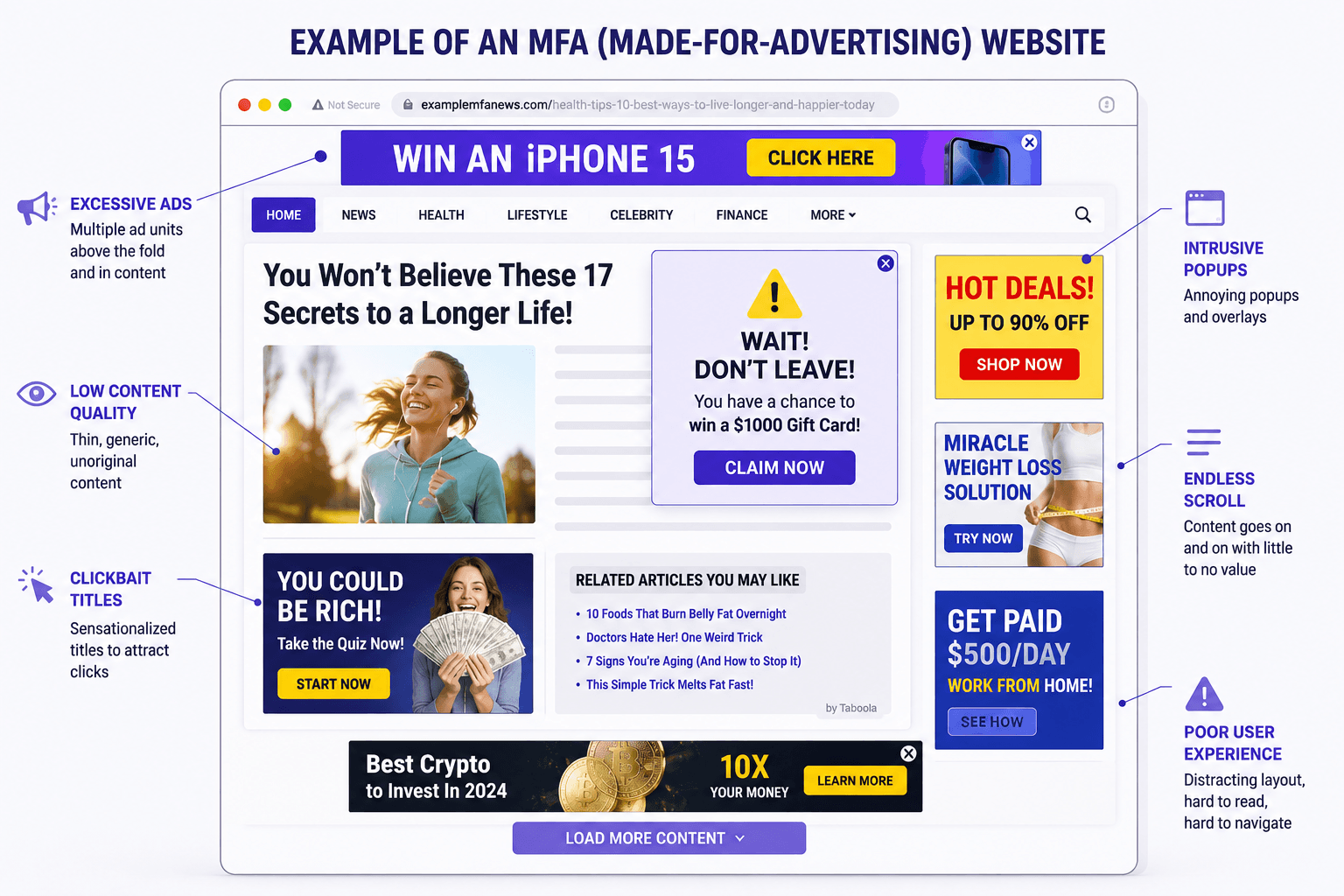
Put simply, MFA sites are web properties designed with one goal: to maximize display ad revenue at the expense of user experience and content quality. While they aren’t “fraud” in the traditional sense (the impressions are technically seen by humans), they are incredibly inefficient. These sites typically exhibit the following “red flag” characteristics:
- Extreme Ad Density: Ads take up the majority of the screen, often cluttering short text snippets.
- Low-Quality Content: Utilizing AI to churn out clickbait headlines or “zombie” articles to lure traffic from social media.
- High Arbitrage Ratios: Owners buy cheap traffic (from platforms like Facebook or Taboola) and resell that ad space at a premium through programmatic auctions.
- Aggressive Refresh Rates: Ads automatically refresh every few seconds to artificially inflate impression counts without any real user engagement.
2. Why are Major DSPs Leading the Purge?
According to a landmark report by the ANA (Association of National Advertisers), approximately 15-21% of programmatic budgets are wasted on MFA sites. This staggering figure has forced heavyweights like The Trade Desk, Google Display & Video 360 (DV360), and Yahoo DSP to take drastic action.
Media Waste Reduction
Many advertisers discovered they were spending heavily on impressions that looked good on paper but performed poorly in reality. Common red flags include:
- Extremely low engagement time
- High bounce rates
- Thin session depth
- Low scroll activity
- Excessive refresh behavior
- Arbitrage-driven traffic
Brand Safety and Reputation
Brands no longer want ads appearing next to:
- Thin content
- AI-generated spam pages
- Sensationalized headlines
- Low-quality recommendation loops
- Excessive ad clutter
Even if a site is technically “safe,” poor user experience can damage advertiser perception. This is where brand safety in programmatic advertising becomes critical. DSPs increasingly evaluate:
- Content quality
- Ad density
- User engagement
- Viewability
- Page experience
- Domain trustworthiness
Supply Path Optimization (SPO)
Supply Path Optimization (SPO) is another major reason behind the MFA crackdown. Advertisers want cleaner supply paths with higher-quality inventory. That means DSPs are prioritizing publishers with:
- Strong audience signals
- Better viewability
- High-quality content
- Sustainable engagement
- Transparent traffic acquisition
Low-quality inventory often becomes the first casualty.
Pressure From Agencies and Measurement Companies
Companies like DoubleVerify, IAS, Jounce Media, and other quality-focused organizations have pushed the conversation around MFA inventory into the spotlight. Several large advertisers have publicly reduced spending on MFA-heavy environments.
3. Decisive Actions from Major DSPs
The war against MFA is no longer just talk. Leading buying platforms have implemented rigorous technical measures to protect advertiser spend.
| Platform | Action Taken |
| The Trade Desk | Actively removes ad placements identified as MFA from their default inventory. |
| Google (DV360) | Updated algorithms to automatically detect and deprioritize websites with poor user experiences. |
| Jounce Media & DeepSee | Provide inclusion/exclusion lists to help advertisers filter out MFA at the campaign setup stage. |
| GroupM & IPG | Established strict supply chain standards, requiring SSPs to be transparent about traffic sources. |
4. How Legitimate Publishers Can Avoid Being Flagged as MFA
The “great purge” by major DSPs isn’t just targeting bad actors; it’s also placing immense pressure on legitimate publishers—those who truly invest in high-quality journalism but rely on ad revenue to survive. The line between a content-rich site with high ad density and a true MFA site can sometimes be thin in the eyes of automated algorithms.
To protect your domain authority and ensure stable programmatic revenue, publishers should implement the following strategies immediately:
Optimizing User Experience (UX) and Content Quality
- Improve Ad-to-Content Ratio: Ensure that your article content is always the most prominent element on the page. Avoid situations where users have to scroll through multiple ads before reaching the core information. A healthy balance is the strongest signal of a quality publisher.
- Commit to Editorial Excellence: Say no to mass-produced AI content without human oversight, clickbait headlines, fake news, or syndicated/scraped content. Invest in original reporting, expert analysis, and unique perspectives.
- Limit Intrusive Ad Formats: Minimize the use of pop-ups, pop-unders, interstitials that block content and can’t be easily dismissed, or auto-play videos with sound.
- Maintain a Transparent Site Structure: Build a clear sitemap and intuitive navigation. Ensure your site includes comprehensive “About Us,” “Contact,” and “Privacy Policy” pages to establish trust and accountability.
Strategic Ad Tech Management
- Control Ad Refresh Rates: If you use ad refresh to increase impressions per session, ensure the interval is at least 30–60 seconds and only triggers when the user is actively engaged with the page (viewability-based refresh).
- Verify Traffic Sources: Reduce dependence on cheap, low-quality third-party traffic (Arbitrage). Focus on building organic reach through SEO, direct traffic, or official social media channels.
- Be Transparent with Supply Partners (SSPs): Always be honest about your ad formats, placements, and refresh logic in the signals sent to SSPs and exchanges. Transparency is key to Supply Path Optimization (SPO).
- Leverage Third-Party Measurement: Integrate industry-standard tools (like Moat, IAS, or DoubleVerify) to track attention metrics and viewability. Providing verifiable data on real human engagement proves the value of your inventory to premium advertisers.
Conclusion: A Cleaner Digital Future
The MFA purge is not the end of Programmatic Ads; it is a necessary evolution. It forces the advertising ecosystem to become more transparent, sustainable, and fairer for both advertisers and legitimate publishers who invest in high-quality content.
How has the rise of MFA impacted your campaign performance? Have you noticed a shift in your ROI since the major DSPs began their crackdown?
Don’t let your budget feed “junk” websites. Contact our team of experts today for a programmatic account “health check” and let us help you optimize your whitelist for 2026!