


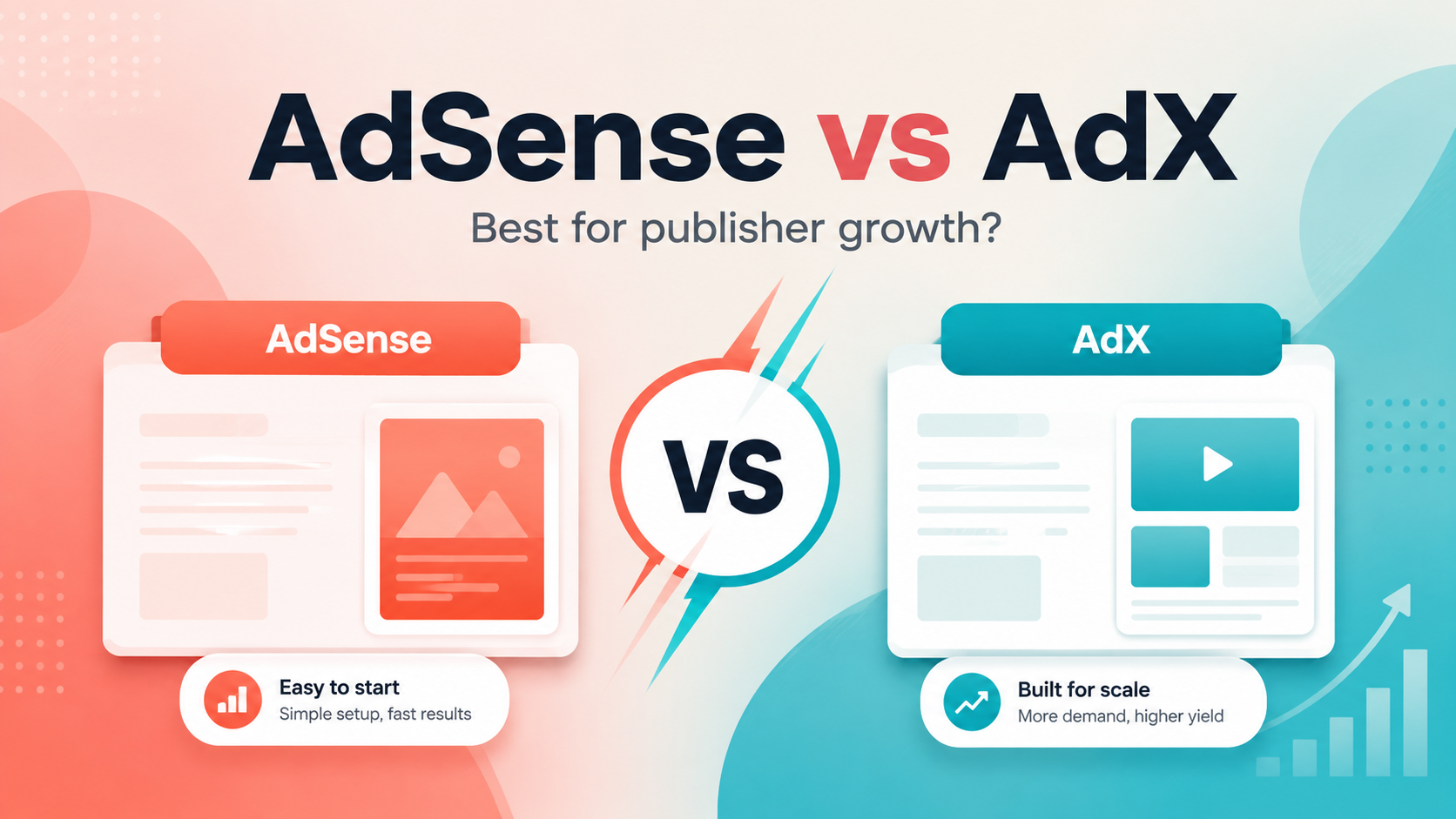
For growing publishers, the AdSense vs AdX decision usually appears when a simple monetization setup starts feeling too limited. Traffic is increasing, more inventory is available, and the publisher wants better control over how that inventory is sold.
AdSense is designed around simplicity and automation. Google Ad Exchange, usually referred to as AdX, provides access to Google’s exchange demand through Google Ad Manager and fits a more advanced programmatic setup.
Neither option is automatically better. AdSense can remain effective for publishers that want low operational overhead, while AdX becomes more useful when traffic, direct demand, reporting needs, and monetization complexity begin to scale.
Table of Contents
What is Google AdSense?
Google AdSense is an ad network that allows publishers to monetize website inventory without building a complex advertising stack.
Google positions AdSense as a solution for publishers that want automated monetization, fast implementation, accessible reporting, and relatively little day-to-day ad management. Auto ads can also automatically identify placements and optimize ad delivery.
For AdSense for Content, publishers receive 80% of revenue after the advertiser platform takes its fee. When Google Ads buys the impression, this works out to approximately 68% of advertiser spend. AdSense now pays publishers primarily based on impressions rather than clicks.
The main advantage is simplicity. Publishers can start monetizing without managing multiple demand partners, complex line items, or auction configurations.
What is Google AdX?
Google Ad Exchange, or AdX, is a programmatic marketplace available through Google Ad Manager.
This distinction is important. AdX is not simply a premium version of AdSense with a different dashboard. Google Ad Manager is the platform used to manage inventory, while Ad Exchange provides an additional source of programmatic demand within that environment.
Google states that there are currently two main paths to Ad Exchange access:
- Direct access from Google: Typically available to large publishers with significant traffic.
- Access through a Google Certified Publishing Partner: Publishers can connect through Multiple Customer Management, or MCM, using their existing AdSense and Google Ad Manager accounts.
With Google Ad Manager, publishers can also manage direct campaigns, third-party networks, exchanges, AdSense, and other demand sources from the same ad serving platform.
AdSense vs AdX: What are the main differences?
The biggest difference between Google AdSense vs Google AdX is not simply CPM. It is the level of control publishers have over their monetization stack.
| Factor | AdSense | AdX through Google Ad Manager |
|---|---|---|
| Setup | Relatively simple | More technical |
| Best suited for | Smaller or less complex publishers | Growing and larger publishers |
| Ad management | Highly automated | More granular control |
| Direct campaigns | No | Yes, through Ad Manager |
| Third-party demand | Limited | Can manage multiple networks and exchanges |
| Reporting | Standard reporting | More granular reporting |
| Deal management | Limited | Preferred Deals and other programmatic deal options |
| AdOps resources | Low | Moderate to high |
| Optimization flexibility | Lower | Higher |
Google itself describes AdSense as more suitable when publishers do not have a significant direct-sales operation, while Ad Manager is designed for larger publishers that need granular inventory control and more complex monetization.
Demand access is not as simple as “AdX has better advertisers”
One common assumption is that moving from AdSense to AdX automatically unlocks completely different premium advertisers.
That is misleading.
Google states that AdSense and Google Ad Manager both provide access to the same premium Authorized Buyers, including demand from Google Ads and Display & Video 360.
The advantage of AdX comes more from how publishers can manage and combine demand. Through Ad Manager, publishers can introduce additional exchanges, networks, direct campaigns, and programmatic deal types around Google demand.
This can create more competition for inventory, but only when the setup is managed effectively.
AdX offers more inventory control
AdSense automates much of the monetization process. That reduces operational work but also limits how deeply publishers can control individual revenue decisions.
Google Ad Manager provides more granular tools for inventory management, advertiser blocking, pricing, reporting, and deal management. Publishers can also use Preferred Deals and other direct or programmatic sales arrangements that are not available through a basic AdSense setup.
This becomes more useful as a site develops different high-value sections, GEOs, devices, or placements that should not all use the same monetization strategy.
AdSense requires less AdOps work
The extra control available with AdX also creates extra responsibility.
AdSense is designed to handle much of the optimization automatically. A publisher can deploy ad units or Auto ads and allow Google to make many serving decisions.
An Ad Manager setup can involve:
- Inventory and ad unit structure
- Line item priorities
- Pricing rules
- Demand partner integrations
- Direct campaigns
- Programmatic deals
- Reporting
- Ad quality controls
- Yield optimization
For a publisher without internal AdOps experience, access to AdX alone does not guarantee better monetization.
Does AdX pay more than AdSense?
AdX can create higher revenue potential, but publishers should be careful with the claim that AdX always pays more than AdSense.
The two systems are not a simple low-CPM versus high-CPM comparison. Google confirms that both can access many of the same Authorized Buyers.
What changes with an advanced Ad Manager setup is the ability to manage inventory more strategically and introduce additional competition.
Revenue may improve through:
- More demand sources competing for inventory
- Better pricing strategies
- Direct and programmatic deals
- Different monetization strategies by GEO
- Better management of high-value placements
- Additional video or other inventory
- More detailed performance optimization
However, a poorly configured AdX setup can still perform worse than a well-optimized AdSense implementation.
Publishers should compare page RPM, fill rate, viewability, total revenue, and revenue by GEO, not only CPM.
When should growing publishers stay with AdSense?
AdSense remains a practical choice when simplicity is more valuable than additional control.
Stay with AdSense if:
- Your monetization operation is still simple: Most revenue comes from standard website display inventory.
- You do not have AdOps resources: There is little value in adding complexity your team cannot manage.
- You do not sell inventory directly: Direct campaign management is one of the areas where Ad Manager becomes more useful.
- Traffic is still developing: The potential gain from a more advanced setup may not justify additional operational work.
- Auto optimization works well: If AdSense already produces stable revenue without hurting UX, changing platforms simply because AdX sounds more advanced may not be necessary.
A publisher does not need to graduate from AdSense at a specific pageview number.
The more relevant question is whether the current setup is limiting the way inventory can be monetized.
When does moving to AdX make sense?
AdX becomes more relevant as monetization starts requiring more decisions:
Your inventory is becoming more valuable. Different sections, GEOs, devices, or formats may require different pricing and demand strategies.
You want multiple demand sources. Google Ad Manager can support AdSense, Ad Exchange, third-party networks, and third-party exchanges within a broader monetization setup.
You are selling ads directly. Ad Manager is designed to manage direct campaigns alongside programmatic demand.
You need more detailed reporting. Google highlights flexible, publisher-defined reporting as one of the differences between Ad Manager and AdSense.
Your team can actively optimize monetization. More control creates value only when someone uses that control to improve pricing, demand, placements, and auction performance.
For publishers without direct AdX access, working with a Google Certified Publishing Partner through MCM is another route into Ad Exchange demand.
AdSense vs AdX for growing publishers: Which should you choose?
The decision can be simplified around the stage of the advertising business.
Choose AdSense when you need automation. It is a strong fit when advertising is still a relatively straightforward revenue stream and the team wants Google to handle most monetization decisions.
Consider AdX when you need control. As revenue grows, publishers may want to combine Google demand with other exchanges, manage direct campaigns, set more detailed pricing strategies, and analyze inventory at a deeper level.
The shift is therefore less about reaching a specific traffic threshold and more about reaching a level of monetization complexity that AdSense can no longer manage efficiently.
Growing traffic alone is not a reason to switch. Growing inventory value, demand diversity, direct sales, and AdOps capability are stronger signals.
How to prepare before moving from AdSense to AdX
Moving to a more advanced monetization setup should start with understanding current performance:
- Build an AdSense baseline: Record page RPM, impression RPM, fill, viewability, revenue by GEO, device performance, and top placements.
- Identify inventory worth optimizing: Not every ad unit requires a more complex auction.
- Assess technical resources: Decide whether monetization can be managed internally or requires an external partner.
- Review demand strategy: Determine whether additional exchanges or header bidding could create meaningful competition.
- Protect user experience: More demand should not translate into excessive ad density, slower pages, or aggressive formats.
Publishers should then compare total revenue and user experience after migration rather than assuming that AdX access alone represents an upgrade.
If your traffic has reached the point where AdSense feels restrictive but managing AdX, demand partners, and Ad Manager internally would add too much complexity, sign up with PubFuture to explore a managed monetization setup built around your inventory and traffic mix.
AdSense vs AdX: Which one is better?
There is no universal winner in the AdSense vs AdX comparison. AdSense is better for publishers that value simplicity, automation, and low operational overhead. AdX becomes more useful when publishers need granular inventory management, multiple demand sources, direct deals, and greater control over programmatic monetization.
For growing publishers, the right time to consider AdX is when the advertising business becomes more complex, not simply when pageviews increase. If your current setup is leaving valuable inventory under-optimized, PubFuture can help evaluate additional demand and monetization opportunities without treating a more complicated ad stack as the goal itself.