


A publisher can keep the same website, traffic volume, ad placements, and monetization setup while seeing very different CPMs from one month to another. These fluctuations are often caused by CPM seasonality, where advertiser demand changes according to budget cycles, consumer spending periods, major commercial events, and regional market activity.
Some changes are highly predictable. Holiday shopping can increase competition for impressions, while January often brings softer demand as advertisers reset budgets and prepare new campaigns. Other changes depend heavily on a publisher’s audience, GEO mix, vertical, and ad formats.
Understanding these patterns helps publishers set more realistic revenue benchmarks, identify genuine monetization problems, and prepare their inventory before periods of stronger advertising demand.
What is CPM seasonality?
CPM seasonality describes recurring changes in advertising prices caused by predictable shifts in advertiser demand throughout the calendar year.
Programmatic CPMs are created through competition for publisher inventory. When more advertisers compete for similar impressions, bid pressure can increase. When budgets slow or fewer campaigns are active, competition can weaken and CPMs may fall.
Google Ad Manager identifies cultural events, commercial events, and other major events as common drivers of advertising seasonality. Google also notes that seasonal traffic and CPM increases often begin around September, peak in late November, and return closer to normal levels in January.
This means a CPM decline does not automatically indicate that something is wrong with a publisher’s website or monetization stack. The wider advertising market can be moving at the same time.
Why publisher CPMs change even when traffic stays stable
Several demand-side factors can change the value of the same inventory:
Advertiser budgets change during the year
Most advertisers plan spending around monthly, quarterly, or annual budgets. Campaign activity can therefore rise and fall even when the publisher changes nothing.
At the beginning of a new budgeting period, advertisers may still be approving campaigns, testing creatives, or allocating spend. Toward the end of a period, some brands increase campaign activity as they work through remaining budgets or prepare for important sales events.
These changes affect the number and value of bids entering programmatic auctions.
More advertising demand creates stronger auction competition
Publisher CPMs are closely connected to the level of competition behind each impression.
If five buyers are actively competing for an audience segment one month and ten qualified buyers are competing the next month, the auction environment can become more valuable. Higher demand does not guarantee that every impression receives a higher bid, but stronger competition can support higher clearing prices across inventory.
The opposite can happen during quieter advertising periods.
Consumer intent changes with the calendar
Advertisers are often willing to spend more when consumers are closer to taking commercial actions.
Travel brands may increase activity before major holiday periods. Retail advertisers become more aggressive around shopping events. Education campaigns may increase around enrollment periods, while finance, fitness, and other verticals can experience different demand patterns around the beginning of the year.
As commercial intent changes, advertisers may value particular audiences differently.
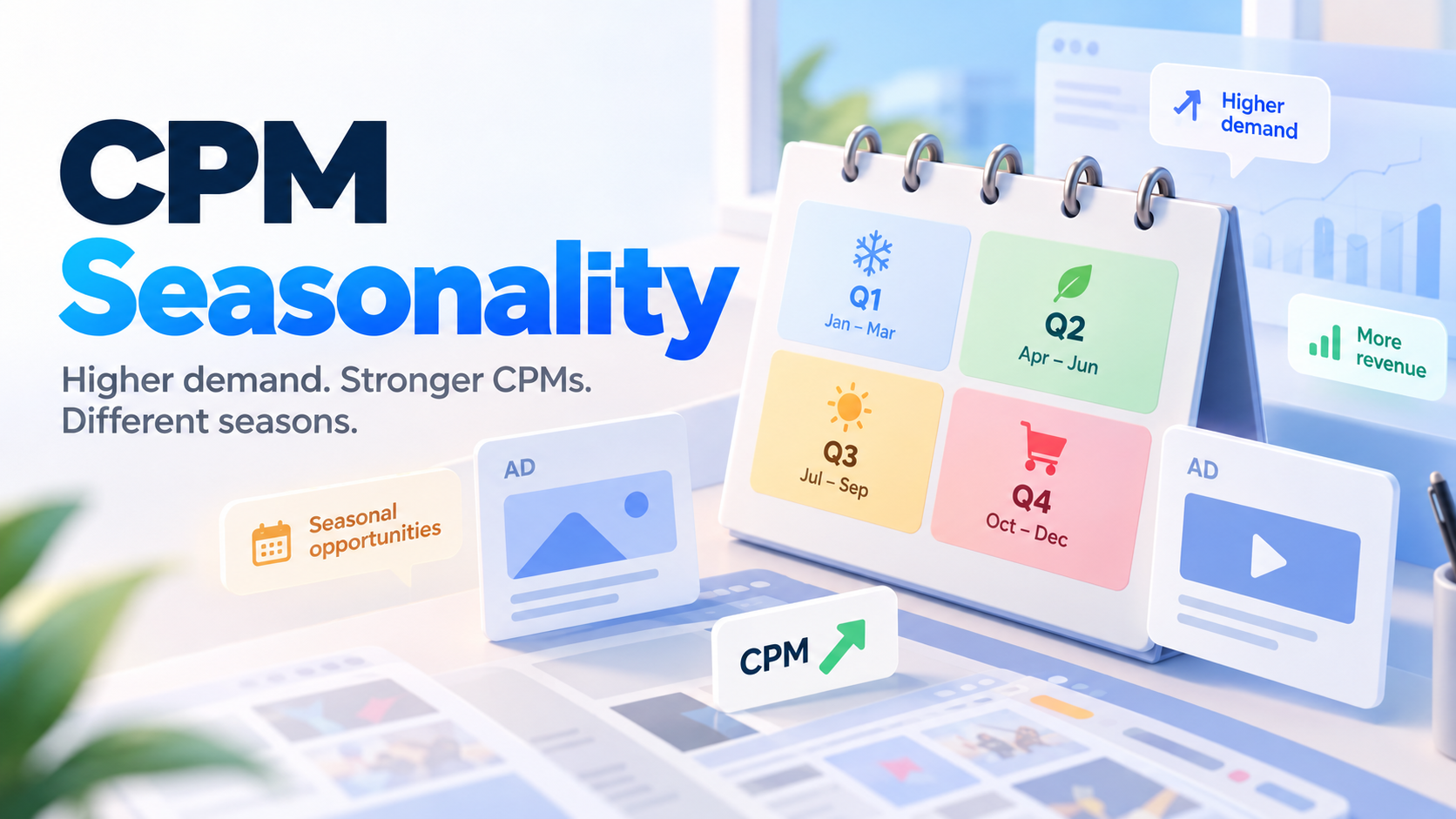
How CPM seasonality typically changes by quarter
Quarterly patterns provide a useful baseline, although publishers should avoid treating them as universal CPM benchmarks:
Q1: Advertiser budgets reset
January often creates one of the most noticeable CPM changes of the year.
Advertisers have just completed a high-spending holiday period, new annual budgets may still be taking shape, and new campaigns require time to launch. This can reduce auction pressure compared with November and December.
Demand usually begins recovering as Q1 progresses, although performance varies significantly between verticals. A health or personal finance publisher, for example, may experience stronger January demand than a site whose audience is heavily connected to holiday shopping.
Q2: Demand becomes more established
By Q2, many annual marketing plans and campaigns are fully active.
Publishers may see more stable demand as advertisers allocate larger portions of their budgets and prepare campaigns for summer travel, shopping events, product launches, and other commercial opportunities.
Quarter-end spending can also influence CPMs when advertisers increase campaign delivery before the next planning period.
Q3: Performance becomes more mixed
Q3 can produce very different results depending on audience and market.
Some publishers experience slower summer demand, particularly when advertiser activity decreases in certain markets. Others benefit from back-to-school campaigns, travel demand, sporting events, or early preparation for Q4.
September frequently becomes an important transition period as holiday advertising campaigns begin entering the market. Google specifically identifies September as a common starting point for broader seasonal increases in CPMs.
Q4: Advertiser competition usually strengthens
Q4 is one of the most important advertising periods for many publishers.
Black Friday, Cyber Monday, holiday shopping, travel campaigns, year-end promotions, and remaining annual advertising budgets can all create additional demand. More advertisers competing for valuable audiences can support stronger CPMs across display, video, and other inventory.
This effect remains market-specific. Publishers with audiences closely connected to commerce may experience much stronger Q4 movement than websites serving niches with limited seasonal buying activity.
Seasonal events can create CPM spikes outside normal quarterly patterns
Calendar quarters provide a useful framework, but individual events can temporarily change advertising demand:
- Black Friday and Cyber Monday: Retailers and ecommerce brands compete heavily for consumers already showing strong purchase intent.
- Christmas and year-end holidays: Retail, travel, entertainment, food, gifting, and related categories can increase campaign activity.
- Lunar New Year: Publishers with significant audiences across Asian markets can experience advertising changes that do not follow the same calendar as Western holiday campaigns.
- Back-to-school season: Education, electronics, apparel, software, and consumer brands may increase demand before the academic year.
- Major sporting events: Large international tournaments can create temporary demand from brands trying to reach audiences around specific events.
Seasonality should therefore be evaluated against the publisher’s actual audience rather than a single global advertising calendar.
CPM seasonality differs by GEO, vertical, device, and format
Two publishers can experience very different seasonal trends during exactly the same month:
GEO changes the advertising calendar
Advertiser budgets, holidays, purchasing behavior, and competition vary significantly between countries.
A publisher receiving most of its traffic from the United States may see strong November demand around Black Friday. A publisher focused on Southeast Asia could have additional peaks linked to local ecommerce events or Lunar New Year.
Publishers with international traffic should analyze seasonality by GEO rather than looking only at the website-wide average CPM.
Website vertical changes when demand peaks
Every vertical has its own commercial calendar.
Travel inventory may strengthen before holiday booking periods. Sports sites can receive increased advertiser interest around major tournaments. Technology publishers can experience stronger competition around product launches or major shopping events.
This explains why there is no universal “good CPM” for every publisher or every month.
Ad format affects seasonal demand
Display, native, outstream video, interstitial, and other formats do not always follow identical demand patterns.
Advertisers may increase spending more aggressively in formats suited to brand campaigns or video storytelling during major commercial periods. Device mix can also influence results because advertiser bidding strategies differ between desktop, mobile web, and other environments.
Publishers should therefore monitor seasonal CPM changes at the ad-unit and format level.
How to tell CPM seasonality from a monetization problem
The most useful comparison is usually historical performance:
Compare year over year before month over month
Comparing December directly with January can make normal seasonality look like a serious monetization decline.
A stronger benchmark is January this year against January last year, while accounting for major changes in traffic, audience GEO, ad layout, or demand partners.
This makes recurring seasonal patterns easier to separate from technical issues.
Check whether traffic composition changed
Stable traffic volume does not mean stable inventory quality.
A site may receive the same number of pageviews while gaining more traffic from lower-CPM GEOs, mobile devices, referral sources, or pages with weaker viewability. Any of these shifts can influence average CPM independently of broader advertising seasonality.
Segmenting performance prevents these changes from being hidden inside one site-wide CPM number.
Review fill rate and demand coverage
A CPM decline combined with lower fill rate or a large increase in unfilled impressions may indicate a broader monetization problem.
Publishers should review demand partner activity, bid participation, floor pricing, ad serving errors, viewability, consent signals, and inventory availability before assuming that seasonality is the only cause.
Seasonality provides context. It should not become an explanation for every revenue decline.
How publishers can optimize around CPM seasonality
Seasonality cannot be removed, but publishers can prepare their monetization stack for changing demand:
Build a publisher-specific seasonal benchmark
Track CPM, fill rate, impressions, page RPM, viewability, GEO, device, and format performance across at least 12 months.
Over time, this data creates a seasonal baseline for the website. Publishers can then identify whether a 15% decline is unusual or simply similar to what happened during the same period last year.
Prepare inventory before high-demand periods
Optimization should happen before advertiser demand reaches its peak.
Google recommends preparing for seasonal demand by improving viewability, reviewing unnecessary blocking rules, making appropriate sizes available to buyers, and monitoring unfilled impressions.
Waiting until late November to make major ad stack changes can mean missing part of the strongest demand period.
Adjust pricing based on real demand
A high floor price during a weak-demand month can reduce fill without producing enough CPM improvement to compensate for lost impressions.
During stronger periods, publishers may have more room to test pricing because more buyers are competing for inventory. Floors should still be based on auction data rather than assumptions about what a particular month “should” deliver.
Keep demand competition broad
Seasonal demand creates more value when enough qualified buyers can access the inventory.
Publishers relying on a narrow demand setup may capture only part of the opportunity. Header bidding, Google demand, video demand, and other compatible sources can create broader competition when implemented appropriately.
Seasonal CPM changes are easier to manage when publishers have access to broader demand, flexible ad formats, and ongoing yield optimization. PubFuture supports publishers with multi-demand monetization, header bidding, Google AdX, video and display solutions, and performance optimization across GEOs and seasonal demand periods. This gives publishers more room to capture stronger advertiser competition during peak periods while continuing to optimize inventory when demand slows.
If you are looking to strengthen your monetization setup before the next seasonal demand shift, sign up with PubFuture to explore more revenue opportunities for your website.
How publishers should forecast seasonal CPM and revenue
Revenue forecasts should account for both CPM seasonality and changes in impression volume.
Start with historical monthly data and calculate how CPM normally changes against the publisher’s annual average. The same approach can be applied to page RPM, fill rate, and traffic.
A publisher might discover that its CPM usually falls after December, gradually recovers through Q2, stays relatively stable during summer, and accelerates again from September. That pattern becomes far more useful for forecasting than applying one fixed CPM assumption across all twelve months.
Forecasts should also include events specific to the site’s GEO and vertical. A major sporting event, holiday, ecommerce campaign, or unexpected change in traffic composition can move performance outside the historical range.
CPM seasonality is part of publisher revenue planning
CPM seasonality helps explain why publisher advertising prices can change substantially even when the website itself stays relatively stable. Advertiser budget cycles, seasonal shopping activity, commercial events, GEO, vertical, audience value, and auction competition all contribute to these fluctuations.
Publishers that understand their own seasonal baseline can benchmark performance more accurately and prepare their ad stack before stronger demand arrives. For support reviewing seasonal performance, demand competition, and broader website monetization opportunities, publishers can explore a monetization partnership with PubFuture.