


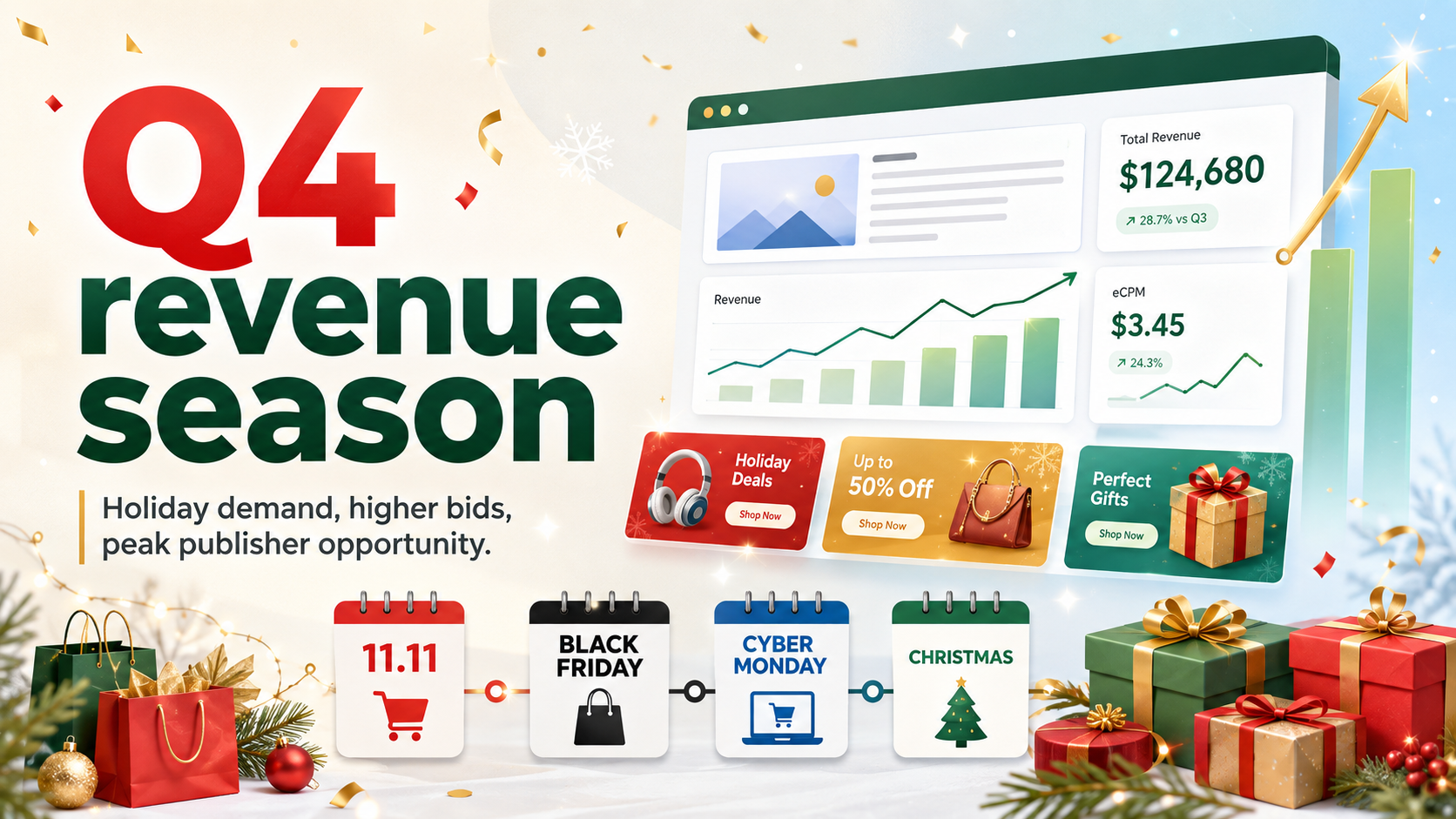
Q4 is traditionally the strongest monetization period for many web publishers. Retail campaigns scale, holiday shoppers become more valuable to advertisers, and competition for quality inventory increases around major events such as Singles’ Day, Black Friday, Cyber Monday and Christmas.
The Q4 publisher monetization forecast for 2026 follows the same seasonal pattern, but the opportunity is not simply “higher CPMs in November.” Demand builds in stages, peaks around specific commercial events and can fall quickly once major shopping periods end.
For publishers, timing matters as much as traffic. Ad stack testing, new demand integrations, video formats, refresh rules and pricing changes should be ready before the strongest advertiser budgets enter the auction.
Table of Contents
Why Q4 seasonality pushes publisher revenue higher
Q4 creates an unusually strong combination of advertiser demand and commercial audience intent:
- More advertising budgets enter the market: Brands increase spending around major retail events and many advertisers also become more aggressive toward the end of monthly, quarterly or annual budget cycles. Mediavine identifies this recurring end-of-period spending pattern as one reason eCPMs tend to strengthen later in a quarter. (Mediavine)
- Visitors have stronger buying intent: Product research, gift guides, travel planning, recipes, shopping comparisons and deal content become more commercially valuable as consumers move closer to a purchase.
- Advertisers compete for finite quality inventory: More campaigns bidding for viewable impressions can increase auction pressure, particularly on sites with strong engagement and commercially relevant audiences.
This also makes demand diversity more valuable. A publisher relying mainly on one monetization source may not expose every valuable impression to enough competing buyers during the period when advertiser demand is strongest.
Internal link: Best website monetization platforms: Top ad networks for publishers to scale RPM
Q4 publisher monetization: How much can eCPMs actually increase?
Historic data shows a clear seasonal lift, although publishers should not treat one percentage as a universal benchmark.
Publift reports that November eCPMs increased approximately 10% to 12% month over month in its historical dataset. During the week leading into Black Friday and Cyber Monday, eCPMs were nearly 40% higher than the July weekly average. It also found that October through December 2022 eCPMs were 13% higher than July through September.
The important pattern is the acceleration, not just the final percentage. October typically begins the recovery, November adds major ecommerce events, and Cyber Week can create one of the strongest bidding periods of the year.
Results still vary significantly by publisher. A product review or technology site may see a larger holiday eCPM surge than a general-interest property because its audience sits closer to purchase decisions. GEO, device, ad viewability, traffic source and available demand also influence the outcome.
Past Q4 performance is therefore more useful as a planning reference than a revenue promise.
Q4 publisher monetization 2026 calendar: the dates publishers should watch
Q4 is easier to prepare for when publishers look at individual demand windows rather than treating October through December as one continuous peak.
| Date | Event | What happens to advertiser demand | What publishers should watch |
|---|---|---|---|
| October 31 | Halloween | Seasonal retail, food, entertainment and ecommerce campaigns support the first major Q4 spending window | Watch for the first clear CPM improvement from Q3 levels |
| November 11 | Singles’ Day | Major ecommerce event originating in China with strong relevance across Asian shopping markets | Review APAC traffic instead of focusing only on Tier 1 U.S. inventory |
| November 26 | Thanksgiving | U.S. holiday campaigns enter their final Black Friday push | Expect auction pressure to build rapidly into Cyber Week |
| November 27 | Black Friday | Retailers compete heavily for shoppers across ecommerce, technology, fashion, home and other commercial categories | One of the most important dates for Black Friday publisher revenue |
| November 30 | Cyber Monday | Online-focused retail campaigns compete for high-intent digital audiences | Ecommerce and comparison content can remain particularly valuable |
| December 1 to 20 | Christmas shopping and travel period | Last-minute gifts, travel, food and seasonal campaigns continue spending | Strong demand can continue after Cyber Week |
| December 24 to 25 | Christmas | Many major campaigns have already completed their conversion push | CPM can soften on the actual holiday even after a strong pre-Christmas period |
| December 26 to 31 | Clearance and year-end budget period | Retail clearance and some remaining fiscal budgets continue, but demand becomes less uniform | Avoid assuming every site will maintain Cyber Week CPMs |
For 2026 specifically, Thanksgiving falls on Thursday, November 26, Black Friday on Friday, November 27, and Cyber Monday on Monday, November 30. Singles’ Day remains November 11.
The period publishers should watch most closely is therefore November 11 through November 30, followed by the pre-Christmas buying period in December.
There is another important detail: the highest advertising demand does not necessarily occur on the holiday itself. Mediavine notes that advertiser spending can peak before Christmas and decline on December 25 once major purchasing campaigns have passed their conversion window. (Mediavine)
Looking for a stronger Q4 ad network partner? Prepare with PubFuture before the peak
Q4 is not the ideal time to discover that the current monetization setup cannot fully capture stronger advertiser demand.
Publishers preparing for the season should look for an ad network or monetization partner that can improve several areas at once:
- More demand competition: Valuable Q4 inventory should be exposed to multiple qualified demand sources rather than relying heavily on a single buyer or basic setup.
- Access to more than standard display: Video, sticky, in-content and other high-viewability formats can open additional inventory when advertiser budgets increase.
- Yield optimization: Higher market demand does not automatically mean every floor price or placement should increase. Publishers need ongoing optimization based on actual auction performance.
- Real-time visibility: During Cyber Week, waiting days to understand what happened by GEO, placement or format limits the publisher’s ability to react.
- Technical support during peak traffic: Integration issues, ad quality problems or unexpected performance changes need to be addressed quickly when every high-value session counts.
PubFuture is built around these requirements. Its monetization stack includes header bidding, programmatic marketplace access, yield management, real-time analytics and dedicated publisher support. PubFuture also works with video demand and formats such as outstream video, allowing publishers to create additional competition beyond standard display inventory. (PubFuture)
For publishers currently monetizing primarily through a basic single-demand setup, this becomes especially relevant in Q4. When more advertisers are willing to bid, connecting more qualified demand gives each eligible impression a better chance to reach its market value.
The important part is not waiting until Black Friday week to switch. A new monetization partner should have time to review inventory, integrate demand, test placements, establish baseline performance and identify technical issues before November. Mediavine similarly recommends completing onboarding and optimization ahead of Q4 rather than trying to make those changes after peak demand has already started. (Mediavine)
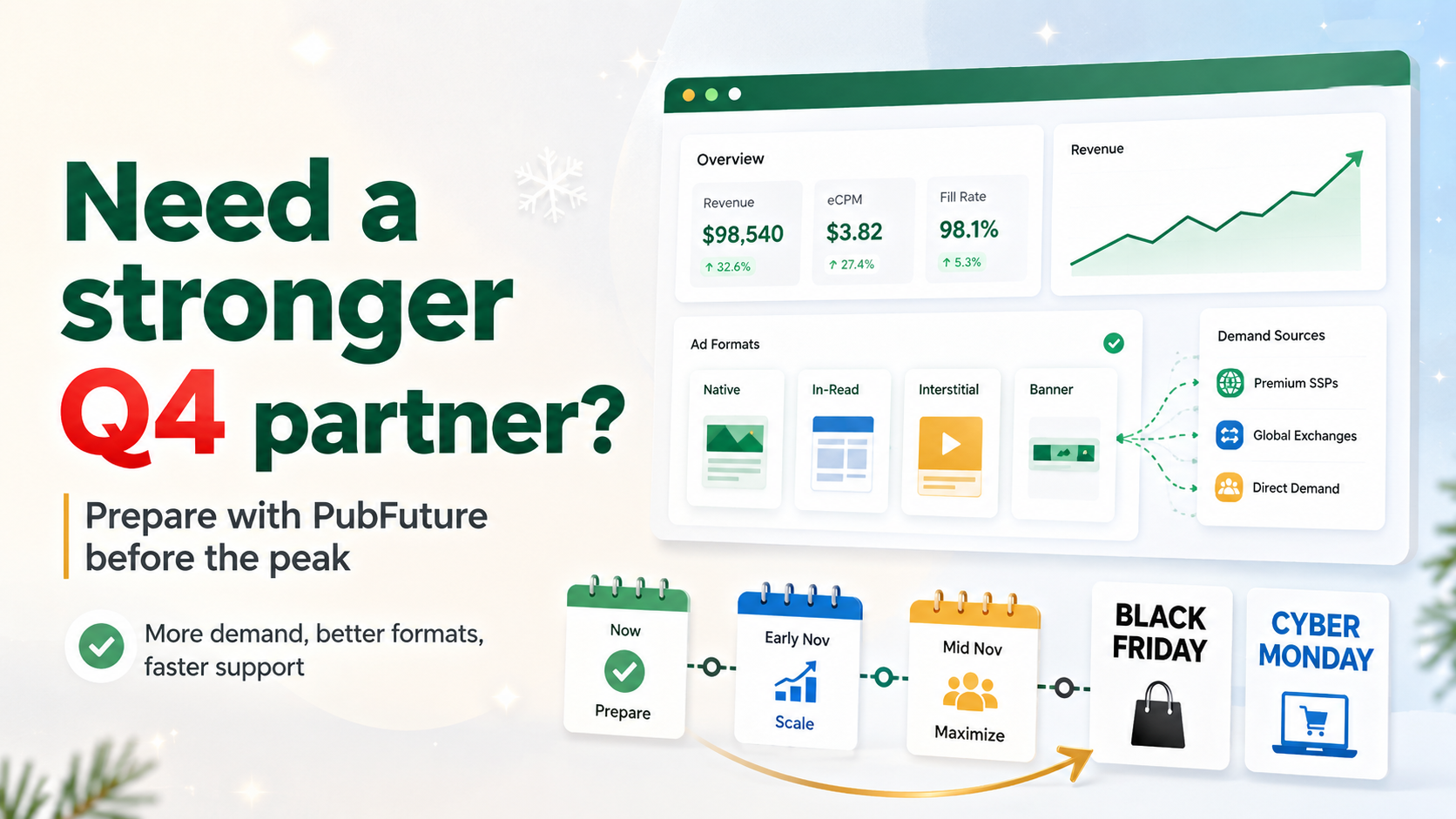
Planning to strengthen your monetization setup for Q4 2026? Sign up with PubFuture now to have your website and current ad setup reviewed before the holiday demand surge begins.
4 ad stack optimizations to complete before Q4 peaks
A stronger demand setup performs best when the underlying inventory is also ready:
1. Test outstream video before November
Publishers do not need original video content to access video demand. Outstream formats can appear within articles, feeds or sticky placements, creating additional video inventory on text-heavy pages.
PubFuture supports outstream setups and programmatic video demand, but implementation should happen early enough to test viewability, loading behavior and user experience before peak traffic arrives. (PubFuture)
2. Configure viewability-based ad refresh
Holiday guides, reviews and comparison pages can generate longer reading sessions. Smart refresh can create additional monetizable impressions from those sessions when the ad remains in view.
Refresh should not run simply because 30 or 45 seconds have passed. Limit refresh to eligible, viewable placements and measure whether additional impressions are maintaining acceptable CPMs.
Read more Ad refresh best practices: How to multiply page impressions without hurting eCPM
3. Review floors gradually
Higher advertiser demand can support higher auction prices, but increasing every GAM Unified Pricing Rule at once can reduce fill.
Instead, compare performance by GEO, device and placement. Test adjustments in smaller increments and measure total revenue rather than looking only at CPM.
4. Remove performance bottlenecks
Page speed becomes even more important when seasonal content attracts sudden traffic spikes.
Review caching, image compression, lazy loading and third-party scripts. Also check bidder latency. Adding demand is useful only when the auction remains fast enough for users to reach and view the ad.
The target should be a more competitive stack, not simply a heavier stack.
Q4 mistakes that can waste peak-season demand
Even strong programmatic seasonality trends cannot compensate for a poorly prepared site:
- Changing the entire stack during Black Friday week: Major wrapper, tag or layout changes introduce technical risk precisely when impressions are most valuable.
- Ignoring traffic outside the U.S.: Singles’ Day on November 11 makes the Q4 calendar particularly relevant for publishers with Asian audiences. Global publishers should evaluate each GEO on its actual demand rather than automatically deprioritizing non-U.S. traffic.
- Adding banners just because CPMs are rising: More placements can lower viewability and damage page experience. Strong demand should increase the value of good inventory, not encourage publishers to create poor inventory.
- Optimizing only for CPM: A $5 CPM is not automatically better than a $4 CPM if the change causes fill, impressions or total session revenue to fall significantly.
- Starting partner discussions too late: A monetization provider still needs time to assess inventory, integrate demand and establish performance data. Beginning this process during Cyber Week means missing much of the opportunity the publisher was trying to capture.

The Q4 publisher monetization forecast for 2026 is less about predicting one dramatic CPM percentage and more about preparing for several concentrated demand windows. Singles’ Day on November 11 starts an important ecommerce period, followed by Thanksgiving, Black Friday on November 27, Cyber Monday on November 30 and the pre-Christmas spending window through December.
Publishers should use September and October to audit their stack, test formats, improve viewability and strengthen demand competition. If the current setup is still dependent on limited demand, sign up with PubFuture before the Q4 peak to explore a broader monetization setup and give the integration enough time to perform before the most valuable weeks of the year.